



Ciao,
Victoria from Techpoint here,
Here’s what I’ve got for you today:
- South Africa claims the right to pick Safaricom’s next CEO
- Panic buttons are now the law for Uber, Bolt in SA
- Uber eyes courier licence as it pushes into Kenyan logistics
South Africa claims the right to pick Safaricom’s next CEO

Here’s the bombshell buried in a SEC filing: if Vodacom acquires a majority stake in Safaricom by buying the Kenyan government’s 15 percent stake, South Africa’s Vodacom will have the power to determine who becomes Safaricom’s next CEO, with the board required to pick from a shortlist of nominees provided by Vodafone Kenya Limited (VKL), the holding vehicle through which the group controls the Kenyan telco.
This is written into a new shareholder agreement that Vodafone Group filed with the US Securities and Exchange Commission on May 22, 2026, triggered by the company’s dual listings in London and New York. The deal also locks in Safaricom’s full transformation into a subsidiary, meaning it will follow Vodacom’s policies on everything from financial reporting to procurement and ethics.
In plain terms, whoever sits in the CEO chair at Safaricom’s Westlands headquarters from the next transition won’t be Kenya’s call. VKL has agreed to notify and consult with the Kenyan government before appointing or replacing a chairman or CEO and has committed to ensuring the chairman is of Kenyan nationality. So Kenya gets the ceremonial seat at the top of the board, but the real power, picking the executive who runs the company day-to-day, shifts to Johannesburg. Vodacom has also agreed to ensure most senior executives remain Kenyan, which is clearly a concession designed to soften the political blow of what is, in effect, a foreign takeover of East Africa’s most profitable company.
Safaricom isn’t just a telco; it’s the backbone of Kenya’s economy, the home of M-Pesa, and a company whose leadership has always been intensely political. The appointment of Peter Ndegwa in 2019, following the death of former CEO Bob Collymore, was a historic shift. Ndegwa became the first Kenyan to head the company after nearly two decades of expatriate leadership. That symbolism ran deep. Now, the deal looks set to return the leadership structure that Safaricom held for years to 2020, when the telco had an expatriate CEO and a Kenyan chairman. The question of who leads Safaricom has always attracted intense political interest, and this revelation is likely to reignite that debate.
Safaricom’s ownership story goes way back. After the company launched in 2000, Vodafone took a 40% stake and installed South African-born Michael Joseph as CEO. In 2007, Vodafone shifted most of that stake to South Africa’s Vodacom, keeping only 5% directly. Now, Vodacom wants to deepen its control by buying an additional 15% stake from the Kenyan government for KSh 204.3 billion, while also taking over Vodafone’s remaining 5% stake. If completed, that would raise Vodacom’s ownership to 55% and make it the majority shareholder. Also, the telco agreed to pay Kenya’s government an upfront dividend of KSh 40.2 billion on its remaining 20% stake, to be recouped from future dividends.
The deal is huge and already has approval from Parliament and regional competition regulators, but it has hit a legal roadblock. Kenya’s High Court suspended the transaction after a petition challenged it, leaving the deal in limbo. So for now, despite detailed agreements being in place, including provisions on future leadership at Safaricom, the transaction remains stalled while the courts decide its fate.
Panic buttons are now the law for Uber, Bolt in SA

South Africa is finally putting some formal rules in place for the e-hailing industry, and the details are now out in the open. Transport Minister Barbara Creecy confirmed that new regulations under the National Land Transport framework will require ride-hailing vehicles to have panic buttons for both drivers and passengers, live trip tracking from start to finish, and systems that provide passengers with the driver’s latest photo and vehicle details when they arrive. The announcement came after questions from Parliament’s transport committee, highlighting growing pressure on government to respond to safety concerns in the sector.
On paper, the changes sound significant. In practice, however, the government has only set the minimum requirements. When asked whether panic buttons would be linked directly to the South African Police Service (SAPS), Creecy said that option had not been considered. Instead, operators are expected to develop their own response systems. That means there is no national standard for what happens after someone presses the panic button during an emergency.
Some companies have already taken matters into their own hands. Uber, for example, works with Johannesburg-based safety company Aura, allowing panic button alerts to trigger a response from nearby private security teams. Other platforms may use different systems or none at all. The new regulations also make dashcams mandatory in e-hailing vehicles, with authorities arguing they can help deter crime and support investigations. But critics point out that cameras are often more useful after an incident than during one.
The regulations come against the backdrop of a serious security crisis affecting e-hailing drivers. Hijackings, robberies and even murders have become a growing concern, with criminals often posing as passengers. Earlier this year, a 20-year-old suspect was arrested in connection with the hijacking of an Uber driver in Soweto after dashcam footage of the attack spread widely online. Yet not everyone in the industry is convinced the new rules go far enough. National E-Hailing Federation of South Africa (NEFSA) president Elijah Lekgowane has argued that panic buttons are only a small part of the problem and warned that mandatory vehicle branding could make drivers more visible targets.
The broader challenge remains unresolved. Years of tension between e-hailing services and the traditional taxi industry have occasionally erupted into violence, including the killing of an e-hailing driver outside Maponya Mall in 2025. Government officials say the latest regulations are designed to formalise the industry, improve licensing processes and create clearer rules for all operators. But while better regulation may help over time, many drivers argue that the immediate threat isn’t paperwork; it’s staying safe on the road.
Uber eyes courier licence as it pushes into Kenyan logistics
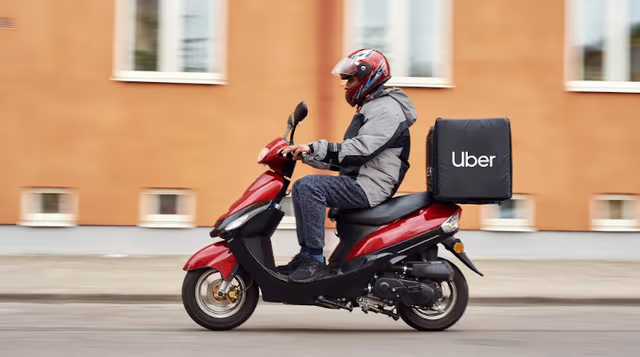
Uber is making another big push to expand beyond ride-hailing in Kenya, this time targeting the logistics space. The company has applied to the Communications Authority of Kenya for a national courier operator licence, which would allow it to officially collect, transport, and deliver parcels nationwide, effectively turning its platform into a full-scale delivery network. The move would put Uber in direct competition with established courier firms and even the state-owned Postal Corporation of Kenya (Posta), which has been struggling to stay relevant as traditional mail volumes shrink.
If approved, this would quietly reshape how parcels move around Kenya. Instead of relying on standalone courier fleets, Uber would tap into its existing driver network and app infrastructure to handle deliveries the same way it already does with rides and food. For consumers and SMEs, that could mean faster, more flexible, on-demand delivery options inside a single app. For government regulators, it also means dealing with yet another tech platform operating in a sector that is increasingly critical to commerce, especially as eCommerce, retail, and even document delivery continue shifting online.
This isn’t an entirely new play, either in Kenya or across Africa. Competitors like Bolt have already launched parcel delivery services in Kenya and other markets, while Uber itself has been gradually building logistics capabilities globally, bundling courier-style services into its broader ecosystem of mobility and food delivery. Across Africa, ride-hailing platforms are increasingly converging into logistics companies because the same driver networks, routing systems, and demand patterns apply whether it’s people, food, or parcels being moved. In Kenya specifically, Uber Eats already laid part of that groundwork by normalising Uber as more than just a transport app.
Why this matters is that it signals how critical delivery infrastructure is becoming in the digital economy. As online retail grows, last-mile logistics is turning into a high-value battleground where whoever controls the network controls the transaction layer. For consumers, it could mean better service and more competition-driven pricing. For traditional courier companies like Posta, it adds more pressure to modernise or risk further decline as letter volumes continue falling and private operators take over parcel traffic. The broader implication is that logistics is no longer a back-end service. It’s becoming core digital infrastructure.
The buildup to this moment has been gradual. Since launching in Kenya in 2015, Uber has steadily expanded its footprint from ride-hailing into food delivery through Uber Eats, while also facing regulatory battles over commissions, driver earnings, and licensing rules. A key turning point came around 2022, when Kenya tightened ride-hailing regulations and required platform operators to obtain formal licences and comply with stricter oversight, forcing Uber and peers like Bolt to formalise operations. Since then, diversification has become a survival strategy, and moving into couriers is the next logical step in that evolution, especially in a market where digital commerce is growing faster than traditional logistics systems can keep up.
In case you missed it
- Infrastructure, capital, and data: The pillars of Nigeria’s digital economy were centred at the DOA Business Series
What I’m watching
- No.1 Christianity Expert: If You DON’T Believe In a God You NEED to Hear This!
- How to Think So Clearly People Assume You’re A Genius
Opportunities
- Qore is hiring for several positions. Apply here.
- Oui Capital has an exclusive AI mixer coming up on June 26. Interested founders, researchers, and engineers should apply here. Apply here.
- inDrive is hiring to fill several vacancies in different countries. Apply here.
- Are you a female-led tech or tech-enabled business preparing for sustainable growth and opportunity to access capital? Apply for the Female Founders Growth Programme and grab up to $2 million. Apply here.
- Bamboo is hiring in Ghana and Nigeria. Apply here.
- Cowrywise is recruiting some engineers. Apply here.
- PiggyVest is looking for a Product Technical Manager. Apply here.
- Paystack is hiring for a few roles. Apply here.
- Moniepoint is recruiting for several roles. Apply here.
- Flutterwave is hiring for several roles in Nigeria, the UK, and the US. Apply here.
- As one of Techpoint Africa’s most engaged readers, you have a direct hand in shaping what we publish next. Take our quick, 3-minute survey to tell us the stories and features you value most. Your responses are anonymous, and your feedback will help guide our editorial focus in the months ahead. Fill the survey here.
- Moniepoint is hiring for over 100 roles. Apply here.
- To pitch your startup or product to a live audience, check out this link.
- Follow Techpoint Africa’s WhatsApp channel to stay on top of the latest trends and news in the African tech space here.
Have a superb Thursday!
Victoria Fakiya for Techpoint Africa