


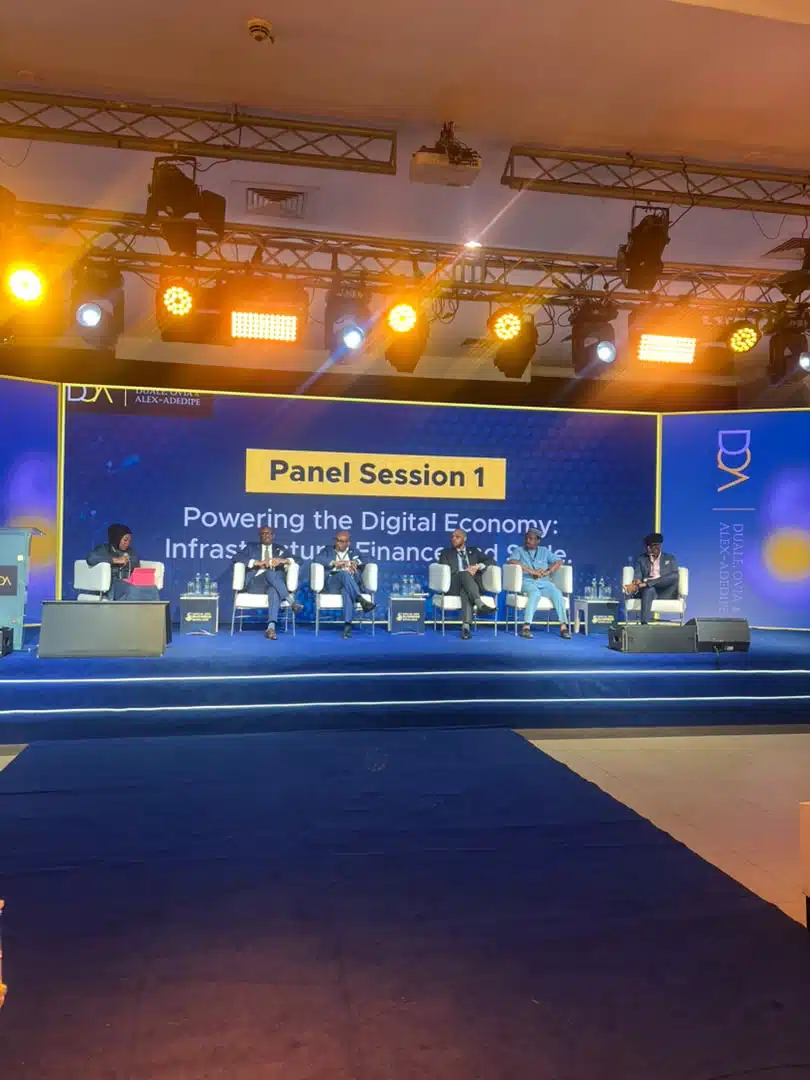


Nigeria’s digital economy is projected to reach $18.3 billion in 2026, but the path to this massive growth in digital revenue is not without its challenges. Commercial law firm, Duale, Ovia and Alex-Adedipe (DOA), brought together leaders across sectors of Nigeria’s digital economy for the 5th edition of the DOA Business Series in Lagos, Nigeria.
The theme of the event — Regulation, Capital and Business Competitiveness: Nigeria’s Digital Frontier — set the tone for two robust panel conversations on the infrastructure and support required to power Nigeria’s digital economy, and how the country can navigate the new era of Artificial Intelligence and data.
The infrastructure gap
The first panel, featuring executives from IHS Nigeria, ipNX, the Nigerian Exchange Limited, NOLT Finance, and Nairametrics, was supposed to discuss what it takes to power the digital economy. However, it quickly became a conversation about the infrastructural challenges that continue to hamper the growth of Nigeria’s digital economy.
Nigeria’s epileptic power supply emerged as a point of convergence across the panellists. Dapo Otunla of IHS Nigeria, which manages over 16,000 towers across the country, described the reality of building telecoms infrastructure without a reliable grid. In comparison, he noted that in India, connecting a tower to the grid would often be the end of the process. However, Nigeria’s situation is far more complex.
“Over here, you put your tower up, then you need to get a generator there, then you need to figure out a way to get diesel there.”
In markets with stable electricity, that problem does not exist.
Still on the challenges facing the telecoms sector, Otunla added that fragmented right-of-way policies and a lack of coordinated engagement between state governments and infrastructure companies all add to the cost of doing business. He noted that some states have resorted to filing individual lawsuits against towers rather than engaging operators at the company level. His broader point was that the conversations that should be happening between the public and private sectors are not happening with enough seriousness or consistency.
Oluwaseun Oluboyo of ipNX made a related argument about digital sovereignty, specifically that routing Nigerian internet traffic through servers abroad is a problem that does not get enough attention. Latency affects service quality, and the solution starts with building the right infrastructure locally: data centres, internet exchange points, and in-country content hosting.
On the capital side, the picture is more nuanced. Jude Chiemeka of the NGX pushed back on the idea that Nigeria’s capital markets cannot carry large-scale digital infrastructure investment. He flagged sustainability finance and non-interest finance as two underutilised channels with significant dormant capital. He also noted that the NGX was making efforts to encourage the listing of more technology companies.
Robert Ijewere of NOLT Finance agreed that capital exists, but argued that the cost is the real problem.
“Whereas you are a viable business when your cost of funds is 13%, that changes dramatically when it’s 30%.”
With the MPR at 26.5%, many digital businesses simply cannot absorb the interest burden. He suggested that intellectual property needs to be formally recognised as bankable collateral, a move that would require collaboration between the financial and legal sectors.
Ugodre Obi-Chukwu of Nairametrics offered what was probably the most optimistic framing of the panel. Nigeria has, in his view, largely solved the payments layer; the ability to transfer large sums instantly and receive same-day credit is not something many countries can claim.
The next frontier is consumer credit and capital formation, which would unlock the next phase of economic value from the digital economy.
AI, data and digital ownership

The second panel, featuring representatives from the Federal Ministry of Communications, the Nigeria Data Protection Commission(NDPC), Microsoft, ESIEE Paris, and Bluechip Technologies, covered a topic that is becoming increasingly crucial in Nigeria and worldwide: how Nigeria governs data and AI, and what businesses need to know before they get it wrong.
Babatunde Bamigboye of the NDPC opened by clarifying the commission’s posture.
“The NDPC is not out there to punish anyone, but to enable businesses.”
He walked through how the Nigeria Data Protection Act applies to AI deployments, noting that its core principles — lawfulness, fairness, transparency, and data minimisation — provide workable guidance even though the Act was not drafted with AI specifically in mind.
He also addressed data localisation, emphasising that localising data is not the same as exercising sovereignty over it. He maintained that a country could localise data without being able to exercise sovereignty over it. The more important question is who has access and control, regardless of where the data physically sits.
Dr Olumide Okubadejo of ESIEE Paris, drawing on his experience building AI systems at Wema Bank, gave the panel some of its most practical observations. Building AI for Nigeria is not the same as deploying a Western model in a new market. Latency, device diversity, language structure, and security constraints all force architectural decisions that simply do not come up in better-resourced environments.
“I feel it is particularly interesting and challenging to build in this part of the world because you have to rethink the problem with the dynamics and the constraints of this environment.”
He also argued that Nigeria needs to pay more attention to data ownership beyond raw training data and focus on the model and output levels. He noted that some data should be nationalised to ensure that Nigeria has a stake in the AI models trained on its citizens’ data.
Across both panels, the same tension surfaced repeatedly. Nigeria has the market size, the talent, and in several areas, the infrastructure momentum to build something meaningful. But the enabling environment — reliable power, coherent policy, affordable capital, and now a governance framework for data and AI — still has too many gaps to fully realise the ambition.
Nevertheless, the real test is how people act on these conversations after the event.