



When most people in Africa’s tech ecosystem think about the Zipline, the autonomous logistics company headquartered in California, the first thing that comes to mind is its contribution to Rwanda’s medical supply chain, where it began operations in 2016 by delivering blood and medical supplies to rural communities. Not many know that Zipline has spent the last four years building a network in Nigeria, delivering vaccines and medicines by drone to communities in Kaduna, Cross River, and Bayelsa states.
Now, the company is preparing an expansion backed by a US government grant across Nigeria, evolving from state-by-state partnerships to engaging healthcare stakeholders at the local, state, and national level.
Anthonio Pinheiro, Zipline’s Nigeria Country Director, says the goal is to build a national delivery network, with plans to build 12 additional distribution centres — which it calls nests — over two years that will significantly increase Zipline’s impact in Nigeria from six million people to up to a hundred million people.
From state partnerships to a national network
Zipline’s Nigeria strategy so far has been built one state government at a time. That approach has delivered results in partner states.
“Zipline has been here [in Nigeria] since 2022, and in four years, we have delivered over a million medical product units and 6.1 million vaccine doses across about 180,000 deliveries. There has been a 30% increase in treatment among malnourished children and a 42% reduction in zero-dose prevalence.” Pinheiro says.
These numbers are particularly crucial in Nigeria, which has the highest number of zero-dose children — children missing out on all vital vaccines — with over two million children unvaccinated.
However, scaling the state engagement model nationally requires a more holistic approach that engages stakeholders at the local, state, and national levels.
Pinheiro clarifies that the company is not abandoning its engagements at the state level; rather, it wants all levels of government to play a part in growth by bringing in initiatives such as the National Primary Health Care Development Agency and the Presidential Vaccine Value Chain initiative, which will broaden its path to expansion.
The expansion is being funded by a grant Zipline received last year from the US government to expand in Africa. The grant will cover the cost of building new nests, including engineering, construction, and equipment, while the Nigerian government will have to commit to ongoing operating costs.
“All we need to make this happen is to partner with the government, work with the regulators to ensure that we’re compliant with their needs, understand what the state and federal governments require for us to make this happen, and start building and looking for talent.”
How Zipline’s nests work
To the average observer, Zipline’s operations might solely comprise transporting medical supplies via drones. However, the company’s work in Nigeria goes beyond drone logistics in healthcare.
Pinheiro describes the company as an “AI robotic infrastructure company.”
He notes that only 20% of Zipline’s operations are drone-related; beyond this, the company operates storage facilities at all its nests, and, because it is primarily focused on healthcare, every facility has a pharmacist, cold chain storage solutions, and a detailed tracking system.
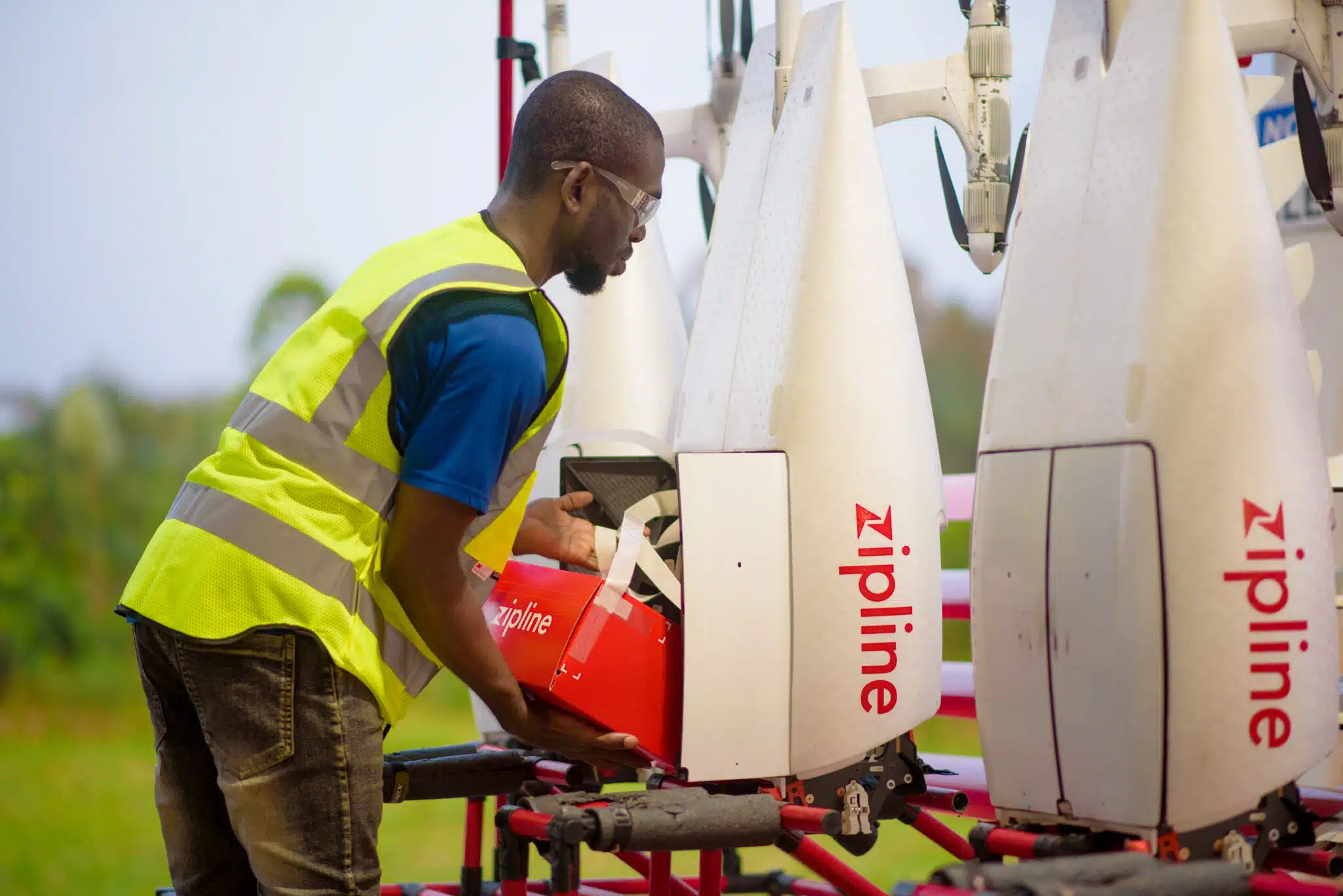
A chain is triggered when an order is received from a hospital or health facility, via phone, WhatsApp, or email. The request is routed through Zipline’s associates to the in-house pharmacist, who pulls the item from cold-chain storage, verifies dosage and condition, and packages it securely in a Zipline box.
From there, the operations team tags the package with a SkyNet tag and destination code before flight operations staff load it into a drone capable of carrying up to three kilogrammes, fit a new battery, program the destination, and run a flight safety check before launch.
The drones, brought in from the United States, fly up to 125 kilometres from a nest, with an average flight time of about 45 minutes, dropping packages by parachute at pre-mapped sites near hospitals before returning or continuing to a second delivery.
The nests currently employ close to 80 people, a figure that Pinheiro says grew recently as Zipline moves towards a national footprint. Beyond the current healthcare focus — vaccines, medicines, and support for campaigns run with partners including Gavi, the Vaccine Alliance, and the Elton John Aids Foundation — Pinheiro points to animal health, agriculture, and commercial delivery as future applications, contingent on market demand rather than any fixed roadmap.
What stands out in Zipline’s account of its Nigeria operation is less the drone technology itself than the logistics infrastructure and operations that give the drone technology room to shine.
In 2025, the company announced it would expand into five additional states, a decision backed by its success over the past four years. Its impact on the millions of vaccines delivered in three partner states shows that its model works and has the potential to improve Nigeria’s vaccination rate, especially in rural and conflict-affected areas where road logistics may prove difficult.
Nevertheless, as Pinheiro notes, many agencies in Nigeria are committed to doing good work in healthcare but remain dormant because they are not carried along. Hence, Zipline’s true test on its national expansion path will be its ability to engage multiple agencies across the levels of government without significantly disrupting its expansion plan.