
On Sunday, August 30th, 2026, a tweet alleging that OPay was taking an “indefinite break” went up, and customers were urged to withdraw their funds urgently or risk losing their money.
By Monday morning, the tweet had gone viral, getting over two million impressions on X alone, before it was deleted, and making its way into numerous WhatsApp groups, heating up discussions. Some individuals panicked and withdrew their funds, and OPay had to play catch-up to douse the tension.
OPay denied the report, stating that the information was false and misleading. The fintech would later issue a warning to the lady behind the viral tweet, instructing her to take it down or face legal consequences.
According to OPay, the misinformation has caused irreparable damage to the company, and it is considering legal action, a move that many customers support. The poster has since deleted the tweet and issued a public apology, but does this solve anything?
OPay considering legal actions
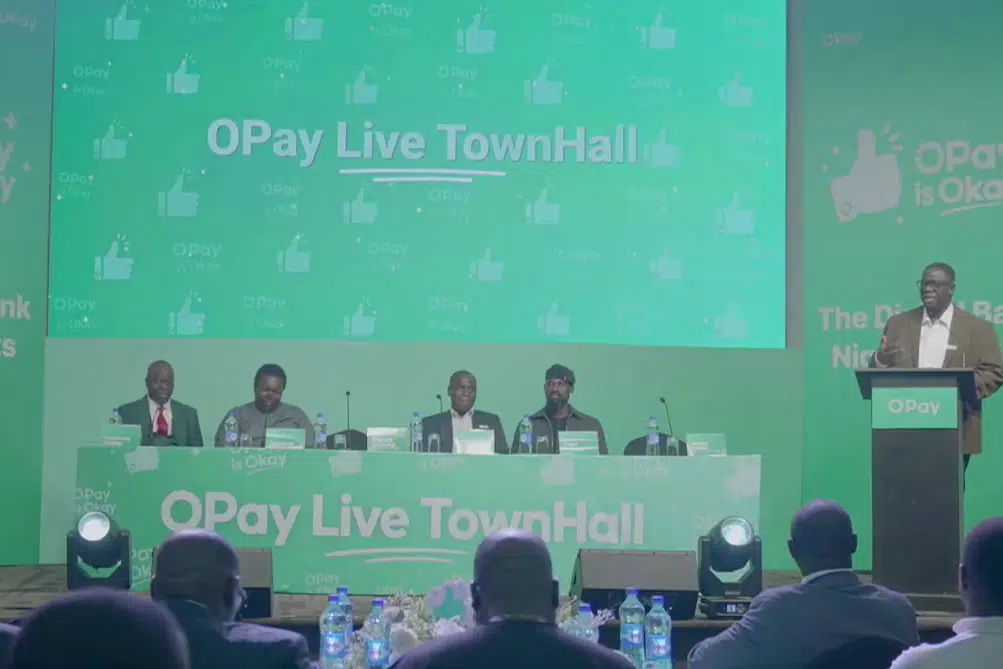
Akinfolabi Rokosu, OPay’s Chief Legal Counsel, informed attendees at a townhall meeting in Lagos that false information was presented as an official message from OPay and was intended to cause financial loss.
He said the fintech has taken the matter beyond social media and is taking legal actions. He added that the Central Bank of Nigeria (CBN), the Department of State Services (DSS) and the Nigeria Police Force (NPF) have also been informed.
“Opay is taking legal action againsts those responsible for deliberately creating and circulating this false information,” Rokosu noted. “We will pursue them and ensure the law takes its full course. This is about accountability, customer protection, and the rule of law and not about silencing anyone on social media.”
On his part, Dotun Adekunle, Chief Operating Officer (COO) and Chief Technology Officer (CTO), OPay, urged responsible use of social media, stressing that a simple message can have far-reaching effects and sway opinions and decisions.
Adekunle argued that such reckless messages can undermine trust and slow progress in the digital payment space, where considerable effort has gone into promoting financial inclusion.
The OPay case is not the first viral falsehood to end in a threat of litigation. Earlier this year, a Nigerian on X made defamatory claims against popular Nollywood actress Eniola Badmus. The tweet went viral, and he only deleted the post and published an apology after Badmus threatened to sue.
Monetisation on social media and the rise of fake news
In October 2022, Elon Musk purchased microblogging platform Twitter for $44 billion and rebranded it as X in July 2023. One of the changes he introduced was the Creator Ads Revenue Sharing programme, which is only available to users with a verification badge.
The verification badge serves three main purposes. First, it prevents prominent individuals and brands from being cloned on the platform and, in return, offers monthly payouts to verified users who generate engagement. The other purpose is to guarantee a revenue channel for X. However, the model proved easy to game, and X has spent the past year adjusting it.
The account behind the now deleted viral tweet carries a verification badge and routinely posts to tens of thousands of impressions, so it likely meets the entry condition for revenue sharing. Whether it is enrolled, or earned anything from the post, is not publicly visible. What is visible is the environment it posted into.
In March 2026, Elon Musk announced that X’s monetisation programme would offer payouts based on creators’ local audiences. The idea was quickly reversed after pushback from creators who target global audiences to earn bigger paycheques.
The following month, X’s Head of Product, Nikita Bier, announced a major crackdown on aggregators (accounts that repost other people’s content or news). He mentioned that payouts to aggregators had been slashed by 80%.
“It became abundantly clear: flooding the timeline with 100 stolen reposts and clickbait everyday crowded-out real creators and hurt new author growth,” he said.
By August 2026, X introduced a new initiative—the Original Content reward —to phase out the existing Creator Revenue Sharing. Allegra Jacchia, who works as Creator Product at X, said the programme is focused on rewarding creators with original ideas, creativity, and expertise, while deprioritising those attempting to game the system.
Creators now face more stringent measures to qualify: be aged 18 and above, have at least 500 verified followers, pull 500,000 home timeline impressions, and actively post original content.
Mitigating misinformation on social media platforms
Various social media platforms have sought ways to address misinformation, but it appears none have been successful. Meta and X have content moderation policies that involve filtering a large volume of posts, images, videos, and comments to ensure compliance with their guidelines. However, due to cost considerations, this important task is often outsourced to low-income countries.
More recently, much of the work has shifted to automated systems, and both platforms continue to face criticism over what gets through.
X introduced Community Notes, which enabled other users to fact-check posts or tweets. However, one study by the Digital Democracy Institute of the Americas found that over 90% of proposed Community Notes never get published because they fail to meet the strict consensus threshold. And even when they get published, the misinformation would have travelled far and wide.
For Múyìwá Mátùlúkò, CEO and Co-Founder of Businessfront (publishers of Techpoint Africa), combating misinformation on social media platforms is a tough battle.
“Social media platforms will have to fundamentally change their business model if they are going to combat misinformation,” Mátùlúkò notes. He argues that the current model gives too many incentives, and it’s always going to be tough to stop people from abusing it.
According to him, discontinuing monetisation on these platforms won’t fix the problem because disinformation existed on X and Facebook before the creator revenue-sharing model was introduced.
Salem King, Co-Founder, Crea8torium, agrees with Mátùlúkò that monetisation is not the problem. He says monetisation creates incentives which bad actors exploit.
“Removing monetisation would punish millions of honest creators who are building businesses, educating people, and creating real value,” King argues. “The focus should be on making misinformation less rewarding, not making creativity less rewarding.”
He says big tech platforms should focus on making truth more rewarding than sensationalism. King believes that continuous investments in better detection, stronger enforcement against repeat offenders, and algorithms that reward credibility over pure engagement can combat misinformation without killing the creator economy.
Creator economy analyst at Communique, Oritsejolomi Otomewo, says most social media platforms are designed to reward attention over accuracy, and he doesn’t see that changing anytime soon.
His views align with King: discontinuing monetisation would hurt many legitimate creators and publishers. Besides, Africans are still fighting to be monetised on many platforms. He, however, provides a middle ground — rewarding credibility and demonetising fake news merchants.
“The balance is to continue rewarding creators for producing content people find valuable, while making it much harder to build a profitable business around misinformation,” Otomewo notes. “If the fastest way to earn money on a platform is to make the most sensational claim possible, fake news will continue to be a feature of the system, not just a bug.”
Femi Falana vs Meta sets a precedent
In early 2026, a case between human rights lawyer Femi Falana vs Meta sets the precedent. A viral Facebook video allegedly portrayed the renowned lawyer as suffering from a serious medical condition. The plaintiff sued Meta when no perpetrator was identified, and a Lagos High Court ruled in his favour, awarding him $25,000 in compensation.
The case essentially ran as a fundamental rights and data protection claim rather than a defamation claim, which Meta argues should have been the case. However, the Courts ruled that a platform that monetises content and controls distribution systems cannot hide behind hosting-and-intermediary argument.
The Court held that Meta owed a duty of care to users whose personal data and reputation were affected by content on its platforms, and that it breached Section 24 of the Nigeria Data Protection Act 2023, thereby reinforcing platform accountability under Nigerian law. Meta has appealed the judgement.
“As a global technology company with advanced resources, Meta was expected to implement: effective content review mechanisms, rapid takedown processes, and safeguards proportionate to the risk posed by misinformation. Its failure to do so amounted to regulatory non-compliance,” Olumide Babalola, counsel to Femi Falana, wrote in a LinkedIn post early this year.
Tech startup and investment lawyer Charles Rapulu Udoh explains that certain defences can weaken even a strong defamation claim, particularly where the published material is substantially true or where reportage protections apply.
“When a claimant anticipates these hurdles, the data protection route becomes attractive, Udoh notes. “It offers a more structured statutory framework, avoiding the unpredictability of common law principles and the discretion involved in criminal defamation prosecutions.”
However, Udoh clarifies that the route is not open to everyone.
“Under the Nigeria Data Protection Act 2023, a data subject is strictly an identifiable, living natural person,” Udoh says. “That means individuals can sue for misuse of their personal data, but companies generally cannot bring such claims in their own right.”
The workaround a company may pursue is via its founders or directors, whose personal data has been affected. According to Udoh, the choice between defamation and data protection is fact-specific. It depends on who has been harmed, how the information was used, and what outcome is actually sought.
How should brands and businesses respond to fake news?
Udoh says business owners often wonder whether a damaging written statement is worth pursuing. He answers that it depends, stressing that the details matter more than most people expect and written defamation (libel) is treated differently from spoken words (slander).
“The Courts usually examine whether the statement was published, refers to you, and could cause serious harm to your reputation or business,” he explains. “Proving serious harm is not always straightforward, especially where financial loss must be shown.”
He explains that an otherwise strong claim can be defeated by defences such as honest opinion or public interest, adding that defamation is a strict-liability tort and that a person can be liable even without bad intent. However, the window to act is very short — one year from publication.
“Given these layers, founders should not try to navigate a defamation matter alone,” Udoh advises. “If you have been targeted by a damaging publication, the next step is not to guess; it is to get proper guidance before time runs out.”
OPay has set the record straight: the information that circulated is false. The poster has deleted the tweet and apologised, but none of that changes the conditions the post travelled through. A claim that moves fast enough is still worth more attention than the correction that follows it, and X’s newly introduced payout adjustments hasn’t been tested to see if it alters anything.
Which leaves the legal route for OPay. On Udoh’s reading, it is the weaker of the two the company might have taken, as it cannot bring the data protection claim that worked for Falana, and a defamation action puts it to the harder task of proving serious harm within a one-year window. If it succeeds anyway, it sets a precedent that Nigerian companies will use. If it fails, the incentives stay exactly where they are.