

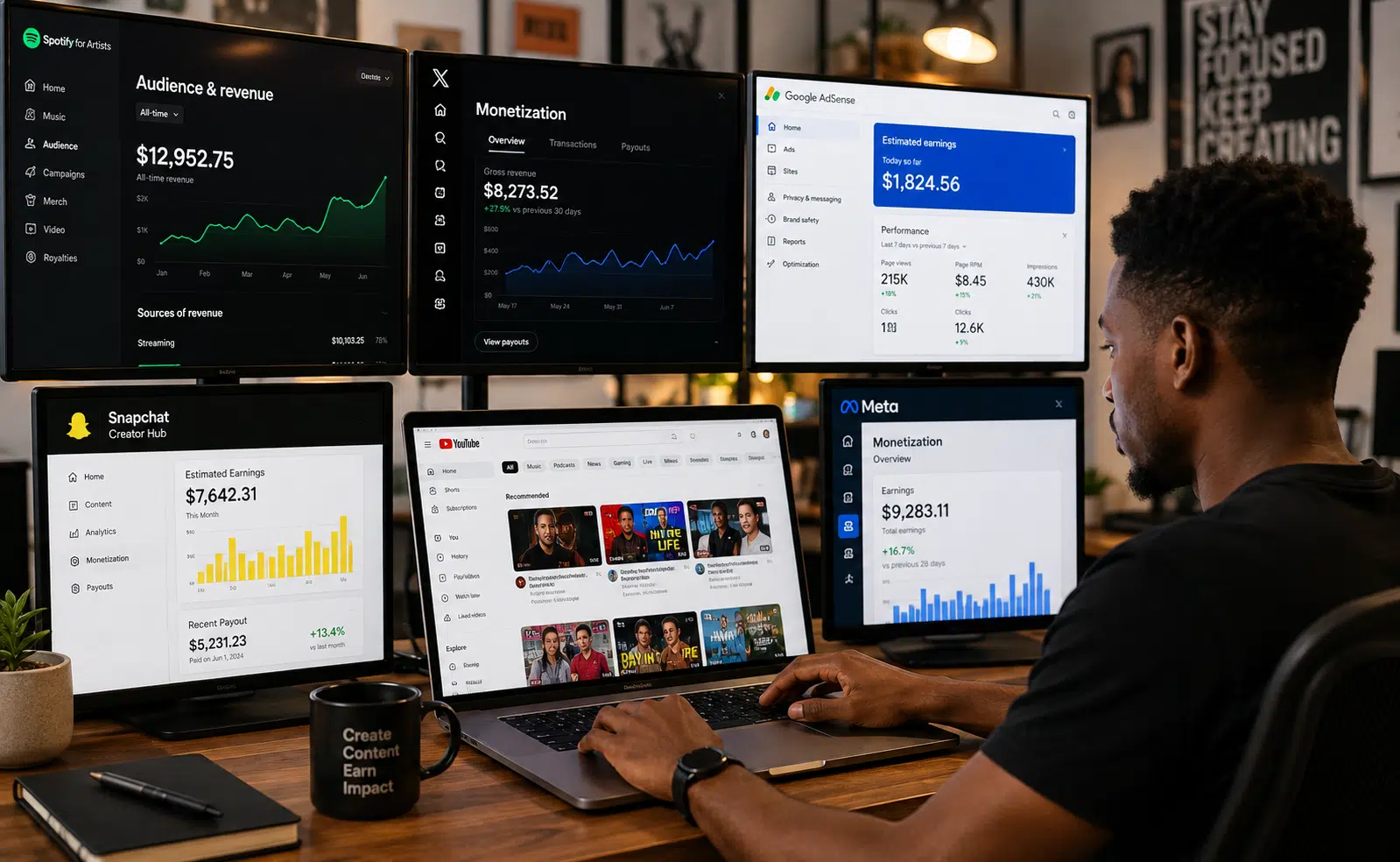

For many thriving African creators, questions about monetisation on platforms like YouTube, Spotify, and Meta have always remained a major concern. First, creators must meet certain requirements (some of which can be stringent) to be eligible for monetisation, and then they must generate sufficient viewership to earn meaningful payouts.
In a recent report, YouTube announced plans that could make it much more difficult for new creators to qualify for its main monetisation programme. Commencing February 1, 2027, creators will need to have over 1,000 subscribers, in addition to attaining either 8,000 valid public watch hours in the previous 12 months or 20 million Shorts views within 90 days, before they’re eligible to apply to the YouTube Partner Programme (YPP).
This new development doubles the current requirement of 4,000 hours and the 10 million Shorts-view route. Although creators already in YPP are exempt from this new directive, many believe the announcement makes it harder to reach full earnings on the platform.
There’s some background to this, though. In July 2026, the platform expanded its explanation of “inauthentic content” to weed out low-quality, repetitive material, including floods of AI-generated content. This means YouTube is pushing for sustained audience interest rather than channels that hit a few viral numbers and immediately qualify for monetisation.
African creators continue to decry poor payouts
Chief Engineer at the University of Maiduguri, Bukar Mamadu, who uses his AI artist to release songs on streaming platforms like Spotify, says payouts vary by geography, with Africa and some Asian countries receiving the lowest payments.
He, however, clarifies that although streaming revenue is calculated per region, the differentiator is often the varying subscription rates across regions.
“Poorer regions pay less and generate less streaming revenue per stream and in total,” Mamadu explains. “So the payouts to artists in these regions reflect the reduced revenue the companies get there. Likewise, richer regions pay more in subscription costs, so they earn more per stream.”
He believes it all comes down to economics, rather than outright discrimination.
For Damilola Ojumoola, an Ibadan-based YouTuber and the founder of ETAVOD, African creators who attract viewers from the USA and other first-world countries will outearn those with viewers from third-world nations because advertisers pay more for viewers from the global north and less for ads shown to global south viewers.
He adds that YouTube deducts a 30% withholding tax from a Nigerian creator’s earnings from US views, and unfortunately, Nigeria doesn’t have a bilateral tax treaty with the US that would reduce this rate.
Ojumoola agrees with Mamadu that the payouts aren’t due to discrimination. He recommends that Nigerian YouTubers who want to earn a high income should create content targeting viewers in first-world countries.
Similarly, a media executive argues that the claim that African creators are paid less than their European or American counterparts for the same number of views is false. His views align with Ojumoola’s: earnings depend on where the audience is— if African creators want to increase their average ad rates, they should focus on building more global audiences.
How monetisation works: An expert explains
Emem Adjah, who spent over a decade leading monetisation across big tech firms such as Google, X, YouTube, and Snap, says two major things impact pricing. The first, she explains, is TV.
When it comes to monetisation on TikTok or Instagram, the primary format is video. And with video, most of the big budgets come from brands that are spending on TV.
The numbers are there, but there’s still what’s called anchor pricing because brands are used to TV pricing, which is quite mature, has measurement, but tends to be very cheap. So it’s difficult trying to sell to them, since pricing is anchored to TV, which can sometimes serve as a ceiling, as brands can be quite price-sensitive.
While big tech platforms try to make a case for paying creators more, they also need to find ways to secure a lot of those TV budgets.
Also, in today’s digital age, where users can now command a bit of a premium because a lot of eyes are being spent on digital platforms, on their mobile devices, on TV, but they’re not connected to cable, they’re using the internet. But to charge a premium, you need to be able to measure it, and that’s where data comes in.
But a constraint arises, especially in Europe and across the globe, where we are empowering users to say, “Hey, you can’t touch my data, you can’t track me because I don’t know what you’re using it for, I don’t know what you’re charging extra, and reselling it.” The challenge with this is that it’s harder to then track or say which ad influences which purchase.
So, platforms are seeking different ways, with the death of cookies and app IDs being stripped to enable attribution and argue why they can charge a premium price.
Adjah explains that, with the anchoring to lower TV prices and gaps in data, it’s difficult to make the case for increasing prices, which is quite important for creators. However, plans are in the works, but it’s a matter of taking small steps to get there because you have to try to balance the ecosystem. Big tech platforms don’t want to raise fees too high and then see advertisers leave, but, again, they are well aware that increasing payouts is a major motivator for creators to produce more content.
When we say “TV,” we mean brands like Coca-Cola and Pepsi, as well as their agencies. Generally, when you’re buying a video format, it’ll be connected to TV. Big tech platforms are always trying to get those budgets to shift towards digital, but advertisers are used to buying TV, which has very cheap rates. And trying to convince them that they can get a better deal with better performance on a digital platform can be difficult at times.
Regarding African creators being paid less, Adjah clarifies that the issue is not only in Africa but in other regions as well, because people look to the US as a benchmark and are unaware that big tech platforms are also competing with TV for big brands’ budgets.
Another point is that much of the growth comes from small and medium-sized enterprises (SMEs), and unfortunately, they’re much more price-sensitive. YouTube over-indexes on agency brands because they tend to have a bit more flexibility in pricing per impression, but for Instagram and TikTok, much of their advertising growth comes from SMEs.
“So we also are tethered to their price sensitivity as well and trying to not hamper growth for SMEs in these markets.”
Asked whether one click in the US is probably worth 100 clicks in Africa, and whether that’s down to purchasing power and how that affects monetisation, Adjah clarifies that there is a science around purchasing power and how it plays into pricing.
“Users having a higher click through for an ad is baked into the math; higher click throughs, higher performance should drive higher pricing. But in my career, based on the technical setup, sometimes that doesn’t even net out to be true.”
Adjah’s view is echoed by the media executive referenced earlier. He says ad revenue is market-driven, and, as in any other industry, you can only earn what customers (in this case, advertisers) are willing to pay.
“Unfortunately, it appears advertisers have a much lower willingness to pay for African audiences because they have lower disposable incomes and significantly lower market values than audiences in, say, Europe or America.”
He further argues that if we want to increase the amount advertisers are willing to pay, we need to increase productivity and spending power in the countries; this responsibility lies with African governments, not the big tech companies. The tech companies don’t set prices; they host auctions where advertisers can bid for views.
Where can African creators go next?
If you’ve been following recent trends in Nollywood and even short skits on social media, you’d notice many of them have turned to brands. Payouts from YouTube, Google, TikTok, and Meta have not been sufficient to keep the lights on.
When the end credits rolled from Nollywood actress and filmmaker Omoni Oboli’s 2025 movie Love in Every Word 2, something stood out beyond the cast and crew. A string of brands, including UBA, MTN, Coca-Cola, GIG Logistics, Vaseline, and Close-Up, appeared as collaborators and sponsors. Also, recent movies and short videos on Meta and IG have infused brands into the production, some subtly, others in a very prominent fashion.
The majority of creators’ earnings come from direct sponsorship deals with brands, not necessarily from programmatic ad revenues received through platforms like YouTube. This is also market-driven and based on individual brands’ marketing budgets, on which big tech has no influence at all.
Africa has an extremely young population compared to the US and Europe. And with young people more likely to become content creators, assuming they do so at similar rates across countries, creators might outnumber their target audience in Africa, resulting in lower average incomes for creators.