



Yá’át’ééh,
Victoria from Techpoint here,
Here’s what I’ve got for you today:
- Former SpaceX executive joins Nigerian defence startup
- Liberia sets new rules for satellite Internet
- Amazon asks ICASA to cut spectrum fees
Former SpaceX executive joins Nigerian defence startup
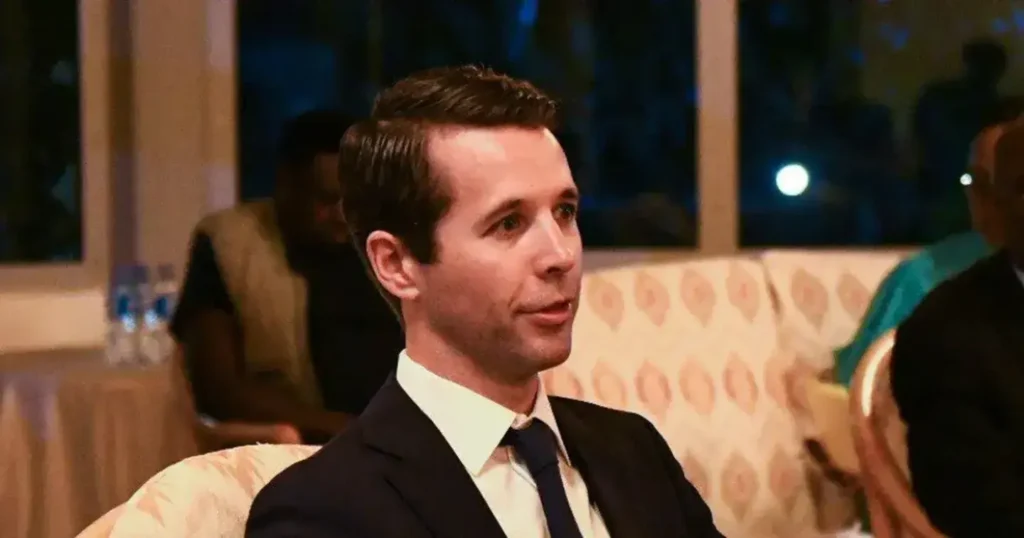
The big news is that Ben MacWilliams, the former SpaceX executive who helped take Starlink into more than 20 African countries, has joined Nigerian autonomous-systems startup Terra Industries as its vice president of strategy. The move, announced on August 19, is interesting because MacWilliams is going from helping a global satellite company navigate Africa’s telecom and regulatory landscape to helping an African defence-tech company expand beyond its home market. At SpaceX, he was responsible for Starlink market access and worked with presidents, regulators, and telecom ministers to secure operating approvals across the continent.
For Terra, the hire is less about the title and more about the network and experience MacWilliams brings. The Nigerian startup wants to build autonomous defence systems for governments and critical infrastructure, rather than simply sell individual drones. Its portfolio includes Archer, a long-range surveillance drone; Kama, an interceptor drone; Kallon, a solar-powered surveillance tower; Druma, an autonomous ground robot; and ArtemisOS, the software designed to connect the systems. Terra says its technology is already being used to protect critical infrastructure worth about $11 billion, particularly in the mining and energy sectors.
The timing is also telling. Terra was founded in 2024 by Nathan Nwachuku and Maxwell Maduka, and it has moved unusually quickly for a young African defence company. It recently closed a $52 million seed round, including an $18 million tranche announced this week, with investors such as 8VC, Lux Capital, Valor Equity Partners, and SV Angel backing the company. That gives Terra money to scale manufacturing and expand into new markets, while MacWilliams gives it someone who has already spent years figuring out how to get complex technology approved and deployed across African countries.
Defence technology in Africa has traditionally relied heavily on imported systems, whether from China, Russia, Europe, or elsewhere. Terra’s pitch is that African governments should have more control over the hardware, software, and data protecting their borders and critical infrastructure. That makes its ambitions particularly interesting at a time when governments are becoming more concerned about surveillance, cybersecurity, supply-chain dependence and national security. MacWilliams’ move from Starlink to Terra also shows how talent built around Africa’s connectivity boom is beginning to spill into other technology sectors.
What Terra now has to prove is whether it can turn that ambition into a genuinely pan-African defence business. MacWilliams will have to navigate a very different regulatory environment from telecoms, including government procurement, security clearances and arms-control requirements. But his experience securing Starlink’s entry into more than 20 African markets could be valuable here. If Terra succeeds, this could become a story not just about a former SpaceX executive changing jobs, but about African defence technology attracting serious global capital and talent and trying to build locally designed alternatives to imported security systems.
Liberia sets new rules for satellite Internet

Liberia is putting a formal regulatory framework around satellite Internet and other satellite communications services, with the Liberia Telecommunications Authority (LTA) signing new Satellite Communications Guidelines on August 19, 2026. The rules cover everything from satellite network operators and broadband providers to landing rights, VSAT services and satellite direct-to-device services. The aim is to bring some order to a market that is becoming increasingly important as satellite operators such as Starlink, Eutelsat OneWeb, and Amazon’s Kuiper look for opportunities across Africa.
The interesting part is that Liberia isn’t simply making satellite companies jump through hoops. The regulator says the rules are also meant to help the country finally solve one of its biggest connectivity problems: reaching people outside the areas where traditional telecom infrastructure makes economic sense. The LTA says satellite broadband could help deliver internet access to communities across the country, while also supporting digital payments, education, healthcare and government services. So for Liberia, this is less about having fancy satellites in the sky and more about using them to get connectivity to places where fibre and mobile towers struggle to reach.
Satellite providers will need landing rights authorisation to transmit signals to terminals in Liberia, while companies actually providing services on the ground, including satellite broadband, VSAT, gateway, backhaul, and direct-to-device services will need the appropriate LTA licence. The framework also requires providers to meet quality-of-service, consumer protection, data protection and cybersecurity requirements, keep records of customers and disclose pricing and service-performance information. For non-geostationary satellite systems such as Starlink, landing rights are valid for five years, while geostationary systems get 10 years.
This is also the culmination of a broader shift in Liberia’s satellite market. In January 2025, the LTA gave Starlink a one-year provisional licence to provide nationwide internet, and the service subsequently went live. That gave Liberians another option for connectivity, particularly in underserved areas, but it also meant the regulator needed rules that were designed specifically for satellite operators rather than trying to squeeze them into frameworks built around conventional telecom networks. The new guidelines are therefore arriving as Liberia moves from simply allowing satellite internet into actively regulating and shaping the market.
Liberia’s move is part of a much bigger regulatory race. Satellite broadband is spreading rapidly across the continent — Starlink alone reached 28 African markets by July 2026 — and regulators are having to figure out how to balance faster connectivity with issues around spectrum, licensing, consumer protection, cybersecurity and national control. Liberia’s approach is particularly notable because it explicitly covers newer services such as direct-to-device connectivity, which could eventually allow satellites to connect directly to ordinary mobile devices. The real test now is whether the rules make it easier for more providers to enter and compete while keeping services affordable and ensuring Liberia doesn’t sacrifice regulatory oversight in the process.
Amazon asks ICASA to cut spectrum fees

Amazon Leo is asking South Africa’s telecoms regulator, ICASA, to cut the spectrum fees it will pay for its satellite broadband service, warning that high fees could make the service too expensive for customers. The request came during ICASA’s public hearings on 20 August 2026 over proposed changes to the country’s satellite licensing and spectrum-fee rules. Amazon supports a proposed “frequency factor” that would reduce the weighting, and therefore the cost, of higher-frequency spectrum. Its argument is that satellite operators use relatively high bands that are less congested and typically share spectrum rather than getting exclusive blocks, so charging them like traditional terrestrial operators could undermine affordability.
That matters because Amazon Leo is hoping to become a major new player in South Africa’s broadband market. The company says it wants to connect underserved communities, but its South African rollout will depend heavily on what it costs to operate. Amazon has already committed more than $10 billion to building its LEO constellation globally. It launched its first 27 production satellites on April 28, 2025, and by February 2026, it said it had passed 200 satellites. The company has also started an enterprise preview, while its South African retail partner, Herotel, unveiled the Evry brand in July 2026 and does not expect to launch commercially until 2027.
There is a bigger regulatory battle underneath this, though. South Africa is trying to work out how satellite Internet companies should fit into its existing telecom framework as LEO services become more competitive. Amazon is asking ICASA for three things in particular: free registration for foreign satellite operators, blanket licensing for user terminals rather than licensing every individual dish, and the lower frequency factor for spectrum fees. The company also wants ICASA to clarify how it will charge for gateway stations and spectrum above 50 GHz. These may sound like technical details, but they can ultimately determine whether satellite broadband is priced as a premium product or becomes a realistic alternative for people in poorly served areas.
And Amazon isn’t alone in pushing for a friendlier framework. SpaceX’s Starlink is making similar requests around the frequency factor, gateway fees and blanket licensing. The irony is that while Amazon and Starlink are competing globally, both have a reason to want South Africa’s rules to be cheaper and simpler. Starlink, however, faces a much bigger regulatory hurdle: ICASA says SpaceX has not met the country’s requirement that certain licensees have 30% ownership by historically disadvantaged groups, and SpaceX has not yet submitted a formal licence application. Amazon is taking a different route, working through local partner Herotel rather than trying to operate as the direct retail provider.
The timing is important because South Africa could become one of the continent’s key battlegrounds for satellite broadband. Fibre and mobile networks have expanded considerably, but satellite services can reach places where laying fibre or building terrestrial towers is difficult or uneconomical. Amazon has previously told ICASA that its goal is to bring high-speed, low-latency broadband to unserved and underserved communities, including in South Africa. So the spectrum-fee argument is ultimately about more than Amazon’s costs: if ICASA lowers the regulatory burden, customers could potentially get cheaper satellite Internet; if it doesn’t, Amazon is warning that affordability could suffer, and it could even reconsider providing the service.
In case you missed them
- MTN at 25: How much has Nigeria changed with it?
- CBN’s second sandbox cohort quietly opens a testing ground for permission-based data sharing
What I’m watching
- Secrets Of The Brain With Jim Al-Khalil | FULL DOCUMENTARY
- How does sexual desire really arise? – The science behind arousal | DW Documentary
Opportunities
- Flutterwave is hiring for several roles. Apply here.
- Moniepoint is hiring for over 100 roles. Apply here.
- Follow Techpoint Africa’s WhatsApp channel to stay on top of the latest trends and news in the African tech space here.
Have a fun weekend!
Victoria Fakiya for Techpoint Africa