

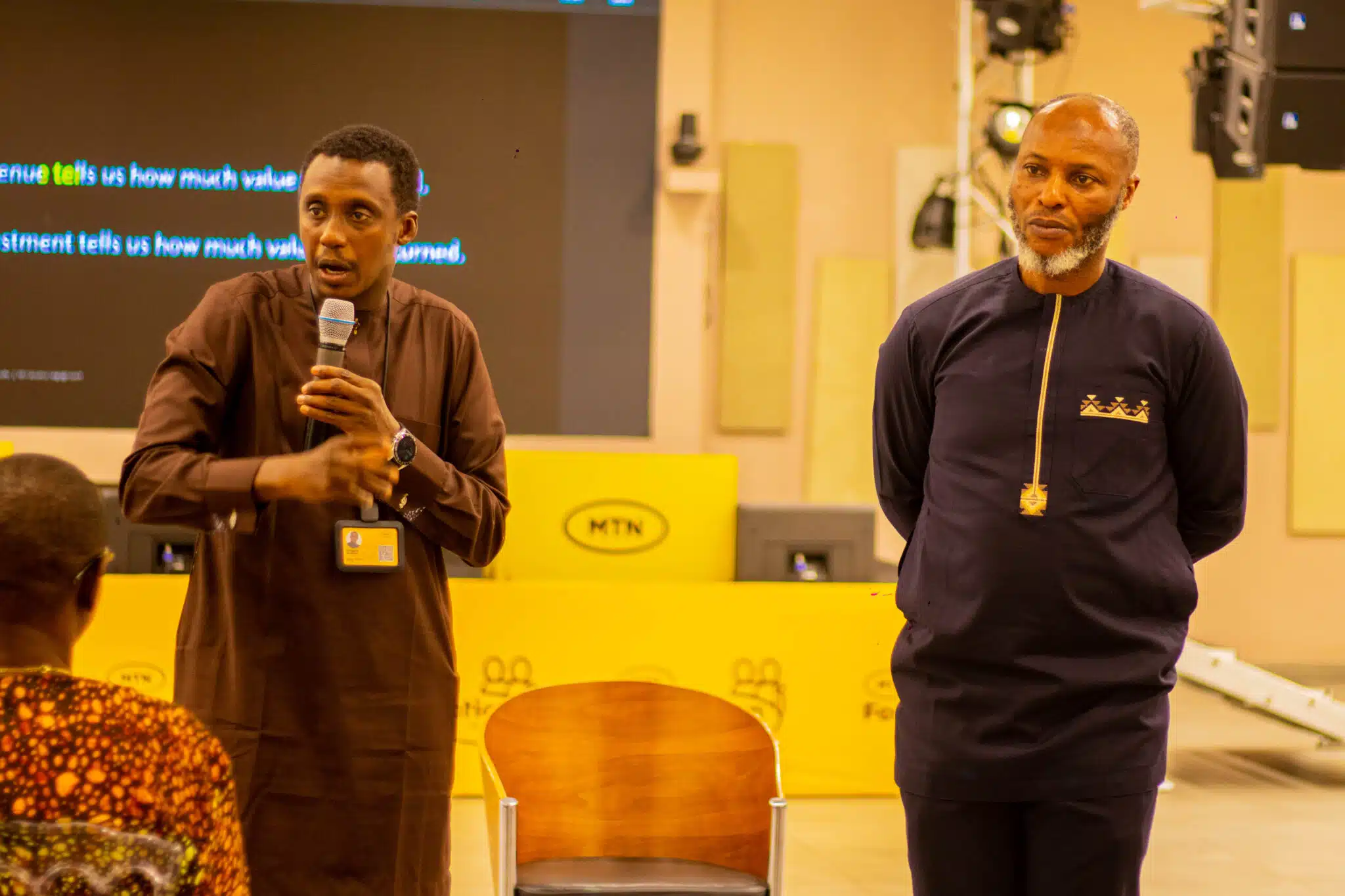


MTN Nigeria marked its 25th anniversary, celebrating two and a half decades of operation in the country’s telecommunications industry. In 2001, the company was one of three telcos, alongside Econet Wireless and Communications Investment Limited, that won bids to revolutionise the nation’s telecommunications. It was a pivotal moment for the country, as it looked to move away from the inefficiencies that plagued the Nigerian Telecommunication Company (NITEL).
Per NCC data, the telco has over 96 million subscribers, commands 51% market share, with many Nigerian businesses relying on its services to power their operations and stay connected. However, there’s also growing frustration with network costs and quality of service (QoS). MTN has had to answer questions repeatedly about these, but it’s simply difficult for Nigerians to understand why they’d pay for a service that then fails when it matters most.
This piece attempts to X-ray the challenges MTN has faced in its two-and-a-half-decade operations in Nigeria, how it has survived, and how much work it still needs to do.
Operating in a tough environment
MTN, through its Chief Corporate Services and Sustainability Officer, Tobe Okigbo onced said “you can’t do better than the environment you’re operating in”; Chief Financial Officer, Modupe Kadri recently noted that “telecoms will get better when we fix Nigeria”; Chief Technical Officer, Yahaya Ibrahim stressed that “a complete ecosystem is needed for things to works,” lamenting that over 450 network sites are vandalised daily.
In 2025 alone, MTN reported 9,218 fibre cuts, averaging more than 25 per day. This adds to network expenditure, and it’s separate from other costs, such as vandalism, theft, diesel to power base stations, Right-of-Way RoW, spectrum licences, and many more.
Former MTN employee and telecoms analyst David Onyeke, who now works for a competitor, says fibre cuts have persisted because we have built a system in which the party that causes the damage bears none of the consequences, while the party that suffers bears all of them.
“When you penalise only one side of a two-sided failure, you don’t get better outcomes,” Onyeke notes. “You get a transfer of cost.”
He further explains that five factors have kept the problem of fibre cuts persistent.
One, accountability is a one-way street. The NCC punishes only the operators, not the contractors whose activities severed the cables. The NCC, however, recently released a directive after stating that over 5,000 fibre cuts happened in H1 2026. It urged construction agencies to adopt preventive measures to protect fibre-optic cables during construction activities. Some would argue that this is a bark without bite.
Right-of-Way is treated as a revenue pipeline rather than an infrastructure policy. Operators are charged for laying fibre, but the state doesn’t take responsibility for protecting them or penalising anyone culpable. Third, government agencies (the Ministry of Communications and the Ministry of Works) appear to be working in dissonance.
Although telecommunications has been classified as critical network infrastructure, enforcement remains lacking. Onyeke, however, has some blame for the operators too, as some of their fibre deployments involve shallow burial, incomplete as-built records, and designated areas where expansion will eventually occur.
During MTN’s midyear catch-up, Ibrahim told journalists that about 1.5 million litres of diesel is used daily to power its tower sites (towercos inclusive) nationwide. Assume a litre of diesel costs N1,600; this amounts to N2.4 billion daily, N72 billion in a month, and N876 billion annually. Ibrahim says MTN Nigeria utilises alternative energy sources such as gas and solar, but diesel remains the primary means of powering its base stations. No need to ask about the grid, we all know how unreliable it is.
An independent telecoms analyst agrees that operating in Nigeria is quite challenging.
“The environment is genuinely hard, he says. “In 2025 alone, the country logged over 20,000 avoidable fibre cuts [across MTN, Airtel, Glo, and T2], mostly from road works and vandalism; there are tons of taxes and levies on the sector, RoW is a fight in every state, and diesel still carries a big share of the network because the grid can’t be trusted. Ask any engineer, and they will tell you those are real-life, practical constraints.”
However, he argues that “challenging environment” can’t be the whole story, because the same operators just posted record profits once the naira steadied and the tariff went up. While still acknowledging the systemic issues plaguing the sector, poor service in 2026 isn’t mainly a money problem anymore; it’s a demand challenge outpacing the build.
The hidden cost of network operation in Nigeria
Onyeke notes that many Nigerians are unaware of the true costs of operating a network: radio using spectrum bought from the government in dollars, sitting on a leased site, in a shelter, with rectifiers, batteries, air-conditioning, and a generator running 24 hours.
“When you buy airtime or a data bundle, you feel like you’re buying a product off a shelf,” Onyeke explains. “You are not. You are buying a slice of capacity that somebody had to build, power, secure and pay for months, sometimes years, before you ever pressed the call button.”
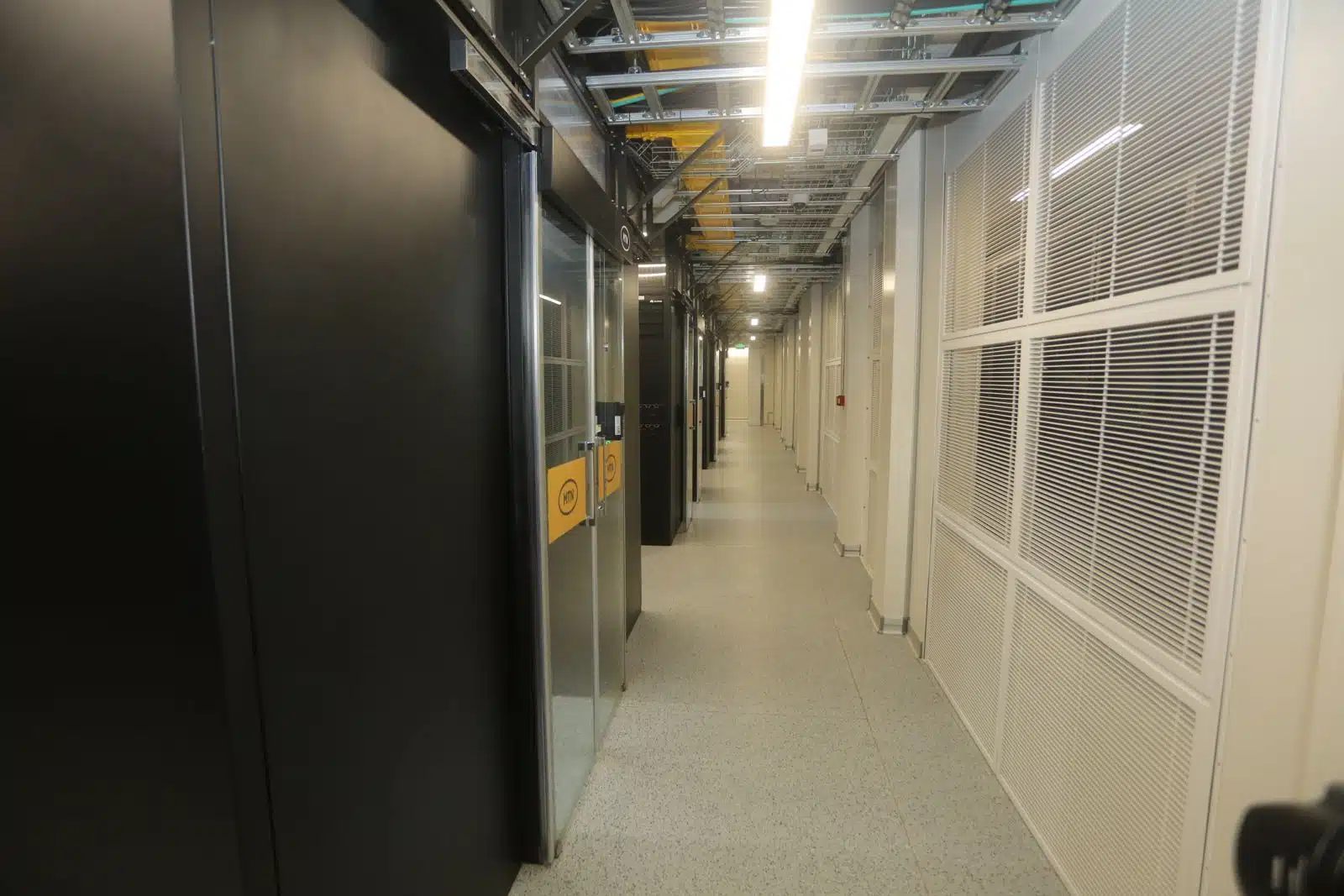
MTN alone runs more than 62,000 base stations, over 43,000 kilometres of fibre, with three or four levels of redundancies routes, and 16 switching centres. Onyeke says every one of these elements is a cost centre and a failure point.
Having once worked in Northeast Nigeria, Onyeke says getting fuel to base stations and repairing fibre cuts in the region are both logistics and security concerns. And sometimes need an escort.
With additional costs from over 50 separate taxes and levies, and RoW charges that are supposed to be harmonised at ₦145 per metre but run at multiples of that in states that never complied with the harmonised fee, making fibre three to five times more expensive to lay in some states.
“And underneath everything, the mismatch that defines this industry. Spectrum, equipment, software licences, international capacity and historically tower leases are priced in dollars. Revenue is collected in naira from customers whose purchasing power has not moved with the exchange rate. Not competition, not technology. That is the commercial problem of Nigerian telecoms.”
Between 2013 and January 2025, tariffs didn’t move in nominal terms, but the naira went from around ₦150 to the dollar to around ₦1,500. While consumers viewed the 50% tariff adjustment as steep, telecoms operators justified the decision as the right one.
“In dollar terms, the service was still dramatically cheaper than it had been a decade earlier, Onyeke notes. “Both things are true at once, and that is exactly why this conversation is so hard to have publicly.”
Is excellent quality of service possible in Nigeria?
While it is true that Nigeria is a challenging environment in which to operate, the question remains whether Nigerians can still enjoy a decent level of QoS. Okigbo previously explained that there’s usually a lag between when an investment is made and when dividends begin to show, and that poor network quality does not benefit MTN or any other telco.
“There is nobody that has base stations on the shelf; if you order from the manufacturer, it takes time to come in, go through customs, and then for you to find the site that you will use, considering that those sites you have to find them at a rate that makes sense”
The independent analyst agrees with Okigbo that money doesn’t become coverage overnight — capex takes 12 to 18 months to show up as faster download speeds and a consistent, stable experience on your phone. Fibre cuts, insecurity, vandalism, and theft can destroy deployed infrastructure faster than crews can lay it.
However, he maintains that, despite Nigeria’s challenging environment, QoS is achievable.
“When telcos were losing billions a year to forex, the ‘we can’t afford it’ argument held water then. But after the tariff adjustment and a record-profit year, that argument is much weaker.”
The most important shift is that, since April this year, the NCC’s compensation framework means substandard service now costs operators airtime credits to be returned to subscribers, and, for the first time, poor QoS hits their pocket, not just the subscribers’. That aligns the incentive for self-improvement far better than any press statement.
Assessment of MTN’s 25-year operation in Nigeria
MTN can lay claim to the numerous job opportunities its operations have created, the substantial taxes (both direct and indirect) they pay to the government, and the magnitude of investment the company has made in Nigeria through the MTN Foundation.
CEO Karl Toriola says over 90 million people are connected to the MTN network, but the story extends beyond the number of connections.
“Businesses have been built, Toriola notes. “Families have remained close across great distances. Students have gained access to knowledge. Creators have found audiences around the world. Entire industries have emerged and grown on the infrastructure that MTN and others in the telecommunications ecosystem have helped to build.”
Asked to strip MTN’s corporate narrative and assess the telco’s performance, the independent telecoms analyst says MTN deserves credit because it earned it.
“MTN walked into a 2001 market where a phone line was a luxury and built real national infrastructure out of almost nothing, he says. “90M+ subscribers later, a lot of what we now call Nigeria’s digital economy runs on the rails they laid.”
He explains that if we strip the narrative, two things sit side by side. One is that much of that early growth came from MTN being among the first and biggest in a near-empty market with enormous pent-up demand. This means that the hard part was never winning customers; it was actually building fast enough to serve them. Also, that demand probably wouldn’t slow down soon, as Nigeria has a young and vibrant population that is becoming more tech-savvy.
Secondly, the network has been allowed to run hot, and the CEO admits that real coverage and quality gaps remain 25 years in. So the honest scorecard, he says, is an impressive build that is yet to catch up with the constantly evolving demand it unlocked. That, however, isn’t uniquely an MTN problem; it’s the shape of the whole Nigerian market, and, being the biggest operator, perhaps they wear it most visibly.
For Onyeke, MTN should be applauded for taking a risk almost no one else would, citing the $285 million the telco paid for a licence in 2001.
“Whatever anyone says about MTN afterwards, that first bet was real and it was brave, and the industry I work in exists because of it,” Onyeke says. “They built distribution, not just a network. This is the part outsiders consistently miss. Everybody built base stations. MTN built a trade channel — dealers, sub-dealers, aggregators, a retail spine reaching into markets where no formal distribution existed. That is the actual moat.”
He, however, points out aspects that were understated in MTN’s corporate narrative. He argues that a large part of MTN’s market dominance is down to timing and first-mover advantage, not superior execution.
“MTN entered a starved market with effectively no competition for its first two years,” Onyeke says. “And some of the consumer-friendly shifts of that era were forced from outside — per-second billing came through competitive pressure after 2003, not from the leader.”
He says the telcos’ compliance record belongs in the story, not the footnotes, and any 25-year assessment that skips these isn’t an assessment; it’s a brochure. In 2015, MTN was fined $5.2 billion (later negotiated to ₦330 billion) for 5.1 million improperly registered lines. There’s also the CBN’s $8.1 billion claim in 2018; the telco was said to have illegally remitted the stated amount abroad.
MTN’s reported 4G population coverage is 89.3%, but Onyeke insists that coverage differs from experience.
“Coverage measures where a signal can theoretically reach. It does not measure whether a user in a congested cell, on a saturated backhaul link, at a site running on a generator, can actually load a page. The whole industry is guilty of this, but the market leader sets the standard.”
Another question that arises concerns market structure. MTN and Airtel together control roughly 86% of active lines; the NCC opened a study into industry competition in January.
According to Onyeke, some of that concentration is MTN executing well; some of it is competitors failing to do so. But a market this concentrated is not healthy, and over a long enough horizon, it is not good for consumers either.
MTN went from a ₦400 billion loss in 2024 to ₦1.11 trillion profit in 2025, a commendable turnaround.
“The two biggest levers were a 50% tariff adjustment and a renegotiated tower lease,” Onyeke claims. “The tariff increase was necessary but it’s still true that the correction was substantially absorbed by consumers in a year when their real incomes were falling.”
MTN renegotiated the master lease agreements with IHS and ATC into majority-naira terms with a capped escalator and a diesel-linked component, yielding about ₦113.8 billion in operating savings on its own. Add the January 2025 tariff adjustment, and the company swung to ₦1.11 trillion profit in 2025 and ₦707.5 billion in the first half of 2026.
MTN Group agreed to acquire about 75% of IHS that it doesn’t currently own for around $2.2 billion, valuing the company at about $6.2 billion. The deal was approved by IHS shareholders on August 4th this year, but it remains subject to regulatory clearance in the relevant markets, including Nigeria.
Own the towers, sell the towers, rent the towers, buy the tower company — a full circle in about twelve years. Onyeke says the error was never outsourcing the passive layer; it was denominating a domestic cost base in a foreign currency, in a country with a history of devaluation. Sharing towers was and remains the best approach — four operators building four towers on the same street is a national waste. The mispricing was currency risk, and the entire industry, not just MTN, paid for that lesson.
Onyeke’s verdict is that MTN has been exceptional as a business: very few companies anywhere have created that much value in such a difficult market. He says MTN has been good but incomplete as a development instrument, pointing to Nigeria’s 189 million active lines, but broadband penetration is only around 56%.
What can MTN do better?
The independent telecoms analyst gives three suggestions:
First, more capacity in the congested urban cores: the reason your speed collapses around 7-9 pm, or during traffic on the third mainland bridge or when you get into busy markets, usually isn’t coverage, it’s everyone drawing on the same cell at once, so the network has to be dimensioned for peak, not average, and smore specialised solutions need to be deployed.
Second, moving people off tired legacy layers like 3G is important, as a considerable amount of traffic (and network resources) still sits on 3G (which is less efficient) and should be on 4G. We already see other countries shutting down their 3G networks.
Third, during outages. A simple message from the operator, along with an estimated time for service resumption, would build trust more than any big campaign. Nigerians can forgive a fault far faster than they forgive silence.
Onyeke says the threats to MTN’s next chapter are not competitive. They are structural.
“Energy is first — until sites stop running on diesel, every other cost conversation is downstream of the pump price,” Onyeke explains. “The transport layer is second: you cannot run a digital economy on fibre that anyone can sever without consequence. Third is the change in what the network is even for — data revenue has now overtaken voice, average usage is above 13GB a month, and AI and data-centre demand will arrive faster than anyone is currently provisioning for. Fourth is fixed broadband, where Nigeria is genuinely behind and where the next real growth sits. The fifth thing nobody wants to say out loud on an anniversary: twenty-five years in, this industry still cannot reliably price its product in a currency its customers earn in. Until that is solved, every one of these celebrations will be followed by another crisis.”
Toriola agrees that the work is far from complete, stressing that “millions of Nigerians still need access to reliable, affordable and inclusive digital services.”
However, achieving the sort of progress Nigerians would love in telecommunications and the digital economy will require that both the government and key stakeholders pull in the same direction, not just building infrastructure but also putting measures in place to protect it.
Note: The independent analyst has over 15 years of industry experience but could not be named because he works for a competitor.