

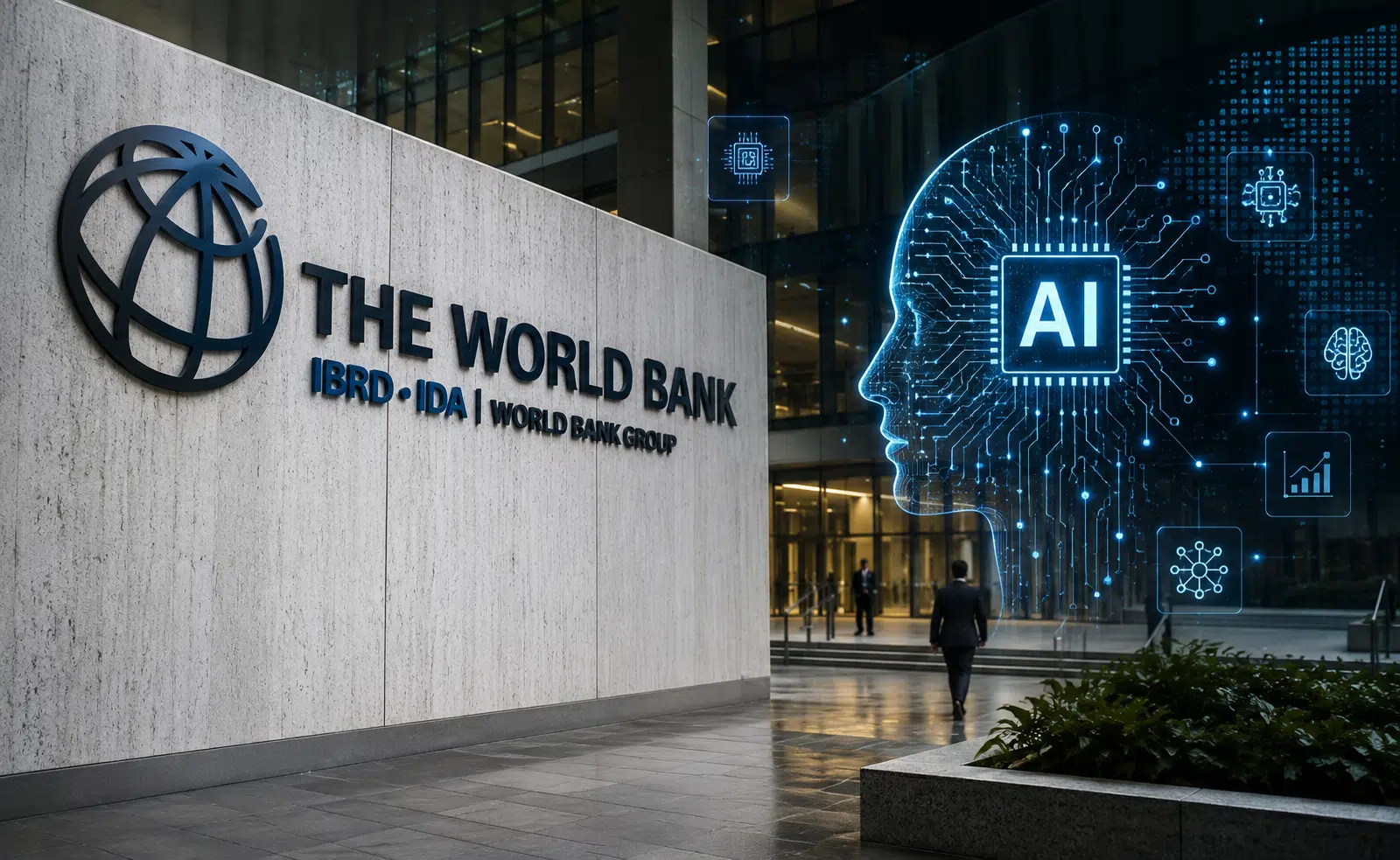


Fears that artificial intelligence (AI) will wipe out jobs may be overstated in Africa. Instead, the technology could become a productivity booster for millions of workers, provided governments can solve persistent infrastructure challenges. That’s one of the key themes from the World Development Report 2026, released by the World Bank.
The report argues that AI presents a rare opportunity for developing economies like Nigeria to accelerate growth at a time when weak productivity, slowing investment, and rising debt continue to weigh on economic prospects.
While much of the global AI debate has focused on automation and job losses, the World Bank says developing countries, particularly those in Africa, face a different reality.
According to the report, only 4.5% of jobs in developing economies are highly exposed to automation, compared to more than 14% in advanced economies. Rather than replacing workers, AI is more likely to help people become more productive by assisting with routine tasks and improving decision-making across sectors such as healthcare, agriculture, education, and public services.
That finding could reshape the AI conversation in Africa, where concerns over job displacement have often overshadowed discussions about how the technology can improve economic outcomes.
The real bottleneck is infrastructure
The report argues that Africa’s biggest AI challenge isn’t access to models like ChatGPT or Gemini. Instead, it’s the digital infrastructure required to use them effectively.
Reliable electricity, affordable broadband, computing capacity, cloud infrastructure, and a digitally skilled workforce remain uneven across much of the continent. Without these fundamentals, the productivity gains promised by AI may remain out of reach.
The challenge is one Techpoint Africa has documented repeatedly. Across the continent, startups and enterprises are increasingly experimenting with AI, but adoption remains constrained by unreliable power, high Internet costs, limited access to computing resources, and a shortage of specialised AI talent.
The World Bank also warns that countries that fail to build local AI capabilities risk becoming dependent on technologies developed and controlled elsewhere, limiting their ability to shape how AI is deployed in their own economies.

Victoria Fakiya – Senior Writer
Techpoint Digest
Stop struggling to find your tech career path
Discover in-demand tech skills and build a standout portfolio in this FREE 5-day email course
Africa’s opportunity is still significant
Despite the challenges, the World Bank believes developing economies have more to gain than lose from AI.
Unlike previous technological revolutions that required heavy industrial investment, today’s AI tools are becoming cheaper and more accessible through cloud services and open-source models. This lowers the barrier to entry for startups, governments, and businesses looking to deploy AI-powered services.
For African countries, the focus now shifts from building frontier AI models to creating the conditions that allow existing technologies to flourish. That means investing in digital infrastructure, improving access to affordable Internet and electricity, strengthening digital skills, and developing policies that encourage responsible AI adoption.
If those foundations are put in place, AI could help improve public service delivery, expand financial inclusion, support small businesses, and raise worker productivity across sectors.
The report ultimately offers a more optimistic outlook than much of the global AI discourse. For Africa, the biggest risk may not be AI replacing jobs, but poor infrastructure preventing the continent from benefiting from one of the decade’s most transformative technologies.