



Sunday* always gets to his ponds just before 5:30 a.m. while the water is still cool from the night, and the catfish are already at the top, waiting quietly for their feed.
He has been doing this for twenty-odd years, on the same stretch of ground outside Mowe, Nigeria, so the routine has long become second nature. He checks the netting. He lifts the bag, and he knows its weight the way you know the weight of your own child.
Then he raps the hollow galvanised frame of the tarpaulin tank twice with his knuckle, a sharp ring the fish have long since learned to answer, and the surface begins to move. The moment he flings the first handful of pellets, the calm water erupts into a violent, boiling frenzy as hundreds of heavy catfish thrash and fight for the feed.
He scoops and throws. The water breaks where the feed lands. He throws again, they keep coming, and he keeps throwing until it looks right.
Then he stops, because it looks right. Or the bag is empty.
There is no science to the method but Sunday can tell you which of his ponds runs hot in March and which one gives him trouble after heavy rain. He can look at a fish and guestimate its weight to within a few grams. What he cannot do, what twenty years has never once given him, is see whether the ones underneath are hungry or already full.
In February, he lost most of a batch across four days. He called it “disease”, because that is what everybody calls it, and he restocked and moved on. He still does not know what happened in that water.
Depending on who you ask, fish feed is roughly 75 percent of what it costs to run a commercial pond in Nigeria.
“One operator even told us it was closer to 87 percent for them,” Samuel Eze, CEO and founder of Fishcluster, recalls.
Yet, there is so much threat-bearing waste.
Whatever the fish do not eat sinks to the bottom, rots, and turns to ammonia. The ammonia kills slowly enough that nobody thinks to blame the feed.
What nobody can see
Eze has spent about six months building a company around this.
“When the fish move around, you do not see what they do underneath the water,” he tells me on the first of two calls. “It is invisible to anybody, no matter how qualified or experienced you are.”
Fishcluster, which comes out of stealth today, is his answer to that: an AI and robotics system for commercial fish ponds. The pitch is not that farmers are careless. It is that the industry’s entire quality-control method is inefficient.
“Every major feed manufacturer in the country employs aquaculture technical experts (ATEs) who move from pond to pond, manually taking readings and writing numbers down,” he explains.
The key metric they are measuring is the Feed Conversion Ratio (FCR), which has become the working benchmark for a decade or more. In a market where farmers can switch brands at will, it is how a manufacturer proves its feed works.
But, as Eze points out, it is unreliable because it arrived at entirely by hand.
“Today in the industry, it is assumed, for example, that one kilogram of feed should produce around 1.5 kilograms of catfish,” Eze shares.
There is another problem.
An ATE covers, on average, fifty ponds (a hundred at most) on a route. But ponds change faster than routes do.
“You can check now with the manual tool and in the next ten minutes the problem is happening.”
The compounding effect is what makes things expensive. Feed thrown unevenly or excessively (backed by unreliable ATE data) means some fish grow faster than others. In the case of catfish, those that outgrow their batch start eating it. Oxygen drops. Ammonia climbs, a cascade is set off.
“That death is not overnight at all,” Eze says. “It comes quietly, every single day.”
He is careful to highlight that the problem is not a Nigerian one only. From Africa to Asia to Latin America, he argues, fish farmers are fighting the same invisible enemy.
The Fishcluster stack
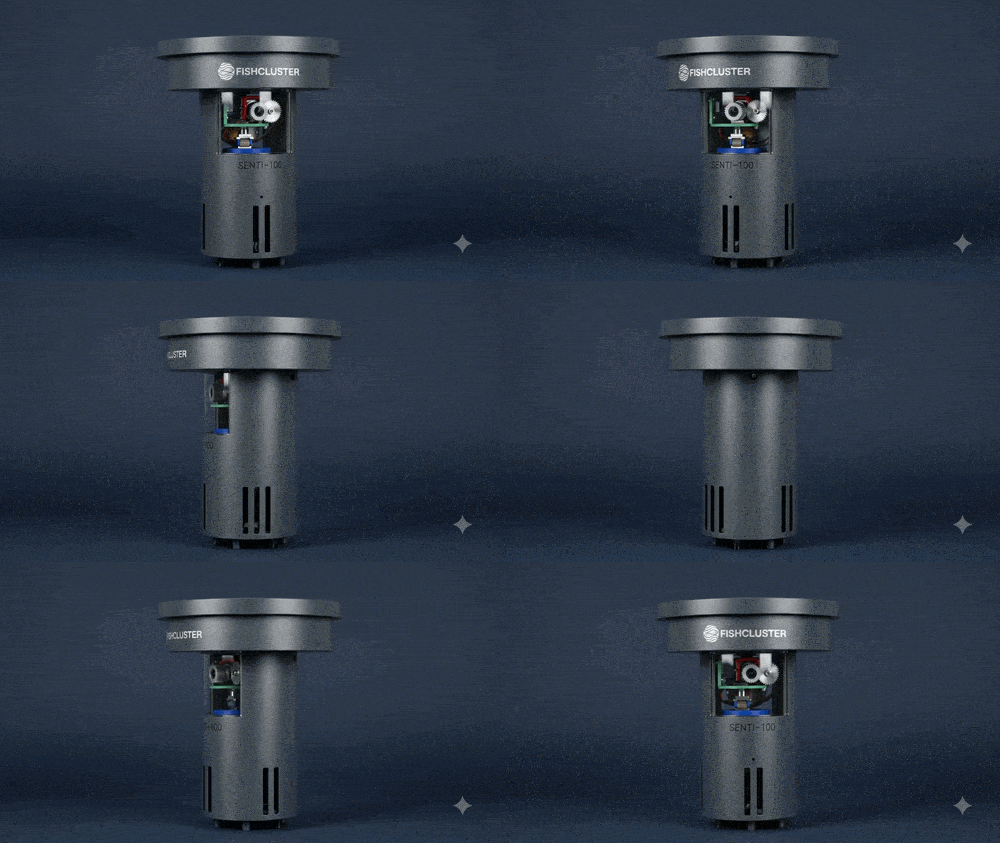
Fishcluster’s solution is three products in one, each aimed at a part of the problem.
SENTI-100 (pictured above) is an autonomous underwater robot. FORGE-200 is a feeder that holds feed in an enclosure and distributes it across the pond rather than into one corner. FOS 2.4 (Fishcluster OS) is the software deciding what the pond needs and telling the feeder what to do about it.
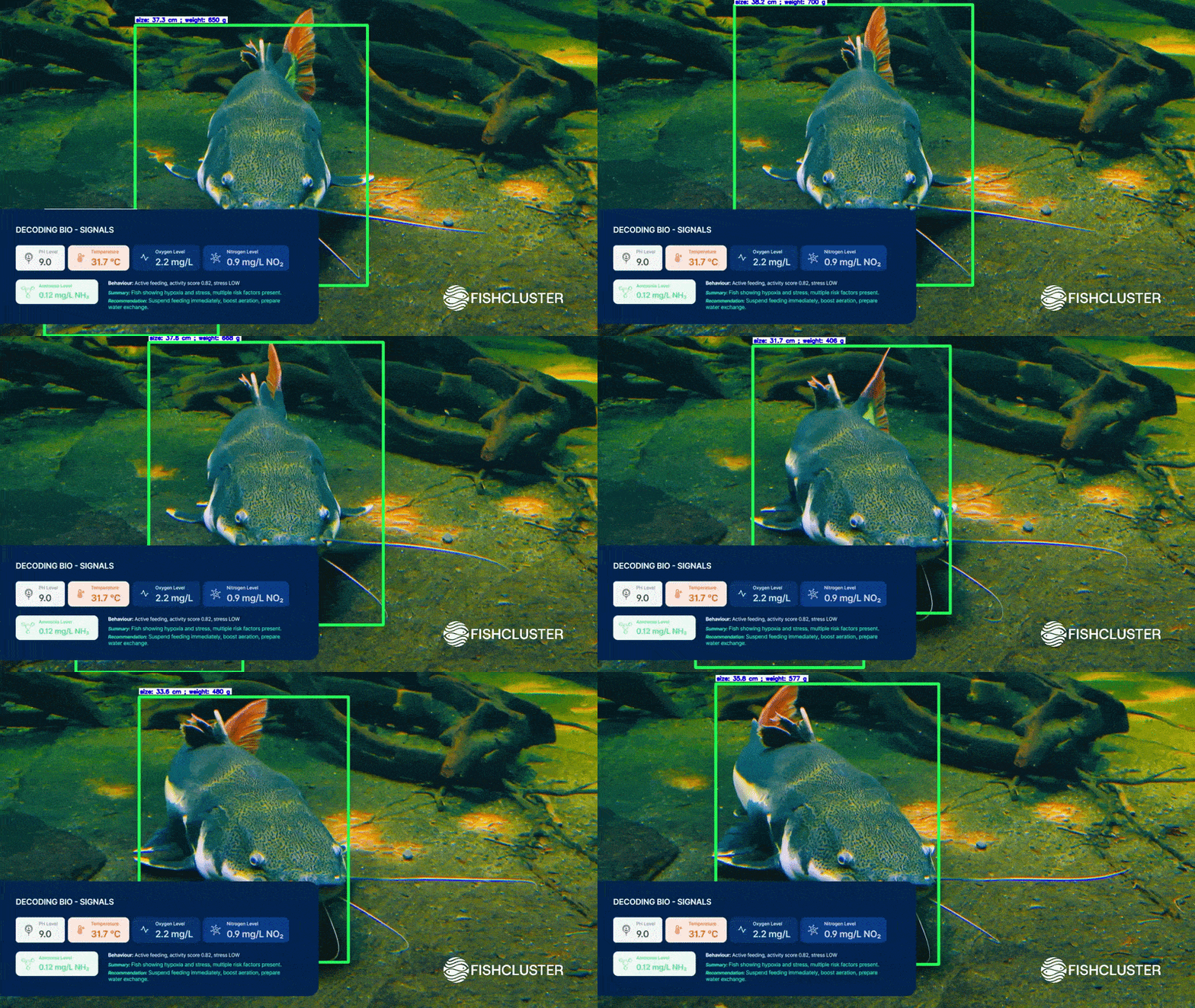
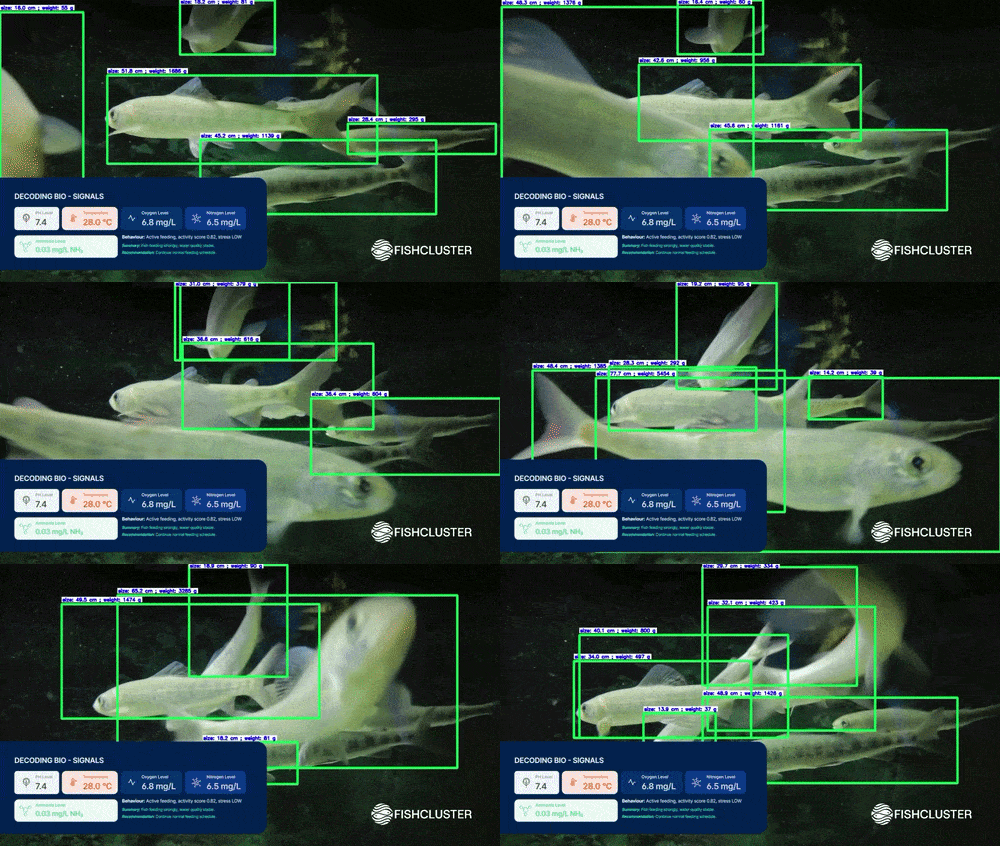
During our first call, Eze shares his screen and plays footage from inside a pond. Oxygen, pH, temperature, nitrite and ammonia update in something close to real time. The cameras are reading the fish too, size and weight and how the school is moving, and the system is tracking their behaviour.
Where the intelligence comes from
None of the components are novel. Sensors exist, feeders exist. What is new is the loop.
A sensor reporting ammonia at a given level has told you nothing by itself. Somebody has to have decided in advance that ammonia at that level, in catfish of that weight, in water at that temperature, is the point at which something has to happen. Those decision points are the actual intelligence in the system, and they did not come from the software side.
Eze recruited top researchers out of Nigerian technical universities to set them.
Between them they hold PhDs in fish nutrition, pond systems and aquaculture physiology, with fifteen to twenty years each in the field. One of them has presented at the World Aquaculture Society’s global conference. Some of them keep their own ponds.
These are not people who normally take a call from a six-month-old startup.
What that buys, in Eze’s account, is a way to blast through the fifty-pond ceiling. Empowered by the Fishcluster stack one ATE, he claims, can now oversee a thousand ponds instead of fifty, and that compounds.
I wonder out loud if the obvious cheaper fix isn’t better training for ATEs and more accurate tools in their hands. Why slap equally unreliable AI and robotics on top of the problem?
He does not accept the premise.
“Scattered tools cannot solve what is obviously an infrastructural problem,” he argues. “If they could, they would have by now.”
In his words, Fishcluster is not a replacement. It is a triage of sorts. The system flags the pond with the ammonia problem, and the ATE goes to that pond rather than walking the route and hoping to arrive at the exact time and day the problem is happening.
Who is paying for Fishcluster?
For now, large-scale fish pond operators.
According to Eze, the full Fishcluster stack sells for around ₦1.5 million ($1100) per unit and they have commitments toward a thousand of such from four three large-scale fish pond operators, some of the biggest in the country. If you do the maths, this lands them at roughly a million dollars in revenue.
“Also, a major Nigerian commercial bank has come on board as a financing partner,” he adds.
While the pilot itself starts far smaller than a thousand units, the fish pond operators are established agribusinesses that have been running for decades. They know what due diligence costs and have presumably run it. Getting them to pay upfront for unproven hardware is the opposite of how pilots usually go in this market, where a startup gives the trial away and hopes the results argue for it later.
It also helps that he has been collecting people. Four advisers now sit around the company, drawn from global agribusiness strategy, American diplomacy in Nigeria, international aquaculture supply chains and Nigerian fisheries policy.
Some questions are still open, though. But, to be fair, a pilot is what will answer them.
For one, Eze has described a system that works while somebody is watching. It does not, however, tell you what happens post-pilot, on say pond number five hundred and fifty-three, probably six months from now, when it’s raining heavily, network is bad, and nobody is watching at all
I am also curious about who absorbs the cost when a unit fails underwater. Eze admits there is no framework yet and it will be decided during and after the pilot.
Fair enough. Nobody runs a pilot because everything already works.
And, quite frankly, not many people launch a pilot with $1 million in commitment.
I also pushed on how much of his own money went into research, product and prototype development for Fishcluster. He declined to answer, pleasantly and without evasion, on the grounds that it is not the point at this stage.
“Shared vision is a way bigger superpower than just capital,” he insists.
That sounds more like a philosophy than an answer. But I’ll take it.
The whale in the room
If the name “Samuel Eze” is familiar, it is because of what came before Fishcluster.
Last August, Techpoint Africa reported on the state of things at OurPass, the B2B fintech Eze founded and ran before Fishcluster. Former employees described salaries unpaid for weeks and a workplace culture they called toxic. Co-founders left within a year of each other, and a partnership with Flutterwave, powering the company’s terminals, reportedly broke down.
I ask whether OurPass has since formally shut down and what he has to say about all the allegations. He responds that most of the issues have been resolved, and then offers what I consider a canned response.
“OurPass was one of the most meaningful experiences of my life. It served thousands of businesses and processed over $500 million. It also suffered serious operational failures with real consequences for employees and customers, and as founder and chief executive I was ultimately accountable for those. The experience changed how I think about leadership, governance and risk.”
I push further but he insists that is all he is willing to share on-record.
Why fish?
If you’re wondering why the jump from fintech to aquaculture, of all things, you’re not alone. Eze’s first answer is a childhood one. An aunt who kept poultry on one side and a fish pond on the other, both failing the way small Nigerian farms fail, quietly, from conditions nobody was tracking.
But what I consider the “real” answer takes longer to draw out, and it is connected to the ATE problem.
A pond an ATE reaches in time is a pond that starts behaving predictably. A pond that behaves predictably is one whose production you can actually see. Production you can see is risk somebody can measure. And risk somebody can measure is the point at which a lender or an insurer is finally able to move.
That last step is what Eze is building toward.
“As far as the aquaculture industry is concerned,” he says of credit infrastructure, “it does not exist.”
What interests him about a pond is not necessarily the fish. It’s the kind of operational record a bank could underwrite against. He wants a million ponds under management within five years, and he is explicit that the number matters to him more than revenue does.
Eze studied electrical and electronic engineering at the University of Ilorin, which explains the hardware more than the fish does.
The rest explains itself.
OurPass was financial infrastructure built around merchants who lacked it, and it broke on governance. Fishcluster is the same instinct pointed at ponds. Whether that reads as continuity or as repetition remains to be seen.
But what is clearly different this time is the structure. A major commercial bank, with vested interests in the aquaculture space, sits inside the money from the start. And a pilot produces real numbers whether or not a founder wants to discuss them.
Sunday* will not hear about any of this for a while. Tomorrow, he will be at the water before 5:30 a.m., with the feed bag, throwing until it looks just right.
*Sunday is a composite, drawn from how commercial catfish farmers in Ogun state, Nigeria describe their feeding routine.
Editor’s note [July 28, 2026 at 21:25 WAT]: This article has been updated to correctly indicate that three, not four, large scale operators have committed to Fishcluster.