

For every five dollars spent on online gambling in Africa, four dollars flow to unregulated operators as they occur outside local regulatory frameworks.
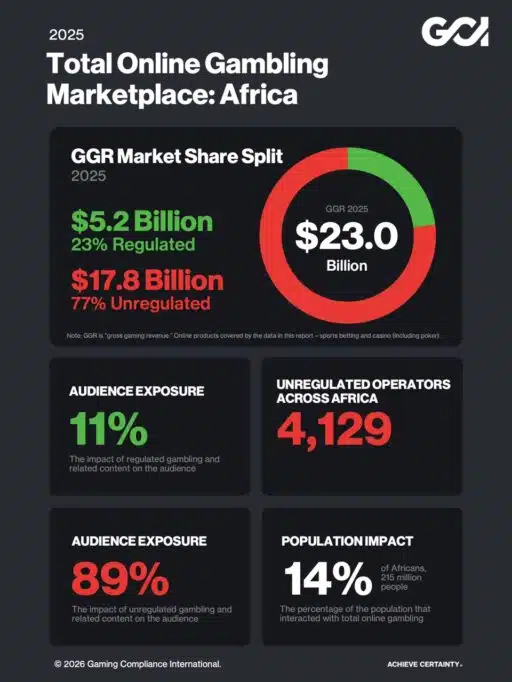
Africa’s online gambling industry generated $23 billion in Gross Gaming Revenue (GGR) in 2025, but licensed operators accounted for just $5.2 billion, or 23%, according to a new report by Gaming Compliance International (GCI).
That means 77% —roughly four out of every five dollars generated by Africa’s online gambling industry went to operators that are not licensed in the jurisdictions where they accept bets. In monetary terms, the report estimates these unregulated operators generated $17.8 billion in revenue last year.
In plain English, the vast majority of money generated by Africa’s online gambling market is flowing through operators that sit outside local regulatory frameworks.
This means governments collect less tax, regulators have less oversight of gambling activity, and consumers are less likely to benefit from safeguards such as responsible gambling measures and self-exclusion programmes. Despite the scale of the unregulated market, GCI says the data also points to encouraging progress.
“For the first time, we can see the whole of Africa’s online gambling market clearly. Nation by nation, across two full years, the picture is encouraging. The regulated sector is growing, and in several countries, it is starting to gain ground,” said Matt Holt, CEO of GCI. “That tells us these tools work. Our job is to give regulators a complete and honest view of their own market, so they can build on the progress this data now shows.”
GCI estimates that African governments lost about $3.55 billion in tax revenue in 2025 due to the dominance of unregulated operators.
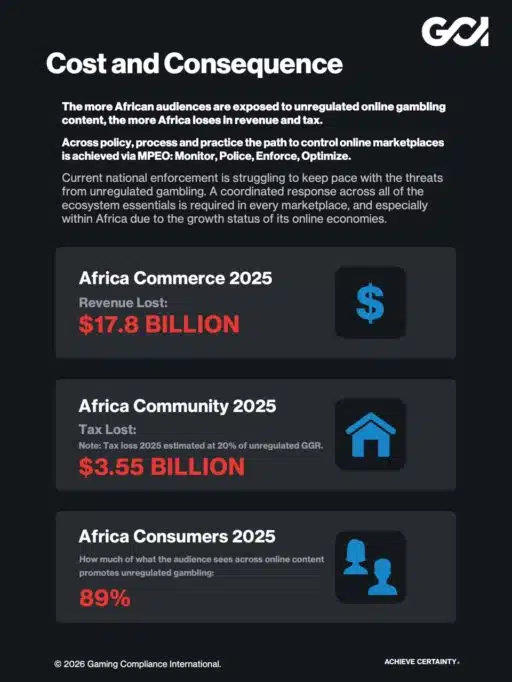
The report covers online sports betting and casino gambling, including poker, across African markets.
To estimate the market size, GCI says it combines proprietary and third-party licensed data with AI, machine learning, and expert human analysis, monitoring both regulated and unregulated gambling websites and apps to measure market activity.
GCI is a regulatory technology and consultancy firm that works with governments and regulators on gaming compliance and market oversight. The company, which acquired market intelligence firm Yield Sec in 2025, specialises in monitoring regulated and unregulated gambling activity across online markets.
Africa’s figures are broadly in line with those of some other parts of the world.
According to the report, unregulated operators account for 76% of online gambling revenue in North America, 77% in Europe, and 73% in Latin America. Asia-Pacific records the highest share at 94%, while the wider Middle East and Africa region stands at 86%. Africa’s standalone figure of 77% places it close to Europe but still highlights the dominance of unregulated operators across the continent.
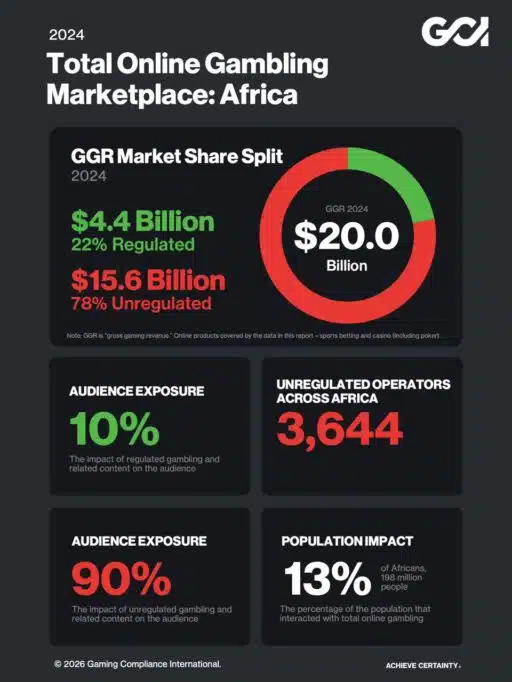
The report’s finding that 89% of audience exposure is to unregulated gambling content helps explain why market share remains so heavily skewed and why exposure is an early indicator of future marketplace outcomes.
Nigeria stands out
Despite longstanding concerns about Nigeria’s betting industry, the country recorded the lowest share of unregulated online gambling revenue among African countries covered in the report.
According to GCI, 56% of Nigeria’s online gambling revenue comes from unregulated operators, well below the African average of 77%. While more than half of the country’s online gambling market still falls outside local regulation, Nigeria performs better than several of Africa’s largest gambling markets, including Ghana (67%), South Africa (69%), and Kenya (84%).
The regional picture tells a similar story. West Africa has the continent’s strongest regulated online gambling market, with licensed operators accounting for 31% of total revenue. Southern Africa follows at 28%, while Central Africa records 22% and East Africa 15%. North Africa has the weakest-regulated market, with just 0.3% of online gambling revenue generated by licensed operators.
The report also estimates that 215 million Africans, representing 14% of the continent’s population, interacted with online gambling in 2025, up from 198 million people in 2024.
In Nigeria’s case, the increase in online gambling is driven by economic factors. The Financial Times reported last year that Nigeria’s betting boom has been driven by worsening economic conditions, youth unemployment, and the rise of betting influencers on social media, with bookmakers partnering with creators to attract users.
Since 2020, platforms like bet9ja.com and 1xbet.ng have become increasingly popular in Nigeria. For many Nigerians, it started as a way to make more money, but slowly evolved into a hobby and, for some, an addiction.
How to reduce unregulated betting
The report argues that unregulated operators enjoy structural advantages over licensed competitors.
Because they do not pay local taxes or comply with domestic regulations, they can often offer better odds, larger bonuses, more betting products, and fewer restrictions. GCI also argues that high taxes on operators or customers, expensive payment systems, and restrictive product rules can make regulated platforms less attractive, encouraging gamblers to migrate to unregulated alternatives. The report also attributed the boom in unregulated operators to tax advantages, pricing, promotions, broader product availability, payment advantages, ecosystem reach, illegal streaming, and customer acquisition advantages.
Interestingly, several African governments, including South Africa, Malawi, Zimbabwe, and Senegal, are raising gambling taxes. But then, the main thrust of regulation is not to exclusively regulate licensed operators; the goal should be to regulate the entire marketplace
Instead of focusing solely on licensing operators, the report argues that regulators should optimise the entire online gambling marketplace. It recommends an approach built around Monitor, Police, Enforce and Optimise (MPEO), alongside reforms to taxation, payment infrastructure, product availability, and enforcement to make regulated operators more competitive while maintaining consumer protections.
GCI President Ismail Vali said Africa’s online gambling industry should be viewed through the lens of its economic potential rather than its challenges. “Millions of consumers already participate in online betting and gaming, creating substantial economic activity and the potential to deliver sustainable local commerce, public revenues and safer consumer outcomes,” he said. “The challenge is not creating demand. The challenge is ensuring that demand is captured within the regulated sector.” Vali added that the success of regulation should ultimately be measured by marketplace outcomes. “The objective is not simply to regulate licensed operators. The objective is to optimise the entire online gambling marketplace so that consumers choose to enter, remain within, and benefit from the regulated sector.”
While GCI has an interest in promoting stronger regulatory frameworks, its central argument is echoed by other industry researchers. In a 2025 report, independent gambling market intelligence firm H2 Gambling Capital similarly argued that poorly designed regulations can push consumers towards offshore and unlicensed operators, reducing tax revenue and weakening consumer protections.
The GCI report advocates optimising marketplaces so the regulated sector is attractive, competitive, and delivers better outcomes, and not simply adding more regulation.
As more African governments consider increasing taxes on gambling, the debate is shifting from whether the industry should be regulated to how regulation can keep licensed operators competitive without driving users to unregulated platforms.
Read the full report here.