




Nigerian businesses are not short on enthusiasm for AI. According to a 2025 survey by Google and Ipsos, 88% of Nigerian adults used an AI chatbot, an 18-point jump from the previous year and well above the global average of 62%. The country’s AI market, meanwhile, is projected to grow from $1.40 billion in 2025 to $4.64 billion by 2030, at a compound annual growth rate of 27.08%. By any measure, the experimentation phase is well underway.
But experimentation and operational advantage are entirely different things. Most Nigerian companies have adopted AI in the same way they might trial a new piece of office equipment: useful in isolation but disconnected from the deeper systems that actually run the business. In 2026, the organisations that pull ahead will be those that move beyond the pilot phase and begin rebuilding their operations around AI in ways that reflect the specific realities of doing business in Nigeria. That requires four strategic shifts.
From AI assistants to AI that runs workflows
The dominant mode of AI use in most businesses today is consultative. This creates incremental value but rarely transforms how work gets done. The real productivity opportunity lies in agentic AI: systems that can plan, act, and execute multi-step tasks autonomously without waiting to be prompted at every stage.
According to a 2025 report from MIT Sloan Management Review and Boston Consulting Group, 35% of organisations surveyed had already adopted AI agents, with a further 44% planning to deploy the technology imminently. Similarly, Gartner predicts that 15% of day-to-day work decisions will be made autonomously through agentic AI by 2028, up from effectively zero in 2024.
The real productivity opportunity lies in agentic AI; systems that can plan, act, and execute multi-step tasks autonomously without waiting to be prompted at every stage. While global interest is high, Nigerian businesses are already moving aggressively in this direction. According to a 2025 Zoho Nigeria survey, 93% of Nigerian organisations have already begun adopting AI, with nearly one-third reporting advanced integration across their operations.
Breaking the app sprawl cycle
A second structural challenge is one that many Nigerian SMEs will recognise immediately: the accumulation of disconnected tools. A typical business might manage its finances on one platform, its customer relationships on another, its HR processes on a third, and its marketing on a fourth. Each tool was adopted for good reason, but together they create data silos that make it nearly impossible to get a coherent view of the business, let alone deploy meaningful automation across it.
This fragmentation is not a minor inconvenience. AI systems depend on clean, unified data to deliver useful outputs. When customer records live in one system, transaction data in another, and operational logs in a third, there is no foundation on which to build automation or business intelligence.
The solution is not to adopt yet another tool, but to consolidate around integrated platforms that unify data and processes. Businesses that prioritise this consolidation will find AI much easier to deploy and far more useful once it is in place.
Prioritising technology built for local realities
Much of the AI technology available to Nigerian businesses has been designed for markets with reliable broadband, stable electricity supply, and relatively homogeneous user bases. Nigeria presents a very different operating environment.

Victoria Fakiya – Senior Writer
Techpoint Digest
Stop struggling to find your tech career path
Discover in-demand tech skills and build a standout portfolio in this FREE 5-day email course
Internet affordability remains a material constraint. In 2024, the median price of an entry-level mobile broadband plan in Africa represented 4.2% of gross national income per capita, more than double the UN Broadband Commission’s affordability target of 2%. Nigeria’s broadband penetration, while improving, stood at just 50.58% by November 2025, well short of the government’s own 70% target. Meanwhile, major telecoms providers raised data prices sharply in 2025, with MTN Nigeria increasing the price of its 15GB plan by 200%, and connectivity infrastructure continues to face challenges, including fibre vandalism and high right-of-way fees.
Against this backdrop, AI tools that assume always-on connectivity or require constant large data transfers will simply fail many Nigerian users. Businesses should instead prioritise solutions built with offline capabilities, data efficiency, local-language support, and flexible deployment in mind. The Nigeria Artificial Intelligence Landscape Report 2025 specifically highlights the need for AI models that understand local context and languages as a key challenge for the country’s AI ecosystem. Technology chosen without these considerations will deliver far less value than its prospectus suggests.
Using AI to navigate economic volatility
Perhaps the most compelling opportunity for AI in the Nigerian business context is one that directly addresses the country’s macroeconomic environment. Nigerian businesses do not operate in a stable, predictable economy.
Inflation remained above 30% throughout 2024, reaching a 28-year high of 34.8% in December, and the naira lost more than 40% of its value against the dollar during the same period. A 2025 survey by Intelpoint found that nearly half of Nigerian businesses identified inflation as their greatest economic challenge, with a further 17% citing foreign exchange volatility as their primary concern.
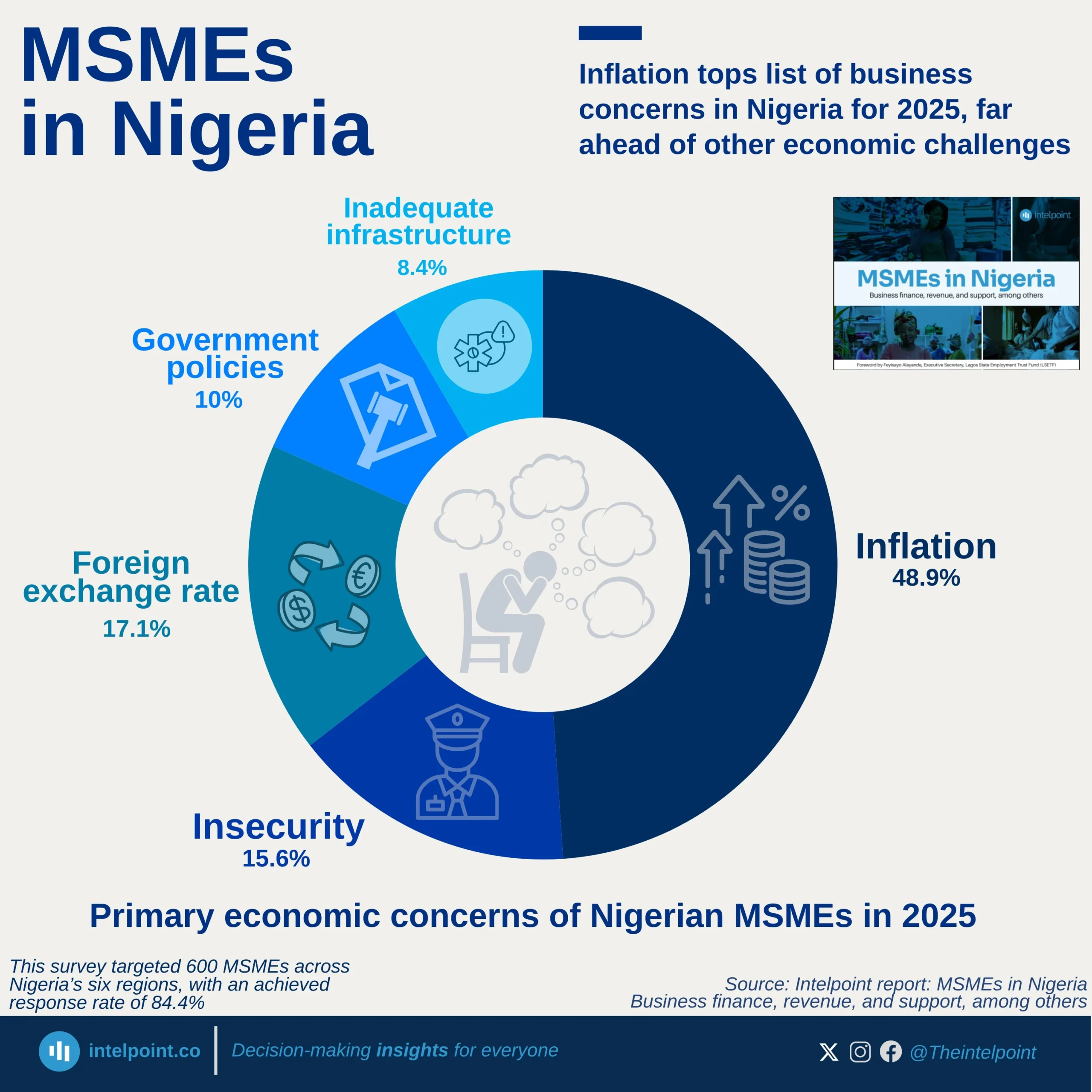
These pressures do not disappear simply because a business adopts AI. However, AI does give businesses better tools to navigate them. Dynamic pricing models can adjust in real time to changing input costs. Forecasting systems can anticipate demand shifts with greater accuracy than manual planning allows. Cost optimisation tools can surface inefficiencies that would otherwise go unnoticed under the pressure of day-to-day operations.
For businesses managing the uncertainty described above, the ability to respond more quickly and more precisely to economic signals is a genuine competitive advantage.
The real opportunity ahead
The next stage of digital transformation for Nigerian businesses will not be about adopting more technology. It will be about adopting the right kind of technology and deploying it in ways that address the specific challenges of operating in this market.
The organisations that invest in unified systems, that move AI from the assistant layer into the operational layer, and that choose tools built for the realities of Nigerian infrastructure and economics, will be better placed to scale efficiently and compete effectively in the years ahead. The experimentation phase has served its purpose.
About the Author
Kehinde Ogundare heads Zoho’s business development and expansion in West Africa. He specialises in understanding each business’s unique needs and guiding them through their digital evolution, leveraging his skills and experience to drive their success.