


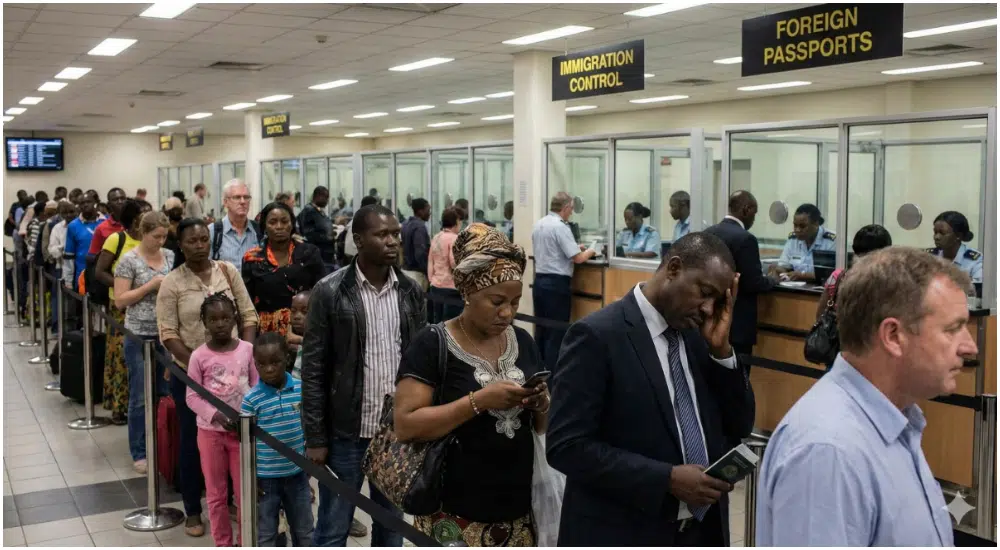


A few weeks ago, I spent nearly twenty-four hours travelling from Kigali to Casablanca. Two major African cities. One African passport. And yet, the most efficient route required a detour through Europe. This was not an airline glitch. It was a reflection of how far Africa still is from the integrated continent we like to imagine in speeches and strategy documents.
It remains easier for an African to move through Paris or Istanbul than through parts of East, West, or Southern Africa. That reality should concern us. It should prompt an honest reckoning with the real barriers to African integration, which come from policy choices, political mistrust, and a reluctance to build the systems that enable Africans to move freely.
Visa policy is the first barrier we pretend not to see
Two-thirds of African countries still require visas from fellow Africans, rooted in the assumption that greater mobility weakens security. But the evidence shows the opposite: predictable, regulated movement makes borders stronger, not weaker, and economies more competitive, not more vulnerable.
There is also a more practical and uncomfortable truth behind African visa policy. Many African governments treat visa fees as a dependable source of revenue. For some states, visa income provides a steady flow of foreign exchange. It feels like low-hanging financial fruit.
But this approach destroys far more value than it captures. A fifty- or hundred-dollar visa fee may appear to be revenue on paper, but it comes at the cost of thousands of dollars in tourism, business travel, conferences, professional exchanges, and cross-border investment that never materialise. The price of entry becomes the cost of lost opportunity.
Countries that have liberalised their visa regimes for African nationals are already seeing tangible results. In Rwanda, the total number of international visits increased from approximately 600,000 in 2010 to an estimated 1.36 million in 2024.
Available industry estimates indicate that around 52 per cent of these visitors, or about 774,000 people, came from within Africa, showing how intra-African mobility has strengthened alongside overall demand.
https://www.afdb.org/en/news-and-events/press-releases/africa-visa-openness-index-2023-progress-visa-openness-africa-ease-cross-border-travel-boost-trade-investment-and-regional-integration-66992Rwanda’s decision to simplify entry for African travellers has contributed to this growth, and Kigali’s hospitality sector has expanded accordingly, with more high-quality hotel rooms and conference venues being built to meet the rising regional demand.
The economic benefits are clear. The opportunity cost of restrictive visas is even clearer. Short-term visa income blocks long-term economic activity. It is the equivalent of choosing a one-time fee over a compounding return.
The African Union passport: A strong idea that never became a system
In 2016, when the African Union introduced the African Union Passport, I remember feeling a genuine sense of excitement. For the first time, it seemed possible that an African passport could carry the same international weight and confidence as a European Union passport.
I imagined a future where young Africans could move freely to study, build companies, attend conferences, or simply explore their own continent as tourists without triggering suspicion or endless paperwork. There was a moment when it felt like Africa was finally ready to unlock itself.
But the excitement did not last. The AU passport never made the leap from symbolism to reality. Member states admired it in principle but refused to adopt it in practice. It was issued to presidents, diplomats, and a select circle of officials, while ordinary Africans continued to navigate borders as if nothing had changed.
The African Union passport was never weak in concept, but the system to bring it to life simply didn’t exist. No country updated its immigration laws, no shared security systems or databases were built, and the biometric and legal infrastructure needed for free movement never materialised. The political trust required to turn the passport into a functioning system was absent. Without these foundations, the document remained largely symbolic.
Its failure reflects broader challenges across the continent: ambitious visions launched on fragile institutional foundations, integration efforts pursued without the structural capacity to sustain them, and political will that fades when long-term, collective solutions are needed. Africa tried to claim the benefits of a Schengen-style system without building its foundations, and without harmonised laws or shared sovereignty, a diplomatic passport alone cannot transform movement, reshape opportunity, or drive the integrated future so many hoped for.
Closed skies create closed markets
Aviation is where integration either succeeds or collapses. The Single African Air Transport Market was established to make intra-African travel affordable and frequent; however, implementation has been slow due to many governments continuing to protect their national carriers. Even when those carriers are financially distressed or no longer competitive, they are treated as strategic assets that must be shielded from competition.
This protectionism has predictable effects. Intra-African flights remain expensive and infrequent. Many routes between African regions still require transit through Europe or the Gulf. The continent relies on foreign carriers to connect its own cities.
The effects are most clearly seen in flight prices. Intra-African travel is often more expensive than flying to Europe. A one-way ticket from Lagos to Dakar can cost between $650 and $900, while Lagos to London is often under $600 and direct. Nairobi to Accra can cost close to $1,000 and take a full day with connections, yet Nairobi to Paris is frequently cheaper and faster. Kigali to Dakar can cost more than $1,000 and require long layovers in Doha or Addis Ababa, while Kigali to Brussels is often half the price.
These differences shape mobility choices, talent flows, investment patterns, and where African entrepreneurs meet, build, and collaborate. If Africa wants an integrated economy, it must open its skies. This is not an unattainable reform. It is one of the clearest and most immediate levers available to reduce travel costs, expand direct routes, and enable Africa’s people and ideas to move with ease.
The impact on Africa’s tech ecosystem
These barriers are not just bureaucratic. They shape the future of Africa’s most dynamic industries, especially technology. Tech ecosystems depend on movement: the circulation of talent, the exchange of ideas, and the ability to scale across borders. In Europe, this mobility is built into the system.
The EU hosts over 38,000 tech conferences and events annually, fostering a continuous flow of interaction that promotes collaboration and accelerates learning. Africa, by comparison, hosts fewer than 2,000 tech events annually across the entire continent, many concentrated in Lagos, Nairobi, Cape Town, and Kigali. And because travel within Africa remains difficult and unpredictable, even these events often struggle to attract the regional participation they deserve.
The practical challenges are stark. It is often faster, and sometimes cheaper, for members of Africa’s tech ecosystem to meet in Lisbon or Paris than in another African capital.
A Kenyan founder can reach London more easily than Accra. A Nigerian investor may find a ticket to Paris more reliable than a ticket to Dakar. Many West Africans still route through Europe to reach East Africa, not out of preference but because intra-African flights remain both infrequent and costly enough to make Europe the more accessible meeting point.
This dynamic distorts Africa’s tech map. Thousands of African founders attend European events every year simply because Europe is easier to access than neighbouring African regions. Meanwhile, major continental gatherings like GITEX Africa or Africa Tech Festival draw strong interest but still fall short of their potential because too many African innovators cannot move freely within Africa.
The result is a fragmented talent network at a time when the continent is producing the largest generation of innovators in its history. Lagos, Nairobi, Cape Town, Accra, Cairo, and Kigali are powerful hubs, but they remain disconnected rather than forming a unified ecosystem. No single African city can reach global scale alone. The real opportunity lies in connecting them into a continental market where founders, engineers, and investors can circulate with the same ease Europeans enjoy within the EU.
Until mobility improves, Africa’s tech sector will continue to grow in fragments rather than as the integrated force it has the potential to become.
The steps forward are not mysterious
Africans already know what must be done.
- Make Africa visa-free for Africans, through universal visa-free or visa-on-arrival access.
- Implement SAATM in full, so African carriers can fly freely across the continent without political obstruction.
- Harmonise immigration, customs and digital identity systems, including AU-wide e-gates at our international airports that let Africans move across the continent with Schengen-level ease.
- Create interoperable data and digital-trade rules, so tech firms can scale across markets without duplicating compliance.
- Invest in aviation infrastructure that supports these reforms rather than undermining them.
These practical solutions would unlock more economic value than any new summit, communiqué or strategy document. Mobility is not a soft, aspirational idea. It is hard infrastructure.
The continent we want requires free movement
As long as Africans must route through Europe to travel between major African cities, integration will remain a slogan rather than a strategy. As long as founders, engineers, and investors struggle to move across borders, Africa will not build the competitive, innovation-driven economy it talks about.
This is a choice, not a destiny.
An Africa that moves is an Africa that grows.
An Africa that connects is an Africa that competes.
It is time to stop performing integration in speeches and start delivering it at the border, at the airport gate, and in the systems that decide whether African talent can move freely in Africa.
About the author
Toni Campbell is the Founder and Managing Partner at Kinfolk Venture Capital. The firm has previously invested in African startups such as Norebase, Bento, and Yassir.