
Loudinsight is a hiring intelligence platform built to solve one of the most persistent mismatches in the modern workforce — African professionals who are ready to compete globally, and employers around the world who haven’t found a reliable way to reach them.
The problem nobody was talking about honestly
Anyone who has looked for a job in Nigeria knows the feeling. You find a role that seems right, you apply, and then — nothing. No response, no feedback, no signal of any kind. You don’t know if your application was read, if you were underqualified, or if the position was already filled before it was ever posted.
Employers have the same problem from the other side. A role goes up and hundreds of applications come in, most of them irrelevant. Sifting through them takes time that growing teams rarely have, and by the time a shortlist is ready, the best candidates have already moved on.
But zoom out, and the problem gets more interesting — and more urgent. Africa produces some of the most skilled, adaptable professionals in the world. Yet the infrastructure to connect those professionals to the right opportunities, whether those opportunities are in Lagos, London, or Los Angeles, has never properly existed. Most platforms that came before weren’t really trying to solve that. They were job boards — directories, essentially — optimised for volume over match quality, and almost always pointed inward rather than outward.
The African job market isn’t broken because of a shortage of talent. It’s broken because of a signal problem. And fixing that signal problem, at a global scale, was what eventually became Loudinsight.
Built from scratch
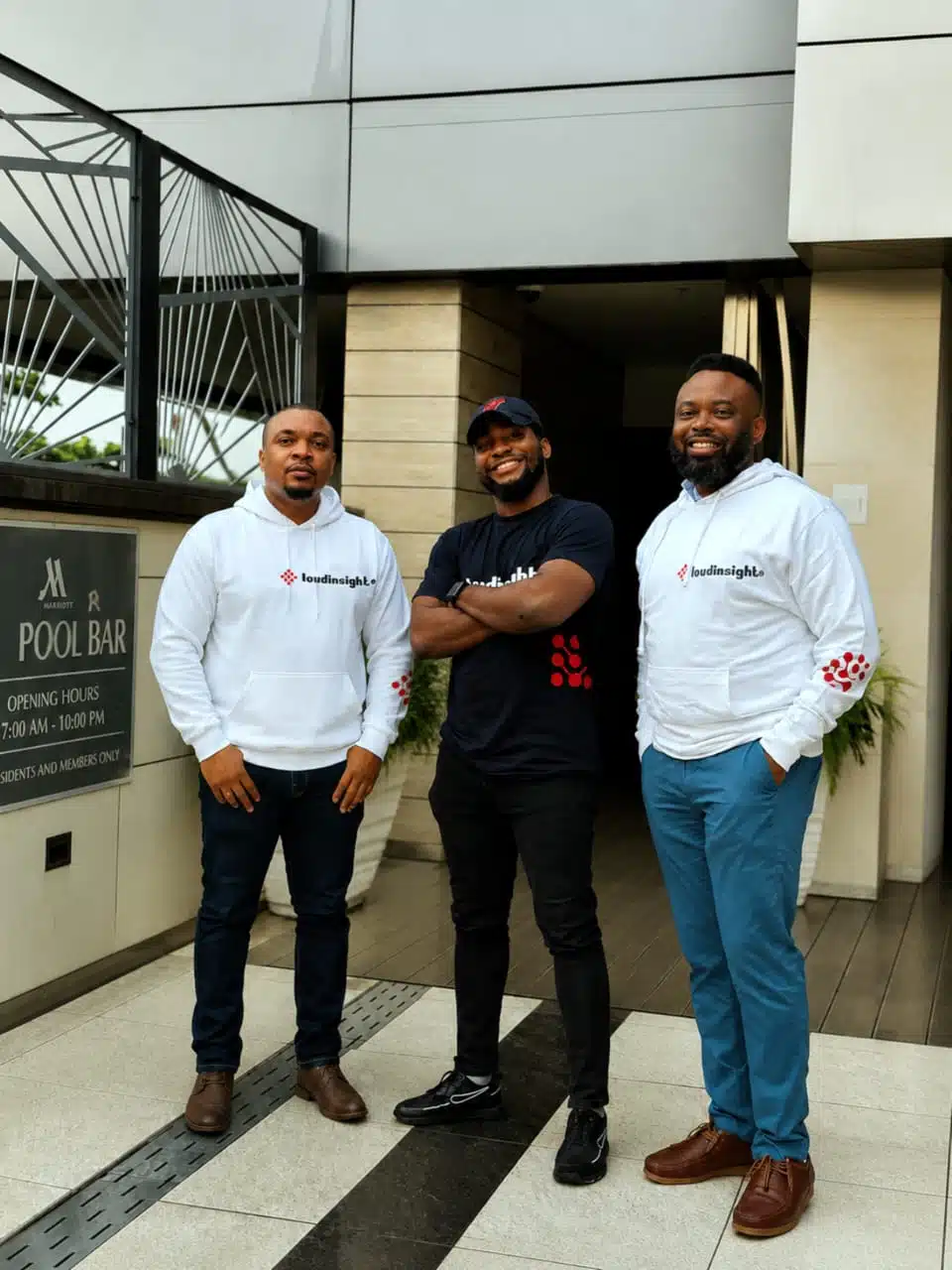
Development began in 2023 when co-founders Paul Eisiri, Kelechi Okpara, and Albert Nwachukwu asked a straightforward question: what would it actually take to make both sides of a hiring conversation feel less like guesswork?
Loudinsight was built from the ground up — every line of architecture, every product decision, every infrastructure choice shaped by someone who had lived the problem firsthand. There was no team yet, no funding, no guarantee it would work. Just a clear enough sense of the problem to start building toward a solution.
The answer wasn’t another job listing site. It was a matching layer — a system that helped job seekers understand where they genuinely stood relative to a role before applying, and helped employers evaluate candidates against the actual requirements of the position rather than just a CV sitting in an inbox.
Getting that right technically is harder than it sounds. The data you need to make a useful match is messy on both sides. Job descriptions are inconsistently written. Candidate profiles vary wildly in how they represent experience. Building something that could make sense of that at scale, without just defaulting to keyword matching, took time and iteration.
The platform was kept deliberately tight in the early months — better to do one thing well than to ship something bloated that didn’t actually move the needle for either side.
Scaling the team to match the ambition
Once the foundation was solid and early traction was clear, the decision was made to bring in a dedicated leadership team — not to maintain what had been built, but to accelerate it. Scaling a platform with global ambitions requires a different kind of organisation than the one that gets it off the ground. Bringing in the right people at the right moment was a deliberate call, not a reluctant one.
Transitions like that carry real risk. There’s institutional knowledge everywhere — in the architecture decisions, in the edge cases quietly handled, in the product instincts that came from watching early users up close. Making sure the incoming team could carry all of that forward, and build on it rather than just preserve it, took deliberate effort.
It worked. The platform didn’t just survive the transition. It grew.
What 30,000 users taught the team
Loudinsight crossed 30,000 registered users with 3,000 daily active users — a DAU ratio that suggests people are actually coming back rather than signing up and forgetting the platform exists.
That number came without a press cycle. No funding announcement, no viral moment, no paid acquisition campaign at scale. Growth was driven by the product working well enough that people told other people about it.
What that user base confirmed was something the team suspected early: the frustration on both sides of hiring is not uniquely Nigerian. It is not even uniquely African. A fresh graduate in Accra trying to break into their first role, a mid-career engineer in Nairobi ready for their next challenge, and a hiring manager at a company in Amsterdam or Toronto looking for strong remote talent are all dealing with different versions of the same problem — too much noise, not enough signal. Loudinsight sits at the intersection of all of them.
The future of work is already here — and Africa is part of it
The global shift toward remote work and distributed teams has fundamentally changed what’s possible. Employers in the Western world are no longer constrained to local talent pools. The best person for a role might be in Lagos or Nairobi or Kampala, and increasingly, forward-thinking companies know it.
At the same time, the gig economy and the rise of project-based, flexible work arrangements mean that the definition of “getting hired” is expanding. It is no longer just about full-time employment. It is about access — to projects, to contracts, to collaborations that can be the beginning of a career trajectory that crosses borders.
Loudinsight is building for that world. A world where African professionals don’t have to relocate to compete, where their skills are legible to global employers, and where the signal problem that has kept two sides apart is finally being solved. Unemployment and underemployment across the continent are structural challenges that no single government or policy will reverse quickly. But platforms that open a direct line between African talent and global demand can move faster than policy ever could.
Where Loudinsight is going
The platform is actively growing its commercial function, with the team now hiring for a Sales and Growth Lead to accelerate what organic traction has already started. The longer vision is clear: make access to global opportunity feel less like a lottery for African professionals. That means better tools for international employers to identify fit faster across borders, and better transparency for candidates about where they stand and why. It means reducing the silence that currently defines the experience for most job seekers after they hit send — whether the role they are applying to is down the road or across the world.
Africa produces some of the most skilled professionals on the planet. The infrastructure to connect those people to the right opportunities — efficiently, honestly, without the guesswork — is still being built. That is the work Loudinsight is doing.