

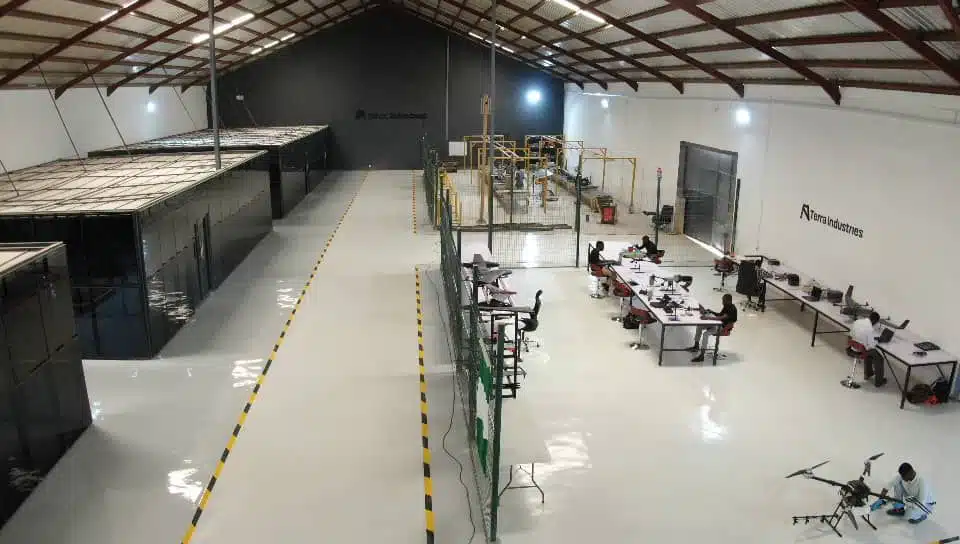


Nigerian defence technology startup Terra Industries is building what will be the largest drone manufacturing facility on the African continent — a 34,000-square-foot factory in Accra, Ghana, the company announced today.
The facility, named Pax-2, will serve as Terra’s primary regional manufacturing base for drone and counter-drone systems. Construction is in its final phase, with full operations expected by the end of June 2026.
Once operational, the factory is projected to reach an annual production capacity of 50,000 units across Terra’s aerial systems portfolio by 2028 and to create 120 engineering jobs in Ghana.
Pax-2 is more than twice the size of Terra’s existing 15,000 sq. ft. Pax-1 facility in Abuja, Nigeria, making it the company’s largest plant to date. The announcement follows Terra’s $34 million fundraise, comprising an $11.75 million round in January 2026 led by 8VC, the firm founded by Palantir co-founder Joe Lonsdale, and a subsequent $22 million raise led by Lux Capital, which the company said would go toward scaling manufacturing capacity and growing its engineering teams across Nigeria and allied African countries.
The Ghana factory will produce several of Terra’s key products, including the Archer VTOL, a long-range surveillance and strike platform; the Iroko UAV, designed for rapid tactical deployment; and Kama, the company’s newest addition. Kama is a high-speed interceptor drone capable of reaching 300 kilometres per hour, built specifically for counter-drone defence and engineered for high-volume production.
Africa needs to stop relying on foreign defence architecture
The timing of the expansion reflects the changing security landscape across the continent. Across the Sahel and sub-Saharan Africa, non-state actors are increasingly deploying modified commercial and fibre-optic drones as attack systems, a tactic that has become prevalent in conflicts in the Middle East and Eastern Europe.
Terra’s bet is that this shift will sharply accelerate demand for integrated defence systems that combine surveillance, electronic warfare, and the kinetic interception capability that Kama is built for.
“The only way Africa can have lasting peace is by uniting to build sovereign defence, not by
relying on foreign security architecture,” Nathan Nwachuku, co-founder and CEO of Terra Industries, said. “We need to control our own destiny by building the tools and systems needed to protect ourselves. That’s how this continent defeats terrorism.”
Nwachukwu also explained that Ghana was the right choice for this expansion for obvious reasons.
“We chose Ghana for Pax-2 because of its talent, strategic position, and political will to become a serious defence exporter and prove that this can be done at scale.”
The Ghana factory is the latest in a string of moves that have rapidly elevated Terra’s profile. In February, Nigeria’s Defence Industries Corporation of Nigeria (DICON) and Terra signed a joint-venture agreement aimed at strengthening local defence production, covering manufacturing, technology transfer, and supply chain integration.
Terra, formerly Terrahaptix, was founded in 2024 by Nwachuku and Maxwell Maduka. The company describes the Pax Factories network as central to its vision of “Pax Africana,” a future in which Africa builds, deploys, and controls its own defence technology.
Whether that vision holds up under the pressures of geopolitics, production scale, and regulatory complexity across multiple jurisdictions will be the real test. But with $34 million raised, a government partnership in Nigeria, and now a regional manufacturing base in Ghana, Terra is making the most credible case yet that Africa’s defence industrial future doesn’t have to be imported.