

Сайн уу,
Victoria from Techpoint here,
Here’s what I’ve got for you today:
- Copia’s insolvency case heads to Kenya’s High Court
- Please Call Me Makate sues his own backers
- Safaricom just had its biggest year in years, and Kenya powered it
Copia’s insolvency case heads to Kenya’s High Court

Copia Kenya is heading back to court, and this time, the conversation is no longer about turnaround plans. It’s about what’s left. A gazette notice published on May 6 confirmed that the same KPMG administrators brought in to rescue the company in 2024, Anthony Makenzi Muthusi and Julius Ngonga, are now the petitioners in a formal insolvency case before Kenya’s High Court. The hearing is set for May 11, and creditors have officially been invited to show up and either support or oppose the petition. In practical terms, this is the moment Copia’s long restructuring saga enters its final legal phase.
That shift matters because administration was supposed to buy the company time — time to stabilise operations, raise fresh capital, or find a buyer. None of that appears to have happened. Nearly two years after taking over, the administrators themselves are now asking the court to intervene. That’s a strong signal that the rescue effort has effectively run out of road. Even internally, the writing had been on the wall for a while. Back in mid-2024, staff were already being told that attempts to keep the business running had “not been successful” and that liquidation was becoming the most likely outcome.
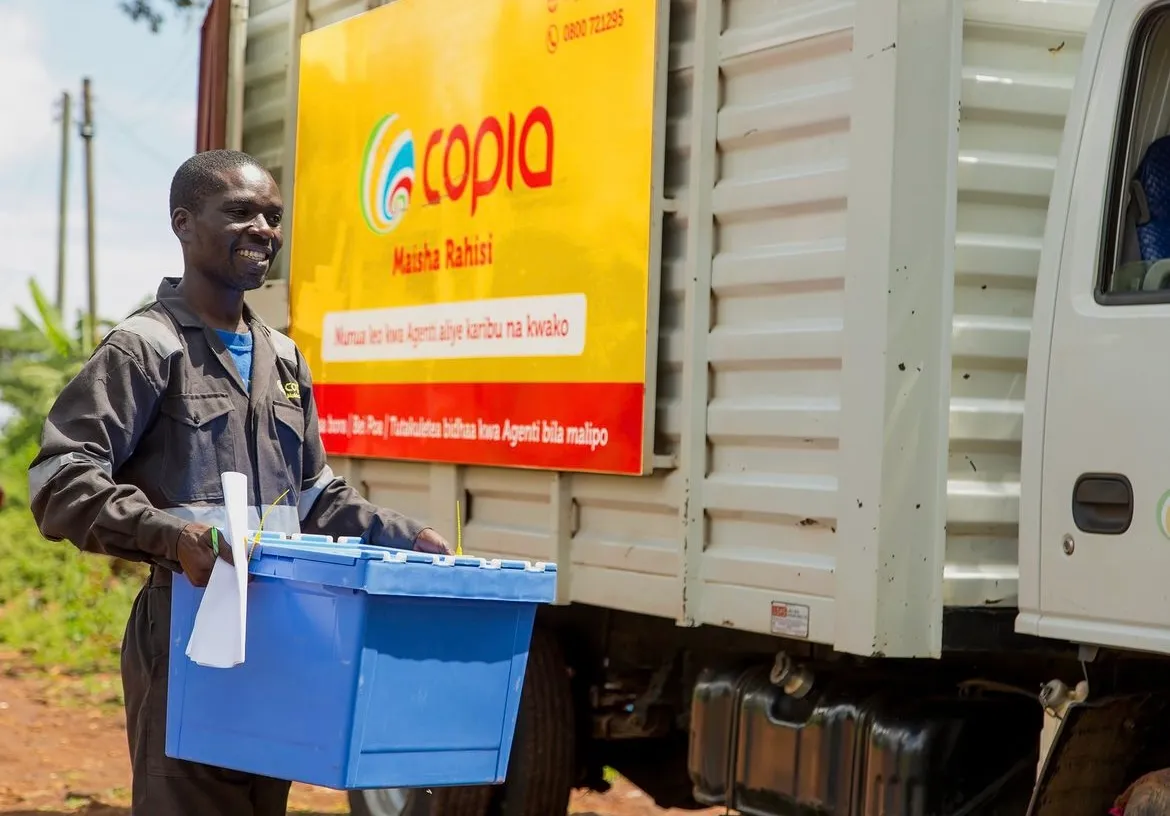
What makes Copia’s collapse so striking is that the business itself wasn’t fictional. This wasn’t a startup with no customers or no demand. Copia built a real logistics and distribution network serving hundreds of thousands of rural and peri-urban households in Kenya and Uganda. Through a network of agents, it delivered basics like sugar, cooking oil, soap, and household goods to consumers largely ignored by mainstream retail and e-commerce players. At its peak, the company had around 1,800 employees and a 50,000-agent network. The infrastructure worked. The economics were just brutally difficult.
And that’s really the lesson sitting underneath this entire story. Rural eCommerce in Africa requires huge upfront investment, long timelines, and enormous operational patience. Copia raised more than $120 million from impact investors and development finance institutions over the years, but even that proved insufficient for the scale and time horizon the business needed. As one investor put it, the model likely needed 10 to 12 years of patient capital before profitability became realistic. Venture capital, especially after the funding slowdown of 2022 and 2023, simply stopped tolerating that kind of timeline.
Copia’s downfall now sits alongside a growing list of African commerce and logistics startups that expanded aggressively before the market — or investors — were ready to sustain them. Sendy entered administration. Twiga and Wasoko pulled back expansion plans. Across the sector, the pattern has looked similar: high delivery costs, thin margins, weaker consumer spending, and investors demanding profitability faster than infrastructure-heavy businesses could realistically deliver it. Copia may end up being remembered less as a failed startup and more as one of the clearest examples of the financing mismatch at the heart of African eCommerce.
Safaricom just had its biggest year in years, and Kenya powered it

Safaricom just had one of its strongest years in recent memory, and Kenya carried most of the weight. For the financial year ending March 2026, the company pulled in nearly $3.2 billion in service revenue, while Group net income hit $775 million. Kenya alone generated about $3.1 billion in service revenue, with EBIT climbing 15.3% to $1.41 billion. The performance was strong enough for the board to approve a 66.7% jump in dividends to KSh 2 per share, signalling growing confidence that the worst of the Ethiopia drag may finally be easing.
At the centre of the story is M-Pesa, which keeps looking less like a telecom add-on and more like a financial giant in its own right. The platform now has 41 million active customers and generated $1.41 billion in annual revenue, a number big enough to rival entire mid-sized African telecom operators. Across Kenya and Ethiopia, Safaricom’s total customer base reached 71.6 million, reinforcing the company’s position as one of the continent’s most important digital infrastructure businesses.
But the real story investors are watching is Ethiopia. Safaricom’s Ethiopian operation is still losing money, but the losses are shrinking fast. For context, the company reduced its losses by 52.83% in the six months to September 2025, with losses declining to KSh13.3 billion ($103 million) in the first half of the 2025/26 financial year, down from KSh28.2 billion ($218.6 million) in the same period a year earlier. The Ethiopian operation recorded narrowing start-up losses relative to the prior period, supported by 3,504 network sites — up from 3,141 a year prior — and CFO Dilip Pal said Ethiopia’s performance “greatly boosted Group performance” precisely because the losses are now shrinking fast enough to stop cancelling out Kenya’s wins.
In other words, the business cut losses by more than half in the first half of FY2026, helped by rapid network expansion and subscriber growth that pushed its customer base to 13.6 million. The network now covers around 60% of Ethiopia. Safaricom has pushed its Ethiopia break-even target back by a year to March 2027, but these latest results make that timeline look far more realistic than it did a year ago.
That matters because Ethiopia has been an expensive and painful market to enter. Safaricom paid $850 million for a telecom licence in 2021, ending Ethio Telecom’s century-long monopoly and making one of the biggest expansion bets in African tech history. Then the macroeconomic shock hit. Ethiopia’s currency liberalisation triggered a collapse in the birr, while most of Safaricom Ethiopia’s costs remained dollar-denominated. The result was brutal pressure on margins and a reported $325 million loss in 2024. Safaricom responded with aggressive price increases and a broader push to stabilise unit economics.
Now the picture is starting to change. Kenya remains the profit engine, M-Pesa continues compounding, and Ethiopia is slowly shifting from a financial drag into a plausible long-term growth story. Competition in Ethiopia is still intense, with allegations of predatory pricing and platform blocking involving Ethio Telecom, but Safaricom’s management increasingly sounds like a company that believes the hardest part of the expansion is over. With Vodacom also exploring deeper consolidation with Safaricom, the company’s FY2026 results feel less like a recovery year and more like the beginning of its next phase.
Please Call Me Makate Makate sues his own backers

Just when South Africa thought the Please Call Me saga was finally over, Nkosana Makate is back in court. This time, fighting the people who helped fund his original battle against Vodacom. After settling his 18-year dispute with Vodacom in late 2025 for an undisclosed amount believed to be worth hundreds of millions of rand, Makate has now launched legal action against Black Rock Mining, the offshore company that financed parts of his legal fight in exchange for a promised 40% share of any payout.
Instead of defending against Black Rock’s claim, Makate is going on the attack, asking the court to rule that the funding agreement is effectively dead and unenforceable.
The stakes are enormous. Depending on how much Makate actually received from Vodacom, Black Rock’s 40% cut could be worth anywhere between roughly R141 million and R299 million. And that’s after reportedly investing only about R4.3 million over the years to help fund the litigation. Makate’s position is that the deal was cancelled back in January 2015 after the relationship collapsed, and that later changes involving another entity called Raining Men Trade involved forged signatures and invalid paperwork. Black Rock’s argument is much simpler: they funded the case when nobody else would, Makate won, and now he’s trying to avoid paying.
What makes this fight bigger than just one payout is the precedent it could set for litigation funding in South Africa. Third-party funders are becoming increasingly common in long commercial cases, especially where lawsuits drag on for years and cost millions to run. If Makate succeeds in killing the agreement, future litigants could have more room to challenge or escape funding contracts after relationships sour. If Black Rock wins, it strengthens the idea that these agreements remain enforceable even years later and even after disputes between the parties explode publicly.
The roots of this entire story go all the way back to November 2000, when Makate — then a young Vodacom employee — came up with the Please Call Me concept. Vodacom launched the service in 2001, and it became massively successful. And Makate spent nearly two decades fighting to be compensated for the idea. Along the way, funding agreements, arbitration battles, disputed entities, and allegations of fraud piled onto an already complicated legal war. An arbitrator ruled in 2020 that Black Rock was the validly nominated funding entity, but never settled the key question now heading back to court: whether the agreement itself had already been legally cancelled years earlier.
And somehow, the story keeps getting stranger. Black Rock itself was deregistered in the British Virgin Islands in 2014 before being revived again in 2021, right around the time serious settlement discussions with Vodacom intensified. Courts have already rejected attempts to freeze Makate’s payout while preserving Black Rock’s right to continue litigating.
Meanwhile, investigations have raised questions about whether a valid contract between Makate and Black Rock ever properly existed at all. What many South Africans thought was the final chapter of one of the country’s longest-running legal dramas is now turning into an entirely new courtroom fight that could drag on for years.
In case you missed it
- We impersonated a restaurant on Glovo and Chowdeck; the platforms never noticed
What I’m watching
- Doctors Warn: 9 Warning Signs in Your Feet That Could Mean Diabetes (Don’t Ignore!)
- What is hantavirus and how is it spread? | BBC News
Opportunities
- Clarus Technologies, in partnership with Norrsken East Africa, has launched Scale Velocity, a go-to-market accelerator aimed at helping high-potential startups across East Africa refine growth, strengthen commercial systems, and scale faster. Applications for the first cohort are now open, and founders are encouraged to apply. Apply here.
- Moniepoint is recruiting for several roles. Apply here.
- Flutterwave is hiring for several roles in Nigeria, the UK, and the US. Apply here.
- ABDS 2026 will take place April 29–30, 2026, in Lagos, gathering founders, investors, developers, and policymakers shaping Africa’s blockchain and Web3 ecosystem. The summit focuses on industry insights, partnerships, and investment opportunities in one of the world’s fastest-growing crypto markets. Secure your pass or sponsorship here.
- As one of Techpoint Africa’s most engaged readers, you have a direct hand in shaping what we publish next. Take our quick, 3-minute survey to tell us the stories and features you value most. Your responses are anonymous, and your feedback will help guide our editorial focus in the months ahead. Fill the survey here.
- Moniepoint is hiring for over 100 roles. Apply here.
- Building a startup can feel isolating, but with Equity Merchants CommunityConnect? You can network with fellow founders, experts, and investors, gaining valuable insights and exclusive resources to help you grow your business. Click here to join.
- To pitch your startup or product to a live audience, check out this link.
- Follow Techpoint Africa’s WhatsApp channel to stay on top of the latest trends and news in the African tech space here.
Have a fun weekend!
Victoria Fakiya for Techpoint Africa