

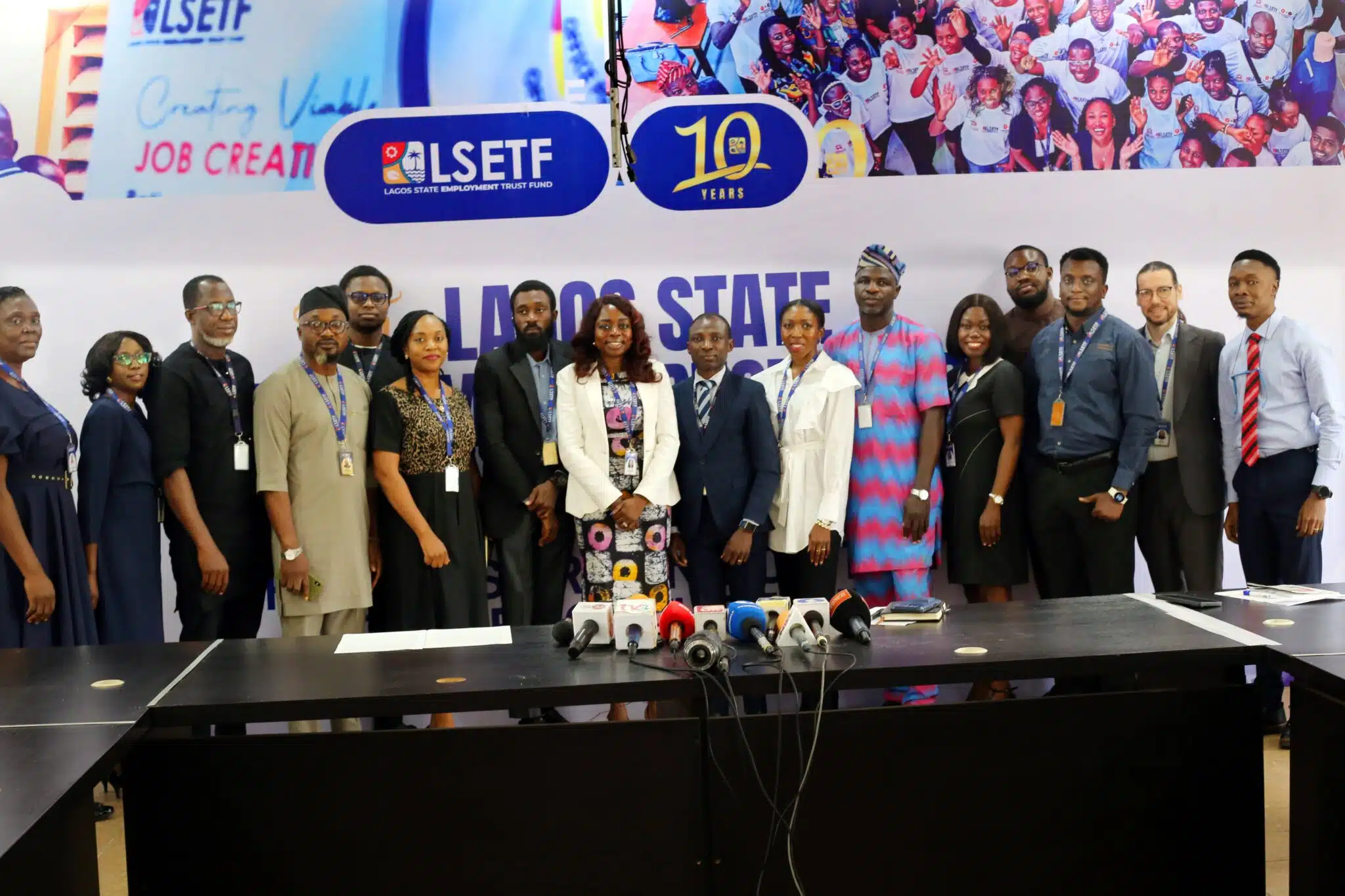


In 2016, the Lagos State Government took a bold step to tackle youth unemployment, provide financial support, and create wealth for residents, which led to the establishment of the Lagos State Employment Trust Fund (LSETF) under the Ministry of Wealth, Creation, and Employment.
Ten years on, Executive Secretary, Feyisayo Alayande, says the fund has continued to provide much-needed support to innovators and businesses in Nigeria’s centre of excellence through five key interventions: access to finance, access to skills development, access to capacity building, access to markets, and access to the technology ecosystem.
Alayande notes that in the last decade, LSETF disbursed over 15 billion naira in loans, created over 320,000 direct and indirect jobs across Lagos state, and saved over 170,000 jobs that would otherwise have been lost.
She added that over 30,000 young people have been connected to employment opportunities after receiving training. And about 1,200 tech startups have also received funding, and over 3,000 talents have been developed through the Lagos Innovative Initiatives. Techpoint Africa could not independently verify these claims.
Lagos entrepreneurs are not a risk

Last year, of the 15 billion naira disbursed, LSETF says it recorded a repayment rate of 94%; its 6% default rate is in line with the CBN’s 5% benchmark.
Alayande maintains that the repayment rate is proof that when people are treated with dignity, they honor commitments because the knowledge gap is closed and they have real opportunities.
“Lagos entrepreneurs are not a risk, they are an opportunity,” Alayande notes. “The Lagos entrepreneur is credible, and we can bank on them, and we’ll continue to support them.”
How much of a difference has LSETF made? – 5 startups share their experience
To assess the impact of the fund on startups in Lagos, Techpoint Africa spoke to five beneficiaries, who shared their journey and how much the support they received has made a difference to their businesses.
For Victoria Duru, founder of fertility health startup, Wakamedics, an idea born from her own fertility journey and the pain of quitting a well-paying job in the air ambulance space, to have children, LSETF was the first validation that what she was working on mattered.
“The funding was valuable and helped open a new product, which helped our revenue. The biggest difference for me personally was the capacity building and mentorship,” Duru said.
UleHomes co-founder, Chisom Okorie, credits the non-dilutive capital from LSETF for directly fueling operational capacity.
“Beyond the financial injection,” Okorie notes, “being backed by an institution like LSETF acts as a strong stamp of credibility. It validates our mission to stakeholders, partners, and the wider market, which is invaluable for an early-stage startup navigating a challenging economic landscape.”
Mbanefo Chinonyelum, founded Cubeseed after experiencing the pains of losing a farm to fraud. He says the LSETF’s 12-week Lagos Innovate programme offered training on operational excellence and business systems sustainability—exactly what a young founder needed to move beyond the idea stage.
“When a farmer sees that LSETF—a government agency—is backing a programme we’re running, the trust transfer is priceless,” Mbanefo explains. “It’s not just about the credit. It’s about acceptance. Awareness. The government’s validation becomes our validation.”
Fatima Yusuf, founder of House of Zibima, a sustainable fashion outlet that transforms waste materials such as plastic, fabric scraps, and pre-owned materials into stylish and functional footwear, says she was introduced to LSETF by her mentor, who shared the Female Funders and Founders Programme opportunity on LinkedIn and encouraged her to apply.
“I gained access to training, mentorship, and a strong support network,” Fatima notes, “What stood out to me was how transparent and accessible the opportunities were for entrepreneurs looking to grow their businesses.”
She adds that LSETF has played a major role in the startup’s growth journey via funding, mentorship, visibility, and business support, positioning it for greater growth.
David Jaiyeola, founder of Fastamoni, a fintech company, LSETF didn’t provide funding but workspace vouchers. He, however, maintains that the support made a difference, seeing that he joined the program at a pivotal time for his business.
All five startups claim that LSETF made significant contributions to their growth, pointing to the ease of working with the fund, but the real question will be whether this can be sustained and how efficient this initiative will remain in the years to come.
Editor’s note: 10:21 am — This article has been edited for conciseness and updated to include an interview with some beneficiaries of the LSETF.