
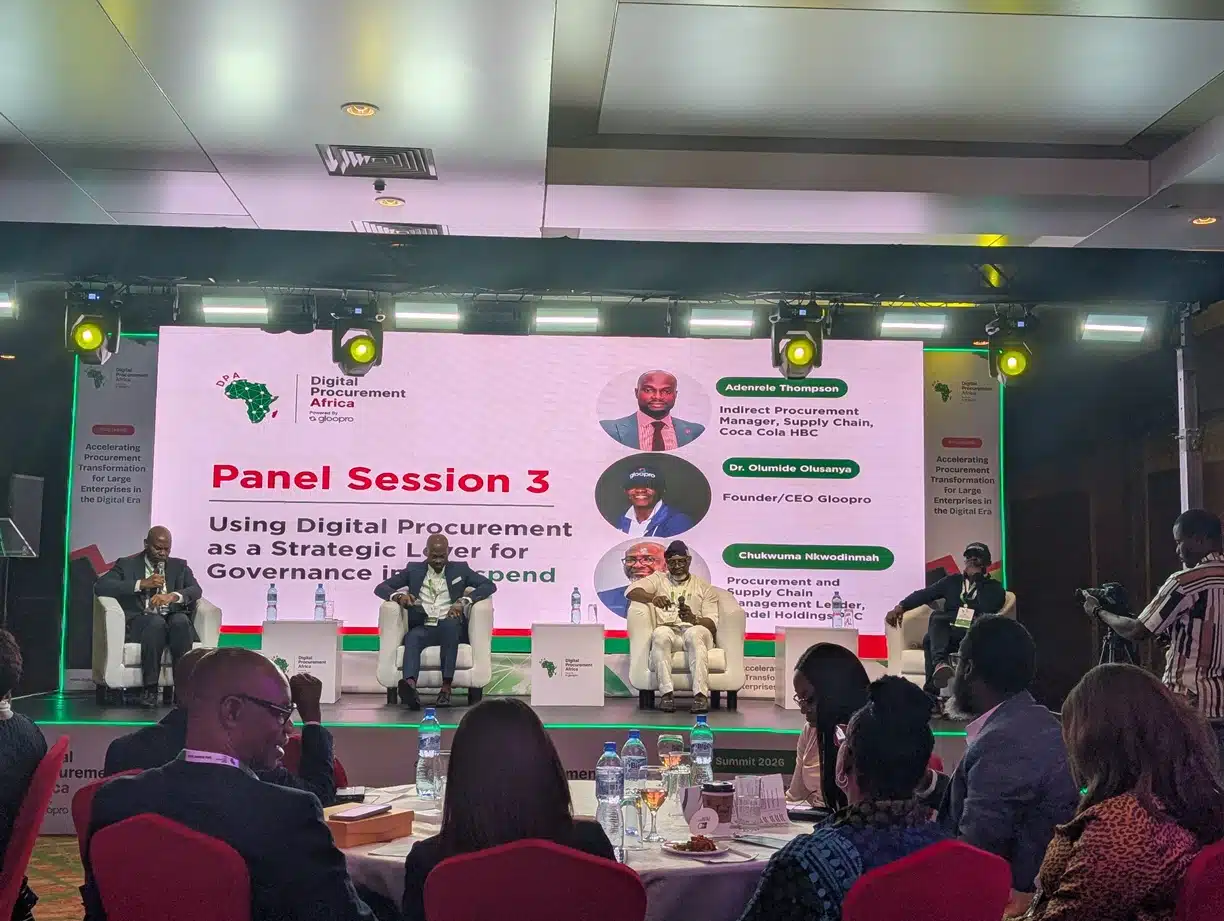

Procurement management has always been a primarily manual role. The procurement manager keeps records of all the resources the organisation needs, sources, liaises with, and manages several vendors, and handles the whole supply chain process. At the maiden edition of the Digital Procurement Africa Summit 2026, held on May 26, 2026, in Lagos, Nigeria, procurement experts from various industries gathered to discuss ways to improve the procurement process in African companies by digitising it to close gaps.
The event, sponsored by Gloopro, a procurement-as-a-service solution for International Oil Companies (IOCs) and Multinational Corporations (MNCs), brought together C-Suite procurement experts from organisations including Flour Mills of Nigeria, Oando Energy, and Coca-Cola. At the crux of the conversation was how to address financial leakages stemming from tail spend and manual processes.
Technology is the way forward
In the first panel session, moderated by Isa Alyiushata, President, Association of Digital Financial Practitioners of Nigeria, the two panellists— Ivy Aisueni, Contracts and Procurement Lead, First E & P, and Afolabi Ademuyiwa, Head Inbound Logistics & Procurement, CAP PLC — agreed that a company’s financial future can be hampered by unchecked leakages in its procurement process.
The experts argued that every company must first conduct an audit of its manual procurement process to fully assess its impact on the business’s bottom line, and then transition to a digital system to prevent further financial wastage.
In the second panel session, Cephas Afebuameh, Group Director, Supply Chain, Flour Mills of Nigeria PLC, emphasised the importance of adopting technology in procurement noting that organisations risk going into extinction otherwise.
“They will be out of existence because you need resilience, you need speed, you need agility, and you also know that you can’t survive now without having technology,” he said.
He added that, with manual processes, procurement officers cannot efficiently do everything they need to, and those who refuse to adapt to technology will be overtaken by those who do.
For Modupe Oyeneyin, Division Manager, Supply Chain and Procurement, Oando Energy Resources, Artificial Intelligence (AI) skills are a necessity in the current organisational landscape. However, she implored people to refrain from the fear that AI will take over their jobs and rather leverage it to work smarter. She highlighted solutions like Gloopro, which embeds AI systems to collate and retain information that might otherwise take several days to gather.
To balance the call for more technology adoption, Kayode Momoh, General Manager, Operations, Berger Paints Nigeria PLC, highlighted that the human in the middle will always be relevant. He argued that technology speeds up the process, but in procurement, human intervention is crucial to assess the results that technology delivers.
“You [procurement officers] must have basic knowledge and be able to decipher if the information you are getting is relevant or not. If the information is not relevant to what you are trying to achieve, then you could just end up working with data that is not relevant. So we are, we are assured that we are not going to be swept away by AI,” he said.
Gloopro: a digital solution
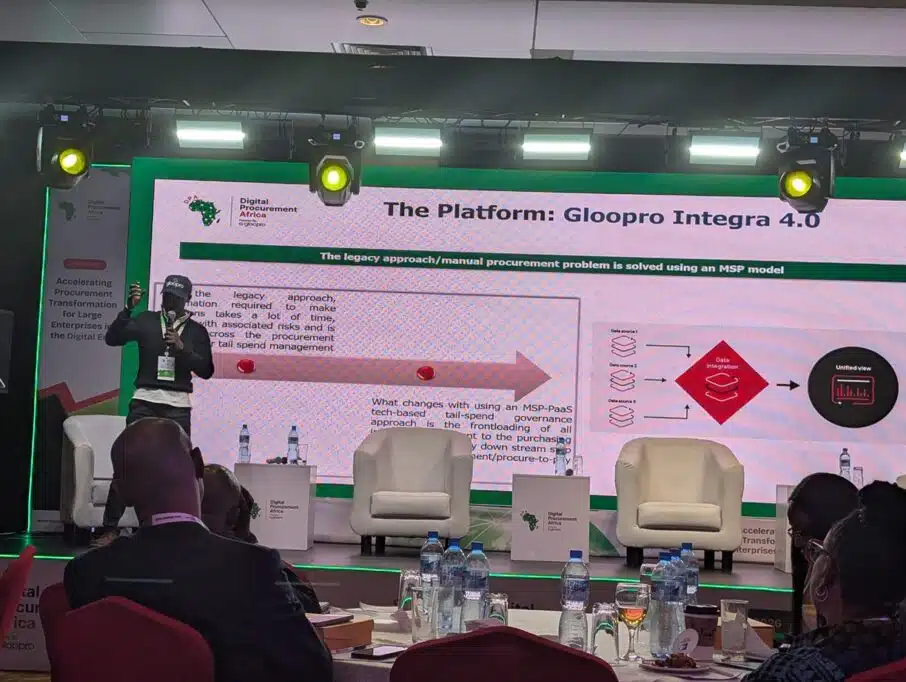
After establishing the crucial role of technology in the new era of procurement, Olumide Olusanya, Chief Executive Officer, Gloopro, presented the platform as the best solution for the procurement needs of IOCs and MNCs.
Olusanya detailed how Gloopro solves one of the most persistent problems in procurement management — tail spend. Tail spend refers to one-off or infrequent purchases that account for 80% of an organisation’s transactions but only 20% of its spend value. They are often difficult to manage because they are small, unplanned purchases.
He emphasised Gloopro’s ability to manage tail spend effectively.
“The same way Oando is committed to being the most successful in whatever parameters they are looking at in oil and gas, the same way Gloopro is focused entirely on tail spend management. Therefore, it will be very difficult for anybody in this room to say they know how to manage tail spend better than Gloopro.”
However, a major problem he highlighted was the uniqueness of tail spend in Africa. Although tail spend is a major procurement challenge globally, in Africa a significant portion of these purchases ends up in the informal market, making them even harder to track, especially when managed manually.
What Gloopro does to solve this problem is handle the entire supply chain life cycle, so when that information is required for decision-making, it can be easily extracted from the platform.
Aderenle Thompson, Indirect Procurement Manager, Supply Chain, Coca-Cola, affirmed the usefulness of the tool in coordinating the chaos of tail spend.
“Most people would usually approve tail spend without going in-depth. Why? Because the value is small. So we opted for a system that would provide transparency, governance, and due diligence.
At the end of the event, the consensus was that legacy procurement processes inevitably had to be replaced with a more digitised system, or organisations risk losing money due to manual processes.
A process that used to involve a list of materials to purchase and a call to vendors now requires a trackable system for better efficiency and longevity.