

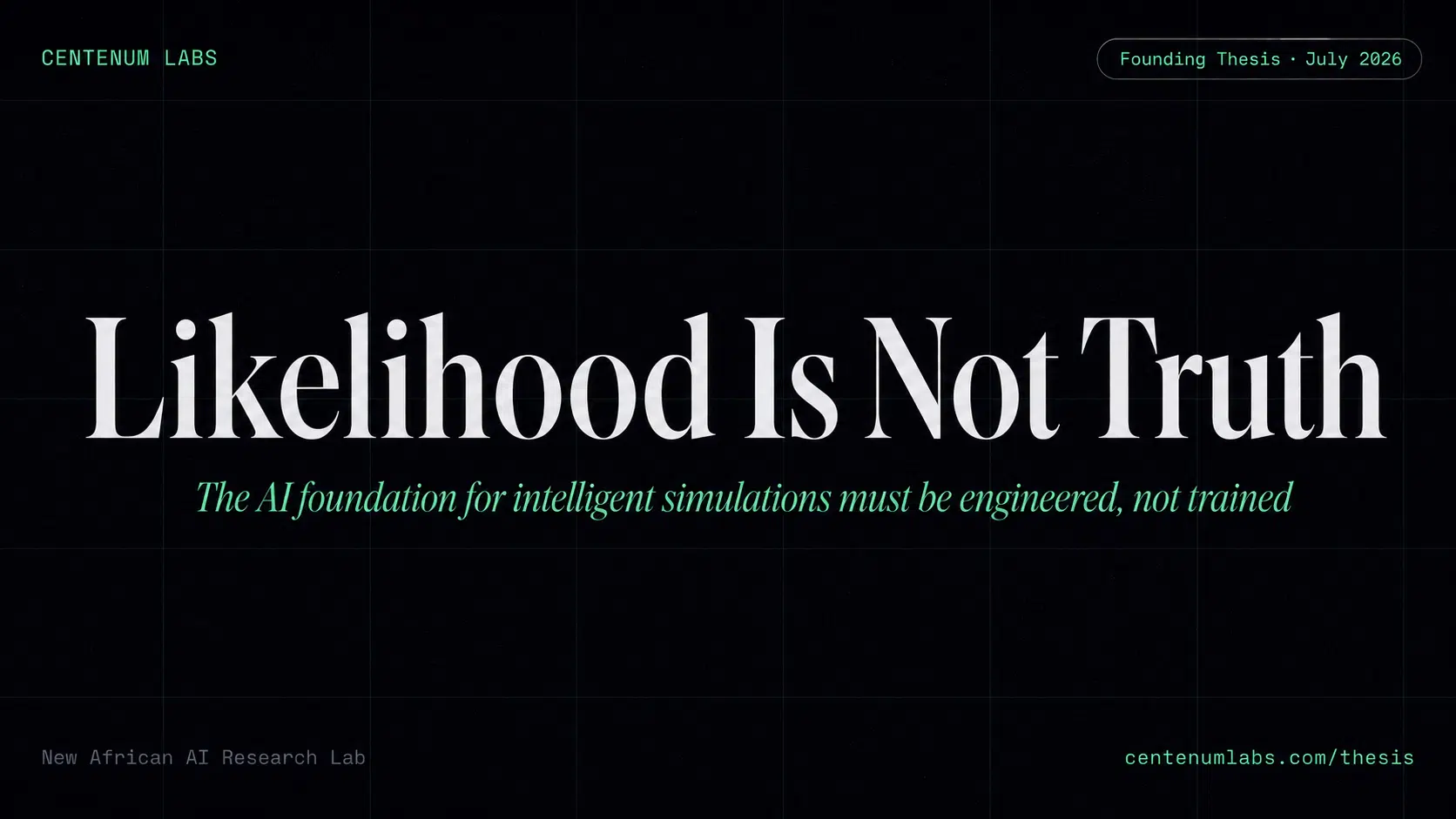
Modern AI is built on one bet: train a model to predict the next token across enough data, at enough scale, and a system you can trust with real decisions will emerge.
Centenum Labs, a new African AI research lab focused on intelligent simulations, argues in its founding thesis that this bet is wrong. Titled “Likelihood Is Not Truth,” the document takes a direct position against the industry’s core objective.
The Wrong Objective
Likelihood, the mathematical property that large language models are trained to maximize, measures how plausible an output sounds given the training data. It does not measure whether the output is correct, causally grounded, or structurally valid. The difference is invisible in familiar problems. It becomes catastrophic for the ones that matter most.
The lab names four properties of the current training objective:
- No truth mechanism. The training objective rewards what sounds right, not what is right.
- No verification loop. The model never checks its answer against a model of the domain.
- No compositional guarantee. Rules learned separately are not enforced to combine correctly in new contexts.
- Frozen weights. The model’s parameters do not update at inference; context can shape outputs, but not the underlying knowledge.
These are properties of the objective, not bugs of insufficient scale. Changing them requires changing the objective, not adding parameters.
Fluent Ignorance
The thesis names the failure mode: fluent ignorance. Outputs that are structurally coherent, persuasively phrased, and wrong in ways the system cannot detect.
“Likelihood measures how plausible an output sounds given a training distribution,” said Kingsley Michael, Head of Centenum Labs. “It does not measure whether the output is correct. The difference is invisible on familiar problems and catastrophic on the ones that actually matter.”
The document uses blood coagulation as its central illustration. The clotting cascade has been mapped for decades. Yet reliably simulating what happens when it is disrupted by medication, genetics, or trauma remains an open problem. The causal structure is dense, and a wrong answer does not look wrong until it is too late.
A Foundation For Reasoning
Centenum Labs builds AI on three disciplines the mainstream has treated as adjacent to the frontier: neurosymbolic computation, program synthesis, and causal modelling. Together, these produce systems that can represent the causal structure of a domain, show the reasoning behind an answer, and be corrected when that reasoning is wrong.
The lab focuses on bioinformatics and frontier engineering, domains where the primitives are well understood but their interactions resist reduction to training data.
MathExec, The First Release
MathExec is the first system Centenum Labs has built on this foundation. It is also the first math-to-model tool: write a formula on the visual canvas, point it at your data, and get a trained model in seconds. An analyst can turn sales = price × volume × seasonality into a forecast without writing code. A researcher can test a neural architecture and iterate on it three times in the time it takes to open a Jupyter notebook. Your formula is the model. MathExec trains it.
The full thesis is available at centenumlabs.com/thesis.
About Centenum Labs
Centenum Labs is the AI research arm of Centenum Technologies, focused on intelligent simulations and reasoning-first, domain-specific AI. Co-founded by Emmanuel Efosa-Zuwa (CEO) and Kingsley Michael (CTO), and headquartered in Lagos and Toronto, the lab works at the intersection of neurosymbolic computation, program synthesis, and causal modelling. Its first release, MathExec, serves research and high-stakes decision environments including healthcare, bioinformatics, and frontier engineering.