



Сәлеметсіз бе,
Victoria from Techpoint here,
Here’s what I’ve got for you today:
- Terra’s defence-tech bet hits $52M
- eTranzact fraud probe hits 69 accounts
- Africa’s moon telescope will hunt for aliens
Terra’s defence-tech bet hits $52M
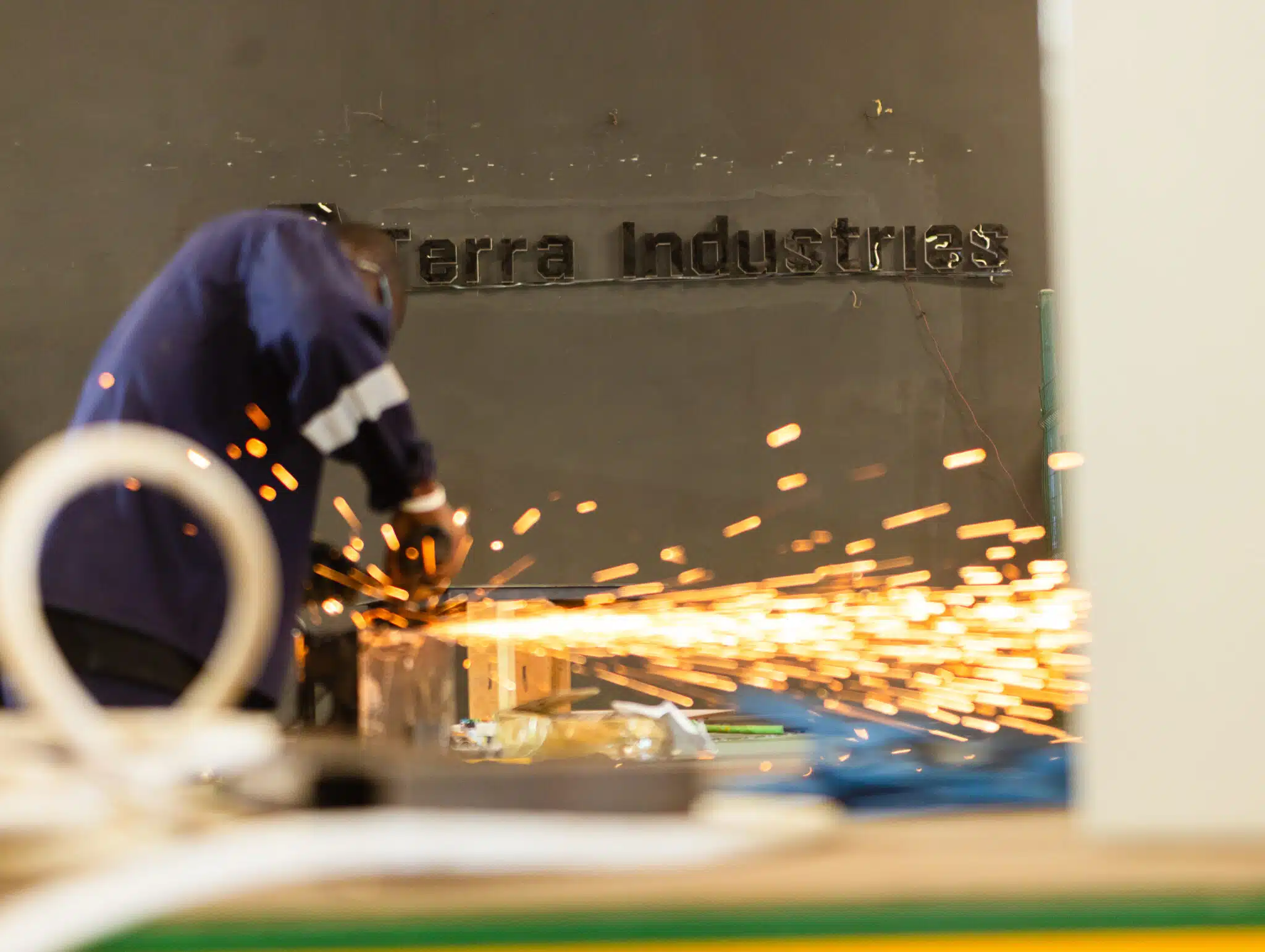
Terra Industries has just pulled off something pretty unusual in African startup funding: the Nigerian defence-tech startup has closed its $52 million seed round. That is a massive jump for a company founded in 2023, making Terra one of the most heavily funded defence-tech startups on the continent. The latest round builds on the $11.75 million it raised in January 2026 and the additional $22 million it secured in February, taking its total funding to $52 million.
The money is going into something very different from the fintech and eCommerce businesses that usually dominate African startup funding. Terra builds autonomous security systems, including drones, sentry towers, and unmanned ground vehicles, with its ArtemisOS software connecting these systems and helping monitor threats across land, air and maritime environments. The company says it is already protecting infrastructure worth billions of dollars, and it has been building out manufacturing capacity rather than simply importing equipment.
That is why this funding matters. Africa has a huge security and infrastructure-protection problem, but much of the technology used to deal with it has historically come from outside the continent. Terra is betting that African engineers can build systems specifically for African environments and security challenges. And investors clearly seem interested in that thesis: its February $22 million extension was completed in less than two weeks, led by Lux Capital, with existing investors including 8VC, Nova Global and Silent Ventures returning alongside new backers.
Terra’s growth has also been pretty rapid. The company was founded by Nathan Nwachuku and Maxwell Maduka in 2023, and by January 2026 it said it had already generated more than $2.5 million in revenue. It operates a 15,000-square-foot manufacturing facility in Abuja, and in April it announced a much larger 34,000-square-foot facility in Accra, Ghana, which is expected to become its main regional manufacturing base and eventually produce up to 50,000 units a year.
And there is a bigger shift happening here. Defence technology is becoming a much more interesting category for African investors, governments and founders as drones, AI and autonomous systems become increasingly important to security. Terra has already partnered with Nigeria’s armed forces, and its expansion into Ghana suggests it isn’t thinking of itself as just a Nigerian company. The $52 million seed round is therefore less about simply giving Terra more runway and more about giving an African defence-tech company the resources to manufacture, sell and deploy its technology at a continental scale.
eTranzact fraud probe hits 69 accounts

Nigeria’s courts have just stepped into another major fintech fraud case. On August 17, 2026, the Federal High Court in Abuja ordered six fintech platforms and 12 commercial banks to place about 69 accounts on post-no-debit, effectively freezing them, following allegations of fraudulent transactions involving eTranzact International. The order was granted after a motion was filed on behalf of the Inspector-General of Police, based on a petition from eTranzact.
The allegation is that someone penetrated eTranzact’s database and manipulated transactions on its Internet banking platform, creating fraudulent credits that were sent into accounts held at other financial institutions. The police told the court that the accounts were allegedly being used to receive or launder money, which is why it wants the funds frozen while the investigation continues. Importantly, these are allegations at this stage; the court’s freezing order does not itself establish that the account holders committed fraud.
Why should we care? Because the case shows just how quickly a security breach at one financial platform can spill across Nigeria’s increasingly interconnected banking and fintech system. Once money moves from one institution to another, investigators have to trace it across multiple banks and payment platforms. In this case, that’s 18 financial institutions and roughly 69 accounts caught up in the court order. It is also another reminder that the bigger the digital payments ecosystem gets, the more attractive it becomes to people looking for ways to exploit weaknesses in it.
The case is also interesting because of the way the authorities are responding. The IGP’s representative asked the court to freeze the accounts under constitutional and criminal-justice provisions, arguing that the restrictions were necessary to prevent the suspected illicit funds from being moved. The court granted the application ex parte, meaning the affected parties were not necessarily heard before the initial order was made. This isn’t an entirely new approach: in 2025, for example, the Federal High Court ordered eight banks to lift post-no-debit restrictions on 13 accounts that had previously been frozen in connection with a separate financial-misappropriation investigation.
For now, the big questions are how the alleged database breach happened, how much of the ₦1.39 billion can be recovered, and who ultimately ends up being held responsible. The case also puts the spotlight on eTranzact’s security controls and the ability of banks and fintechs to detect suspicious transfers once money leaves the original platform. As Nigeria pushes deeper into digital payments, cases like this are becoming less about one company and more about whether the entire financial system can keep pace with the criminals trying to exploit it.
Africa’s moon telescope will hunt for aliens

Africa is getting ready to take its search for the universe to the Moon. On August 17, 2026, new details published in Nature Astronomy showed how Africa2Moon, an African-built radio telescope selected to fly aboard China’s Chang’e-8 mission in 2029, will work, and one of its jobs will be to search for “technosignatures”, or possible evidence of technology beyond Earth. The first version is surprisingly small: three spherical devices, each about 30 cm wide and under 4 kg, that will roll across the lunar surface and spread apart to form a radio interferometer. If it works, it would be the first radio interferometer to operate on the Moon.
The alien-searching part is interesting, but the bigger story is really about what Africa is learning to build. The three BALLS — short for Bounced African Low Lunar Spheres — will carry radio antennas, electronics, and solar panels and are expected to operate for at least six days. During that time, they will observe the Earth, Sun, galaxy and lunar surface, while also looking for technosignatures. The Moon is useful because some very low-frequency radio waves, particularly below about 20 MHz, cannot be properly observed from Earth because of the atmosphere and radio interference. The Moon’s far side is even better because it can shield instruments from much of the noise generated by Earth and the Sun.
And this is where Africa’s existing investment in radio astronomy becomes important. Africa2Moon isn’t starting from zero. South Africa has spent years developing expertise through MeerKAT and the Square Kilometre Array, with researchers learning how to combine weak signals from multiple antennas into useful astronomical observations. In December 2022, for example, Breakthrough Listen began using MeerKAT to search for technosignatures from about one million nearby stars, showing that South African infrastructure was already part of the global search for extraterrestrial technology. Now that expertise is moving from the Karoo to the Moon. Rhodes University’s Oleg Smirnov is the mission’s principal investigator for radio astronomy, while universities and engineering teams across South Africa and other African countries are involved.
The road here has also been a long one. Africa2Moon was selected in April 2025 as one of the international payloads for China’s Chang’e-8 mission, which is scheduled for 2029. By July 2026, the project had moved well beyond PowerPoint: teams had assembled functional BALLS models and tested their ability to communicate with a mock lunar lander. The Chinese launch opportunity is particularly important because, according to the project, putting the payload on the Moon independently could have cost about R1.3 billion, a price that could easily have killed the mission before it started. Instead, the Chang’e-8 partnership gives African researchers a ride to the lunar surface.
But perhaps the most interesting part is what comes after the 2029 demonstrator. The long-term Africa2Moon vision is a network of 55 antennas on the Moon’s far side, one representing each African country. That makes this more than an astronomy experiment: it could become a training ground for African students, engineers, universities and companies working on radio engineering, electronics, systems integration and space missions.
For a continent that has often participated in the global space economy by buying services or relying on foreign infrastructure, building something that can actually land on the Moon is a different proposition. Africa may not find aliens with its first lunar telescope. But if the mission succeeds, it could prove something arguably more useful: that African teams can design, build and operate instruments beyond Earth.
In case you missed them
- CBN’s second sandbox cohort quietly opens a testing ground for permission-based data sharing
- Why African creators earn less and how platforms really decide what they get paid
What I’m watching
- 10 Years as a Therapist — This Is What a Healthy Relationship Actually Looks Like
- The Most Underrated Philosopher in History | Simone Weil
Opportunities
- Flutterwave is hiring for several roles. Apply here.
- Moniepoint is hiring for over 100 roles. Apply here.
- Follow Techpoint Africa’s WhatsApp channel to stay on top of the latest trends and news in the African tech space here.
Have a lovely Tuesday!
Victoria Fakiya for Techpoint Africa