
Twelve months after it was licensed by the National Universities Commission, American Open University has trained more than 220 professionals, taken free artificial intelligence training to four cities, and put four students through the gate on full scholarships. Its founder argues the sector is measuring the wrong thing.
| 1,530applications received in year one | 40Agents of EDGE onboarded | 4full scholarships awarded | 21programs across three levels | 3NUC-approved master’s programs |
“We are not chasing enrollment records. We are chasing employment outcomes.”
That is the argument Prof. David Seyi Akanbi has been making for a decade, and it is the argument on which he built a university. The evidence sits in a feasibility study submitted to the National Universities Commission in 2021, as part of the application to establish American Open University. Among students surveyed, 95 percent said Nigerian higher education does not meet the challenges of the 21st century. Among employers, 85 percent said the same. Fifty-five percent of graduates had considered learning a trade after their degree. Forty-three percent were working in fields unrelated to what they studied.
“Too many graduates leave school certified, but not yet capable of stepping into the work the economy actually offers,” Akanbi says. “That is not a supply problem. It is a fitness problem.”
His quarrel is with the scoreboard. Across the sector, success is reported in students enrolled, students graduated, and faculties opened. “But the only metric that matters to a parent paying fees, a graduate paying rent, or a country paying for its future is this: what percentage of our graduates are hired, or hiring others, within 12 months of graduation? Until that question sits at the center of every accreditation form and every prospectus, the gap between the certificate and the career will keep widening.”
On August 13, 2025, the National Universities Commission licensed the institution. What the University did with the twelve months that followed is now a matter of public record.
A campus, and a faculty to fill it
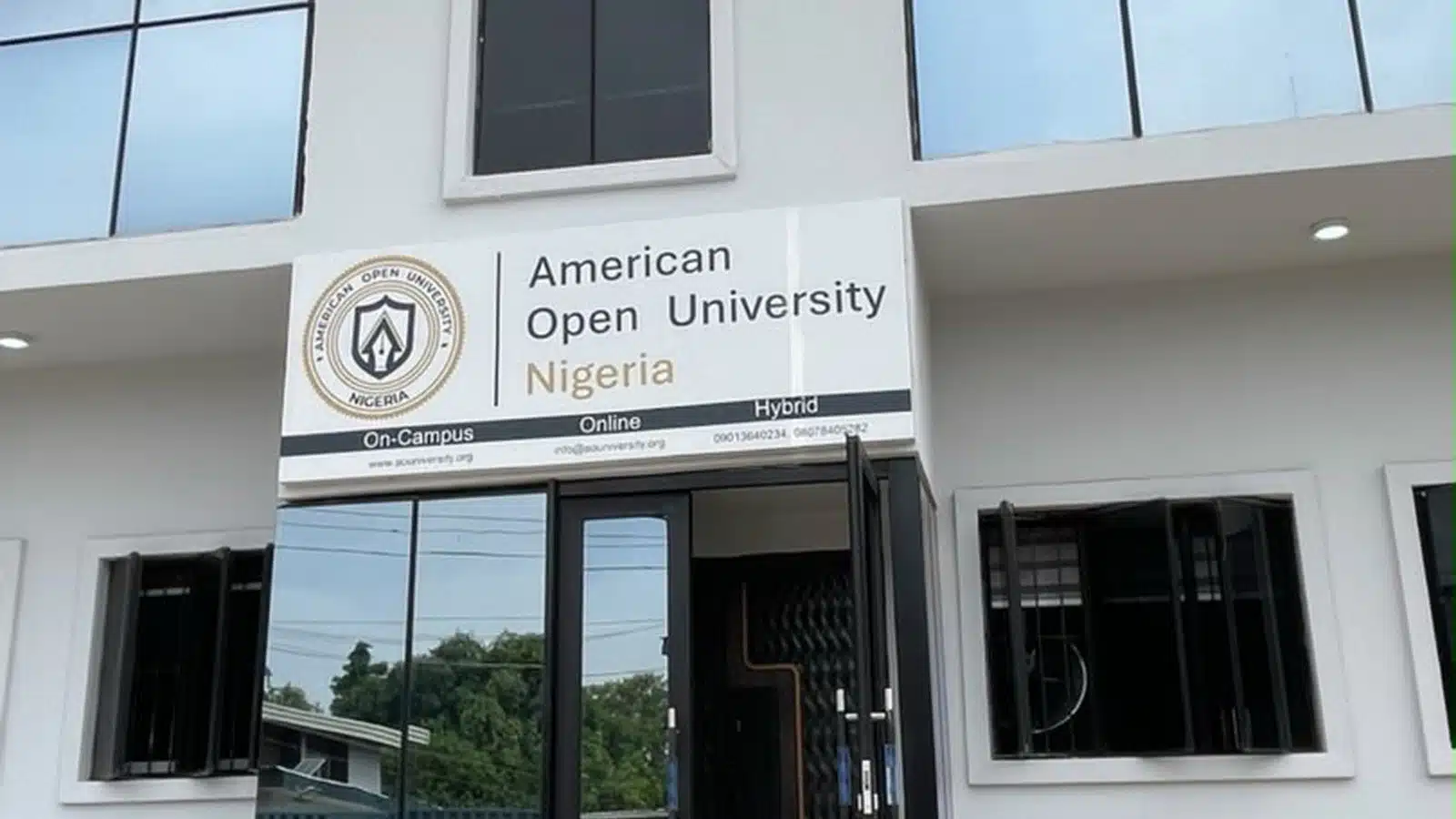
The Global Campus in Ibadan formally opened in February 2026 under the theme Future Forward, with a keynote by Prof. Francis Egbokhare of the University of Ibadan and goodwill messages from JAMB, the Chartered Institute of Personnel Management, the Chartered Institute of Taxation of Nigeria, and the Nigeria Union of Journalists. “Visions don’t die,” Akanbi told the gathering. “Even when the visioners pass on, the dream continues.”
Behind the campus went the people. Across its first year the University onboarded 40 faculty members drawn from across the globe and appointed as its Agents of EDGE, charged expressly with closing the distance between academic theory and industry mastery. The University also sponsored eight of its own faculty to earn Cisco certification, funding their training in full: a university that asks students to graduate with industry credentials, sending its lecturers back to class to earn the same.
Free training, and a promise kept
In April, A-Global opened a free, one-week AI-Powered Software Development Bootcamp to residents of Ibadan, Abeokuta, Ogbomoso, and Ondo Town, a footprint spanning three states. Participants built working applications, and the flyers carried an explicit promise: build an app, win a full B.Sc. scholarship.
At the Grand Pitch Day in Ibadan, with the other centers joining virtually, three of them did. Fakunle Olajuwon Ayomide won with Arche Stream Earn, a platform that uses AI-optimized content delivery to turn digital engagement into income for listeners and artists. Adeniji Flourish took second place with Flowbite, which uses adaptive AI to intercept surplus food before it spoils, matching restaurants and supermarkets with shelters and families nearby. Lawal Mubaraq Tolulope placed third with House Plug, which streamlines property search and matching for agents and seekers alike. A fourth student joined them on a full discretionary award. All four are enrolled and studying today, and the founding cohort as a whole was admitted with substantial scholarship support.
Demand has followed. The University processed more than 1,500 applications in its opening year. Admission to the degree programs is rigorously selective, but every applicant is offered a pathway: candidates not yet ready for direct entry are routed into foundation, skills, and professional programs that lead back to the degree.
Taking AI to the professions
The University’s outreach followed a pattern. In January, 120 members of the Nigeria Union of Journalists, Oyo State Council, completed a two-day artificial intelligence training delivered in partnership with A-Global. In April, the Society of Women Accountants of Nigeria, the women’s body of ICAN, was hosted at the Global Campus, where Akanbi addressed the profession’s future and the tools accountants can use to sharpen their workflow. This month, the University partnered with the Oyo State Ministry of Establishments and Training to develop 100 of the state’s most senior public service leaders, in a system where fewer than 150 senior officers carry leadership responsibility for a workforce of more than 100,000.
The Commission returns
In a letter dated June 19, 2026, the National Universities Commission approved the University’s first three postgraduate programs: the MBA, the Master of Information Technology, and the Master of Public Administration. The approval followed a resource verification exercise in which a panel appointed by the Commission examined academic staff, facilities, and governance. All three embed artificial intelligence in every core module rather than offering it as an elective, and the first cohort enters in the 2026/2027 session.
The approval brought the University’s catalogue to 21 programs across three levels. Its eight undergraduate degrees span Entrepreneurship, Public Administration, Business Administration, Business Information Technology, Information Technology, Software Engineering, Data Science, and Cybersecurity. Above them sit the three professional master’s degrees, and alongside them ten executive and professional development certificate programs for working professionals and institutional clients.
“Competency is the method. Capability is the outcome,” Akanbi says. “The next decade will not reward the institutions that produced the most graduates. It will reward the ones that produced the most capable.”
ADMISSIONS OPEN FOR THE 2026/2027 SESSION
8 undergraduate degrees • MBA, MPA, and MIT • 10 executive and professional certificates
www.aouniversity.edu.ng • info@aouniversity.edu.ng • 0901 364 0234
Global Campus, Ibadan • Metro Campus, Abeokuta • Learning Centers: Ogbomoso and Ondo