

Nigeria’s B2B startups are growing fast; one of them, OmniRetail, recorded 71,818% revenue growth and a 796% compound annual growth rate (CAGR) between 2020 and 2023.
Key takeaways
- OmniRetail’s 796% CAGR shows that B2B commerce infrastructure is currently Nigeria’s highest-upside startup category.
- Six Nigerian startups appearing on the FT Africa Fastest-Growing list confirm that these companies are no longer early-stage bets. They’re institutionally validated businesses.
- Nigeria’s B2B eCommerce market is set to expand at 18.14% CAGR through 2031, outpacing traditional eCommerce growth by a significant margin.
- Despite sustained macro pressure, Nigeria still accounted for 22.5% of Africa’s equity deals in 2024, a signal that investor confidence hasn’t buckled where it matters most.
- Moniepoint’s 1,663.4% CAGR makes the case that SME-focused fintech remains the most scalable startup model Nigeria has produced.
Instead of consumer apps chasing downloads, the fastest-growing companies are B2B infrastructure startups rebuilding the unglamorous but essential rails that enable Nigerian businesses to buy inventory, move money, access healthcare supply chains, and communicate with customers. What was fragmented, manual, and mostly inefficient a decade ago is now being systematically rebuilt by founders who understand that the biggest opportunities in emerging markets lie in building systems that never existed.
In 2024, Nigerian startups raised over $400 million, with the largest share going to B2B fintech, commerce, and infrastructure. That capital is compounding impressively, achieved against a backdrop of inflation, naira volatility, and operational constraints that would have stopped most businesses cold.
In this piece, I’m breaking down the fastest-growing B2B startups in Nigeria right now, the sectors driving that growth, and the data signals behind their rise.
Nigeria’s top 5 fastest-growing B2B startups
| Startup | Sector | Key growth metric | Backed by |
| OmniRetail | B2B commerce | 795.9% CAGR | Goodwell Investments, Timon Capital |
| Moniepoint | B2B fintech | 1,663.4% CAGR | Google, Visa |
| Paga | Payments | 21 million+ users | Adlevo Capital |
| Remedial Health | Healthtech | 5,000+ pharmacies served | QED Investors |
| Termii | APIs & messaging | Y Combinator |
B2B commerce and supply chain leader
There are roughly 10 million Nigerian micro-retailers (e.g., kiosks, open-air stalls, neighborhood stores) that collectively handle a significant share of the country’s consumer goods trade.
For decades, these businesses operated in a supply chain held together by middlemen, cash transactions, and unreliable last-mile delivery. Manufacturers couldn’t reach them efficiently, and retailers couldn’t access consistent inventory or credit.
The system worked just well enough to survive, and badly enough to leave billions in value on the table. That gap is what Nigeria’s B2B commerce startups are now systematically closing, and explains why this category is scaling faster than consumer eCommerce.
1. OmniRetail
Founded: 2019.
Founders: Deepankar Rustagi.
Headquarters: Lagos, Nigeria.
Funding: Closed a $20 million Series A round in April 2025.
795.9% CAGR, ranked among FT Africa’s Fastest-Growing Companies.
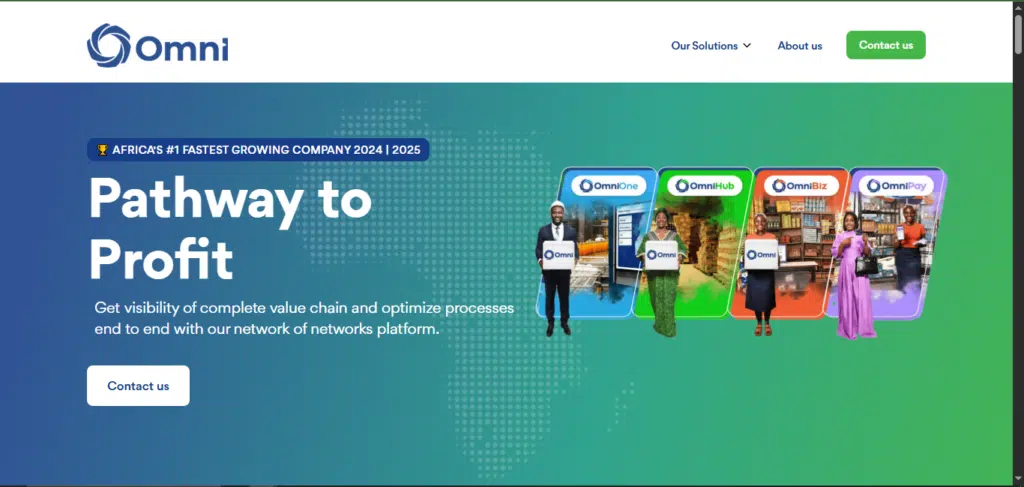
OmniRetail is a B2B eCommerce platform that links manufacturers directly to retailers, cutting out middlemen that historically inflated costs and undermined supply reliability.
With ₦1.8 trillion in transactions processed annually and over 150,000 retailers now connected with 145 manufacturers and 5,800 distributors across 12 Nigerian cities on the platform, OmniRetail has quickly become critical infrastructure for a retail segment that most platforms have ignored entirely.
How it can help your business:
- Direct manufacturer-to-retailer ordering, eliminating middlemen markups.
- Real-time inventory visibility and restocking across product categories.
- Embedded payment and credit tools are built into the commerce flow.
- Transaction data that builds retailer credit profiles over time.
- Last-mile delivery coordination at scale across informal retail clusters.
Who it serves
Manufacturers seeking direct retail distribution reach and small retailers needing reliable inventory access without traditional supply chain friction.
B2B fintech and payments leaders
Nigeria has an estimated 40 million small and medium-sized businesses. Most of them are underserved by the traditional banking system in three specific, compounding ways:
- Credit is inaccessible without collateral that most SMEs don’t have.
- Transaction infrastructure is unreliable at the moments it matters most.
- The speed at which banks move is structurally incompatible with how informal and semi-formal businesses actually operate.
B2B fintech startups filled that lag, becoming the financial operating system for Nigeria’s real economy.
2. Moniepoint
Founded: 2015 (as TeamApt, rebranded 2022).
Founders: Tosin Eniolorunda, Felix Ike.
Headquarters: Lagos, Nigeria.
Valuation: $1 billion; backed by Google, Visa, Development Partners International, and QED Investors.
1,663.4% CAGR; over $100 billion in transactions processed annually
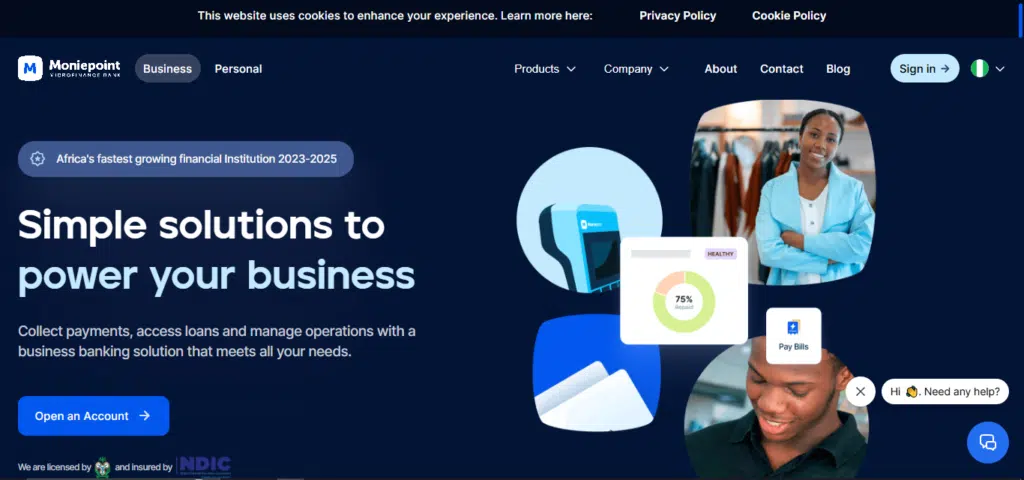
Moniepoint has built a full-stack financial operating layer designed specifically for Nigerian SMEs. Over 1.6 million businesses now use the platform for everything from payment processing and business accounts to credit and expense management.
Responding to being listed on FT Africa’s Fastest-Growing Companies, the Group CEO, Tosin Eniolorunda, said, “We like to let statistics speak for themselves, and accolades do not come much higher. Maintaining such rapid growth is only possible due to the hard work of the entire Moniepoint team, and I thank them all for their continued dedication.”
Key features
- Business bank accounts with faster setup and fewer documentation barriers than traditional banks.
- POS and payment infrastructure built for high-volume SME transaction environments.
- Working capital credit products tied directly to real transaction history.
- Payroll, expense tracking, and financial management tools in one platform.
- Agent banking network extending reach into underserved and semi-urban markets.
Who it’s most suited for
Nigerian SMEs that need reliable payment infrastructure, business banking without traditional bank friction, and access to credit.
3. Paga
Founded: 2009.
Founders: Tayo Oviosu.
Headquarters: Lagos, Nigeria.
Funding: Raised over $35 million; backed by Goodwell Investments, Adlevo Capital, Unreasonable Capital, and others.
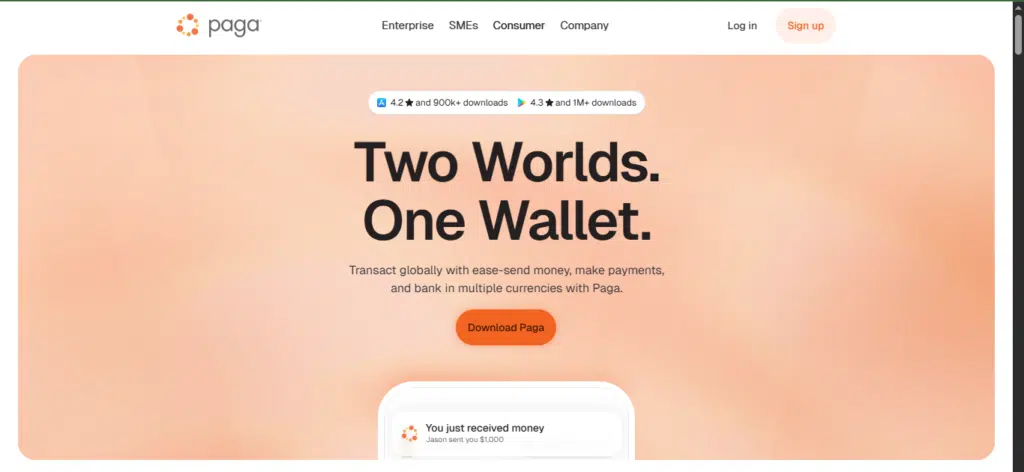
The fintech started in 2009 with a simple plan to digitize cash and simplify payments. Now, however, the company has grown into a group with three major offerings:
- Paga (consumer).
- Doroki (its SME-focused platform).
- Paga Engine (infrastructure and APIs).
What it offers your business
- Bill payments, transfers, and collections through one of Nigeria’s widest agent networks.
- Business payment acceptance without requiring customers to be digitally banked.
- Bulk payment disbursement for payroll and vendor settlements.
- API integration for businesses that need payment infrastructure embedded in their own products.
- Cross-border payment capabilities for businesses with regional transaction needs.
Who it serves
Businesses that need reliable payment reach beyond Nigeria’s major urban centers, and those whose customer base includes unbanked or underbanked users who transact primarily through agents.
B2B infrastructure and API layer
The startups in this section don’t have consumer-facing brand recognition, and that’s precisely the point. Infrastructure companies win by becoming invisible.
4. Termii
Founded: 2017.
Founders: Emmanuel Gbolade, Ayomide Awe, Atinuke Idowu.
Headquarters: Lagos, Nigeria.
Funding: Y Combinator-backed.

Termii is an API-first platform offering SMS, voice, email, and messaging channel connectivity that developers can integrate directly into their products.
It powers the communication infrastructure for most of Nigeria’s digital economy. Every OTP notification you receive from a fintech app, every delivery update from a logistics platform, every appointment reminder from a health service.
What you get with Termii
- SMS, voice, WhatsApp, and email APIs under a single integration layer.
- OTP and two-factor authentication infrastructure for fintech and security-sensitive apps.
- Number verification and fraud detection tools are built into the messaging stack.
- Multichannel messaging campaigns for customer engagement and retention.
- Developer-friendly documentation and sandbox environment for fast integration.
Who can benefit
Developers, fintechs, logistics companies, healthtech platforms, and any digital business that needs a reliable programmatic communication infrastructure without having to build it from scratch.
5. Remedial Health
Founded: 2021.
Founders: Samuel Okwuada, Victor Benjamin.
Headquarters: Lagos, Nigeria.
Funding: $12 million Series A; backed by QED Investors, Pear VC, and others.
Serves 5,000+ pharmacies and hospitals across Nigeria.

Remedial Health is a healthtech and supply chain company digitizing pharmaceutical distribution in the country. It gives pharmacies (5,000+) and patent medicine vendors access to authentic, affordable medicines straight from manufacturers via a mobile-first inventory and procurement platform.
Offerings
- Verified pharmaceutical inventory ordering from a single digital platform.
- Working capital financing for pharmacy owners managing tight cash flow cycles.
- Real-time inventory tracking and automatic restocking alerts.
- Direct manufacturer and distributor relationships that cut out counterfeit supply chain risks.
Who it’s most suited for
Independent pharmacy owners and small pharmaceutical retail chains across Nigeria.
What’s driving B2B Growth?
The growth rates you’ve seen throughout this piece are due to four structural forces:
- Nigeria’s massive informal economy is digitizing faster than most models predicted.
- The SME financing gap remains deep enough for any credible solution to capture demand almost immediately.
- Mobile-first operations have lowered the cost of reaching businesses that traditional infrastructure never could.
- The markets themselves are fragmented, large, and underleveraged; reward the first platform that can aggregate them at scale.
The next wave worth watching:
- Logistics tech.
- Agricultural supply chains.
- HR tech.
- B2B SaaS.
FAQs
What makes a B2B startup fast-growing in Nigeria?
Growth is measured by revenue CAGR, transaction volume, and the ability to scale under real macro pressure. The FT Africa rankings specifically track CAGR between 2020 and 2023 as the primary qualifier.
Which sector dominates Nigerian B2B startups?
Fintech leads on overall capital and maturity, but B2B commerce and supply chain are currently producing the highest raw growth rates. OmniRetail’s 795.9% CAGR makes that case on its own.
Are these startups expanding beyond Nigeria?
Yes. Most are already moving across West and East Africa after proving the model locally.
Conclusion
Nigeria’s B2B startup layer is operational at scale, processing hundreds of billions of transactions, serving millions of businesses, and attracting global institutional capital despite sustained macroeconomic headwinds.
What I find most compelling about this, beyond just the growth rates, is that the underlying problems these companies are solving aren’t going away. Fragmented supply chains, underserved SMEs, and infrastructure gaps don’t resolve themselves. The startups building into those gaps have years of compounding runway ahead of them.
Citations
- https://www.techinafrica.com/top-20-fastest-growing-startups-in-africa-to-watch-in-2025/
- https://techcabal.com/2025/05/14/ft-ranking-6-nigerian-startups-named-fastest-growing-companies/
- https://www.mordorintelligence.com/industry-reports/nigeria-ecommerce-market
- https://insights.techcabal.com/report/ecosystem-report-nigeria-startup-scene-2024/
- https://techeconomy.ng/nigerian-startups-top-list-africas-fastest-growing-companies/#:~:text=Moniepoint%2C%20another%20Nigerian%20fintech%20firm%2C%20made%20the,to%20$264.51%20million%20in%202023%2C%20a%201%2C663.4%25
- https://omniretail.africa/blogs/omniretail-raises-series-a
- https://www.ft.com/reports/africas-fastest-growing-companies?syn-25a6b1a6=1
- https://insights.techcabal.com/african-fintech-ma-2025-the-strategic-exits-reshaping-the-market/#:~:text=Corporate%20acquisition,access%20within%20a%20single%20ecosystem.
- https://documents1.worldbank.org/curated/en/099055202202331735/pdf/IDU0ff38186304ab204c9209dd1037aeeb43b3d8.pdf
- https://www.ft.com/reports/africas-fastest-growing-companies?syn-25a6b1a6=1
- https://africa.businessinsider.com/tech/tech-nigerian-fintech-firm-paga-raises-dollar10-million-funding-to-expand-operations/3nr9k4z#:~:text=BI%20Africa%20%3E%20Tech-,Nigerian%20fintech%20firm%2C%20Paga%2C%20raises%20$10%20million%20funding%20to%20expand,Ethiopia%2C%20Mexico%20and%20the%20Philippines&text=Going%20forward%2C%20Paga%20said%20it,Innovation%20Fund%20and%20other%20investors.
- https://techpoint.africa/news/nigerian-remedial-health-raises-seriesa/
Disclaimer!
This publication, review, or article (“Content”) is based on our independent evaluation and is subjective, reflecting our opinions, which may differ from others’ perspectives or experiences. We do not guarantee the accuracy or completeness of the Content and disclaim responsibility for any errors or omissions it may contain.
The information provided is not investment advice and should not be treated as such, as products or services may change after publication. By engaging with our Content, you acknowledge its subjective nature and agree not to hold us liable for any losses or damages arising from your reliance on the information provided.
Always conduct your research and consult professionals where necessary.