



In December 2025, a food vendor, Corporate Ewa, posted a video on social media drawing attention to several live stores on the Glovo app that were impersonating her business. She claimed that although she never registered her business on Glovo, these fake accounts lifted images from her company’s official social media pages and impersonated her business on the Glovo platform.
That complaint, shared publicly on X, prompted Techpoint Africa to investigate the vetting process for restaurants allowed to operate on Nigeria’s food delivery platforms, like Glovo and Chowdeck.
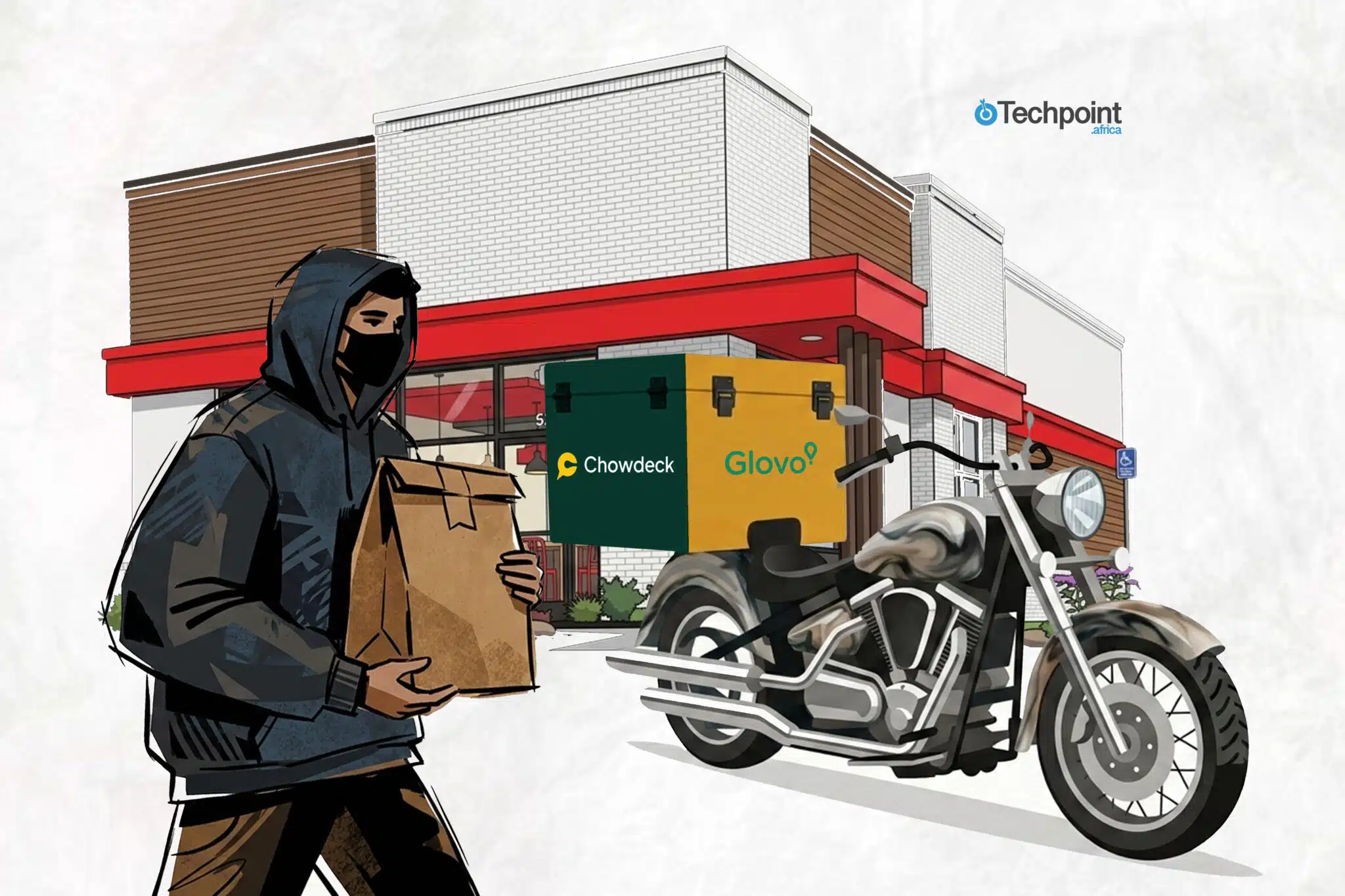
We impersonated a Nigerian restaurant, set up a store, and successfully made a sale on both platforms. The goal was to review the platforms’ vendor registration and onboarding process and determine how easy it would be to set up a store impersonating another business/brand on the platforms.
Glovo
Step 1: The registration process
We began by identifying a business to impersonate. The chosen business needed to be prominent enough that a simple Google search would immediately bring up useful information to raise red flags on our application.
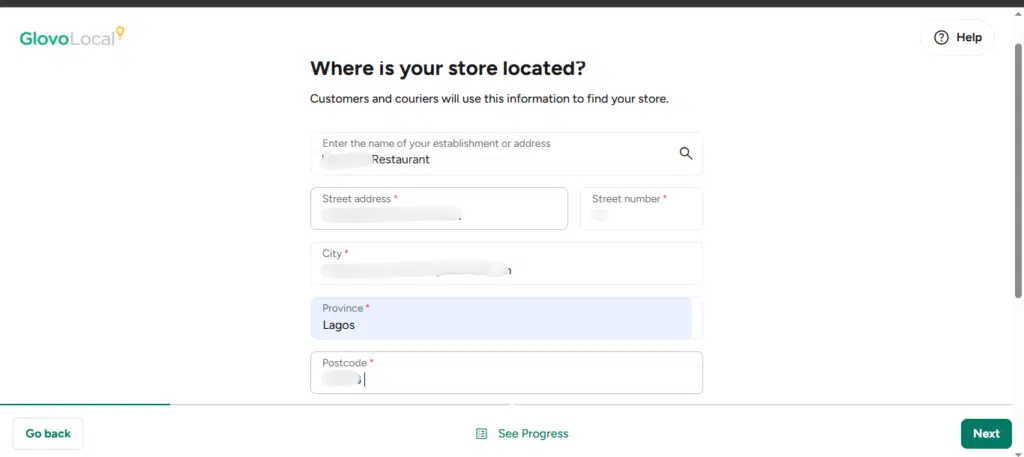
To meet this criterion, we chose a restaurant with at least four prominent locations in Lagos state that was not registered on Glovo. To sign up as a vendor on Glovo, we were required to provide the business name, location, tax ID, and banking details. We filled out the required details and registered the company under a fake address unrelated to or in proximity to any of the real company’s branches.
Although the restaurant’s actual locations were provided as options when entering the store’s name and address, we were allowed to override them and enter our chosen address.
Next, we were required to provide the company’s tax ID and legal business name. We created a tax ID using random numbers in the typical Nigerian tax ID format.
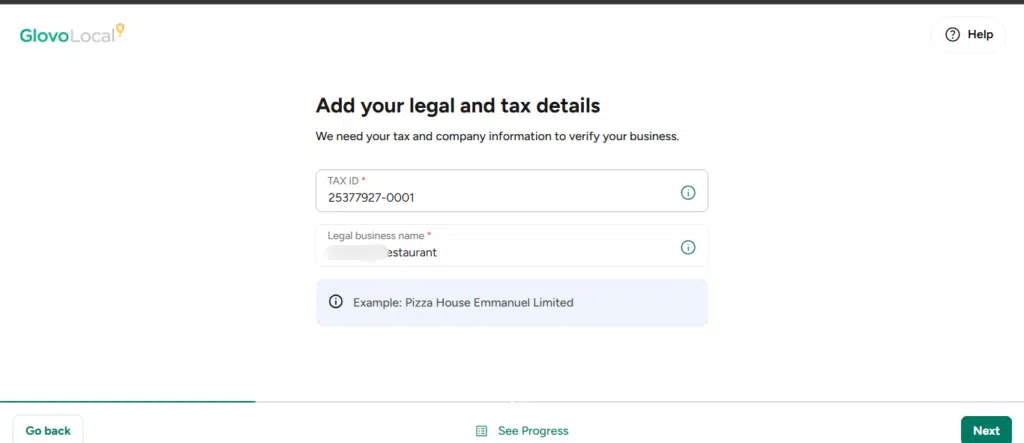
Glovo did not flag the ID, and we were allowed to continue the business registration process. That our fabricated tax ID passed without being flagged suggests the platform does not cross-check submitted details against the Nigeria Revenue Service’s (NRS) TIN verification portal or the Corporate Affairs Commission’s (CAC) register, both of which are publicly accessible.
We went on to fill out the business’ banking details. For this, we used a personal bank account. For the final step in the registration process, we selected a plan that determined the commission fee (25%), monthly fee (₦850), pickup fee (15%), and a few other fees we would be required to pay both at the commencement of the partnership and during the partnership.
Within ten minutes of completing the final step of the registration process, Glovo sent an email congratulating us on a successful registration and attached a partner’s agreement for us to sign.
Step 2: Verifying the business
The next step in Glovo’s vendor onboarding process is business verification. However, while the verification page read that the process was to verify our identity and business, the only requirement was to add a menu. Moreover, this verification requirement came after a partnership agreement had been sent and signed.
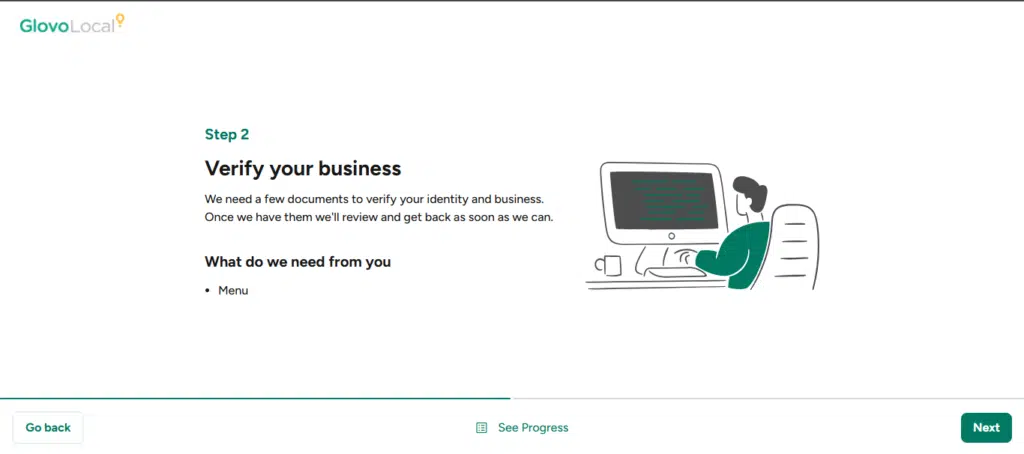
In this step, we were required to upload the menu, including images of the meals we intended to sell, along with descriptions and prices. We created a mock-up menu for the restaurant using images from the restaurant’s Instagram account, which we impersonated, included prices and descriptions, and uploaded the menu to the Glovo Manager portal.
For the next step, we uploaded an image for each meal, including its price and description. All images were sourced from the original restaurant’s official Instagram account.
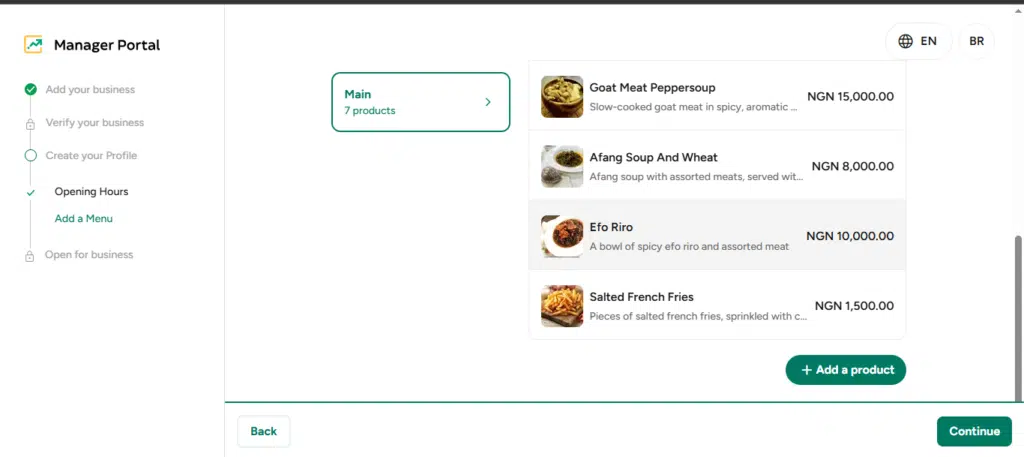
After uploading the items to the menu, we were notified on the portal that our profile details were under review and that we would receive an update within 1-2 days. The next day, a Glovo representative contacted us, asking additional questions about the store.
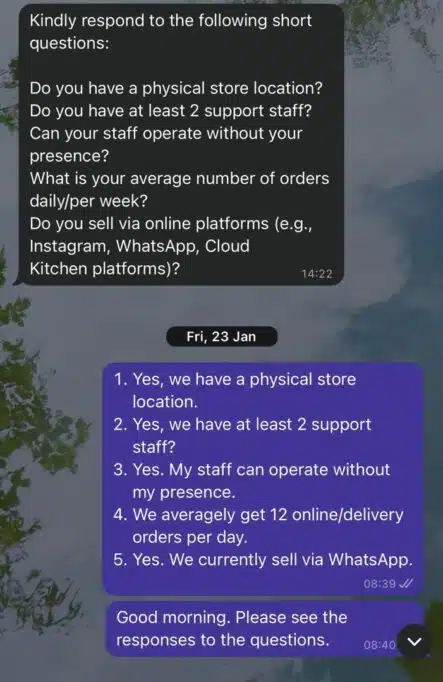
Glovo’s representative then requested much of the information and documents we had previously uploaded to the Manager Portal, including bank account details, TIN, CAC document, a valid email address and phone number, the menu list with images and descriptions, and a one-time activation fee of ₦20,000.
An invoice for the activation fee was generated and remitted to the account details provided. We subsequently provided all other information we had uploaded to the portal, except for the CAC document. A false CAC document had been created using the RC number of a company with a similar name to the restaurant we were impersonating. Following this submission, a signed vendor agreement was sent to our registered email, and within a week, Glovo sent us its device for order receipt and tracking.
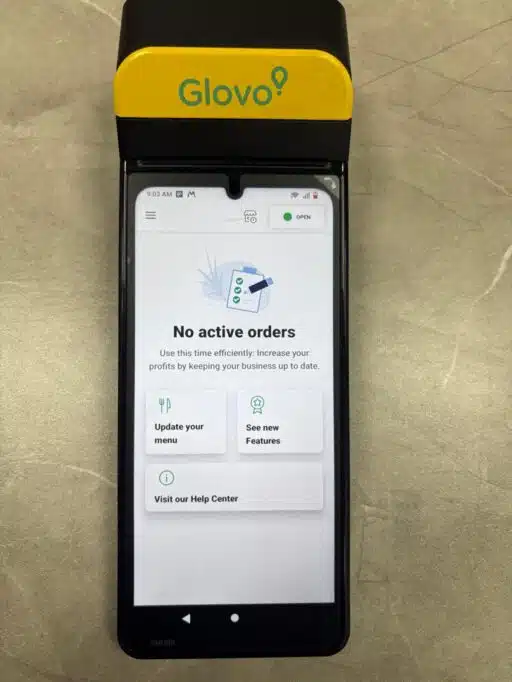
A few days later, Glovo held an onboarding training for new vendors, where it taught us how to run the store on its platform using the device.
After this training, our fake restaurant appeared on the Glovo app, and we placed and delivered an order through it.
Our investigation found no evidence that Glovo’s onboarding process involves independent business verification. A fictitious restaurant was approved within 48 hours of document submission, with nothing in the process suggesting that submitted documents are checked against any regulatory body or that vendors are subject to any Know Your Business (KYB) requirements before going live.
When contacted, Glovo declined to comment on its onboarding process.
Glovo began operating in Nigeria in 2021, and over the past four years, it has onboarded over 6,000 vendors, generating over ₦71 billion ($44.6 million) in revenue.
Chowdeck
It took us a little over an hour to set up a restaurant on Chowdeck and make a successful sale on the platform.
Step 1: Registering the business
To register a restaurant on Chowdeck, we were required to provide a business name, our CAC registration number, and the CAC document. Once we submitted the necessary information, we were informed that our business information had been rejected because our business name did not match the name associated with the CAC number we submitted.
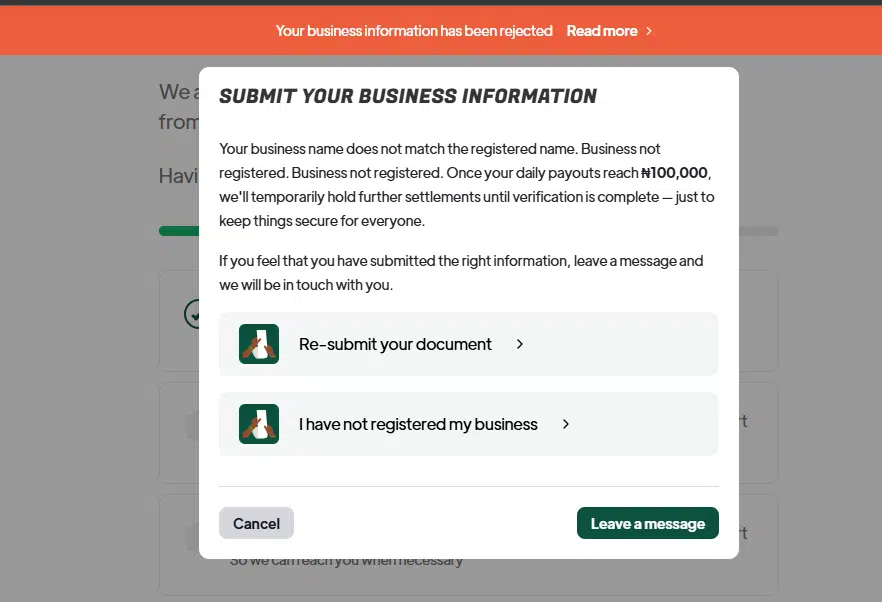
Despite rejecting our document, we were still allowed to proceed with the registration. According to the message, we would be permitted to trade on the platform until our daily payouts reach ₦100,000.
In an emailed response to Techpoint Africa, a Chowdeck spokesperson stated that as part of its onboarding process, the company verifies business information and Tax IDs through third-party partners. But, in limited cases, legitimate small businesses without this information are allowed to operate on the platform under tighter controls.
“Chowdeck’s standard onboarding path is for fully registered businesses. However, in limited cases involving legitimate small businesses that are still in the process of formalising their registration, Chowdeck may provide restricted access to the platform under tighter controls. This can include limits on activity and additional monitoring, with full access contingent on completion of the required verification process.”
However, our business was anything but legitimate.
Chowdeck’s approach reflects a deliberate attempt to limit unverified vendors on the platform. However, the fact that we were permitted to proceed suggests that Chowdeck’s restricted-access provision could also be exploited by fraudulent vendors, undermining the protections the clause is meant to provide.
Step 2: Setting up our profile
To begin selling on Chowdeck, we had to submit and verify our contact information and add our account details. For these, we used a personal email address, phone number, and account details.
Next, we uploaded the items on our menu to the platform. As with Glovo, every picture was taken from the official Instagram account of the restaurant we were impersonating.
Within ten minutes of completing the onboarding process, Chowdeck sent an email welcoming us to the platform, and the store was immediately listed for public viewing.
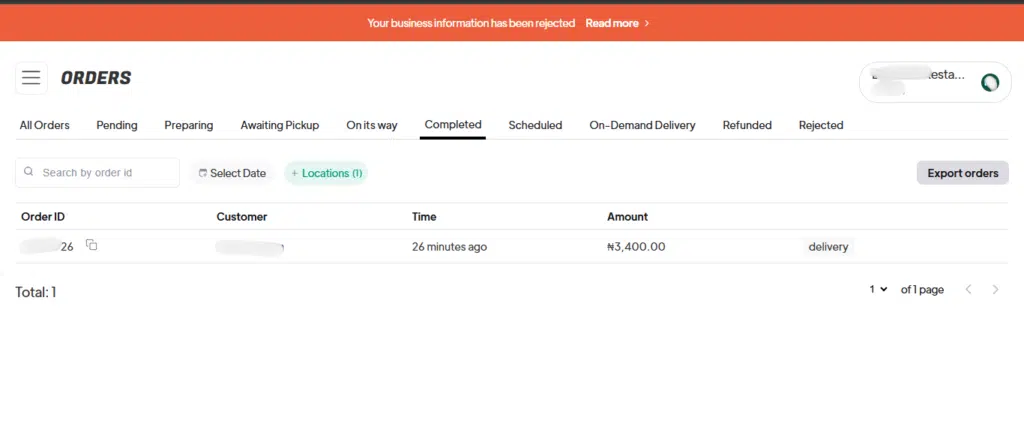
To test the validity of the store, we placed an order on Chowdeck, a dispatch rider came to our registered address, and we sent out an item to fulfil the order.
“Chowdeck has encountered isolated cases [of vendor impersonation] in the past and has taken action where necessary. Its onboarding and verification processes are designed to reduce the likelihood of impersonation or fabricated information, including automated checks, escalation paths, and periodic reviews,” Chowdeck’s spokesperson said in a statement.
The gap
Unlike financial technology companies, where heavy regulation mandates strict KYC and KYB requirements for all signups, the food delivery sector, as evidenced by the investigation, appears more lax.
The regulatory oversight of Nigeria’s fintech industry has led to a few non-compliance consequences. In 2024, two of Nigeria’s largest fintech players, OPay and Moniepoint, were reportedly fined ₦1 billion each by the Central Bank of Nigeria for compliance infractions, a testament to the seriousness with which regulators treat identity verification in that sector.
However, no Nigerian law specifically governs the food delivery sector, and no single regulatory body holds a clear mandate over platforms operating in it. The Federal Competition and Consumer Protection Commission (FCCPC), which enforces the Federal Competition and Consumer Protection Act (FCCPA) 2019, has broad jurisdiction over consumer protection in digital markets, but has not issued any framework specific to food delivery.
Additionally, the National Agency for Food and Drug Administration and Control’s (NAFDAC) food hygiene regulations govern food-handling establishments, but the agency’s mandate does not extend to the platforms that list them. This fragmented oversight in a sector where fraud and food safety concerns could cause consumer harm and public health challenges warrants attention.
In contrast, India’s online food delivery sector, which is significantly larger than Nigeria’s, is regulated by the Food Safety and Standards Authority of India (FSSAI). The regulator sets standards for restaurants and holds delivery companies accountable for the food they deliver.
“The FSSAI and municipal authorities prescribe stringent guidelines for food transportation, preparation, and storage. Food delivery executives must adhere to regulations, for instance, wearing masks, keeping sanitised containers, and practising proper hand hygiene. Swiggy and Zomato [online food delivery companies in India] have introduced app-based hygiene checklists and compulsory training modules for delivery partners,” an industry report notes.
Furthermore, the FSSAI requires restaurants to accurately label food packaging with relevant information, including ingredients, allergens, manufacturing and expiry dates, and nutritional data. This standard has prompted some food delivery operators to work closely with restaurants to avoid regulatory fines.
Similarly, China’s food delivery sector, valued at over $229 billion, is regulated by the State Administration for Market Regulation (SAMR), a multi-departmental agency that oversees competition, product safety, and market conduct across industries, including digital platforms.
A report notes that the country’s biggest food delivery players, including PDD, Alibaba, Douyin, and Meituan, were recently fined 3.6 billion yuan ($528 million) after a disappointing birthday cake triggered an investigation that uncovered thousands of ghost food vendors operating with forged licences and no physical locations.
Nigeria’s food delivery sector is nowhere near India’s or China’s scale, but the potential risks of regulatory negligence are the same. Platforms that do not verify who is selling food expose consumers to harm. As the sector grows, the question of who is responsible for oversight becomes more important.
A collaboration between the FCCPC and NAFDAC may be best suited to take on this role. As the agency mandated to protect consumers across digital markets, the FCCPC has both the legal basis under the FCCPA 2019 and the precedent of engaging with platform-based businesses. NAFDAC, which already regulates food-handling establishments, could extend its framework to cover compliance requirements for platforms that list food vendors.
Editor’s note: 20:56 PM – This article has been edited for clarity. The original intent and core message remain unchanged, but a portion of a previous version could be interpreted as suggesting that the dispatch rider sourced the food from an unknown restaurant.