

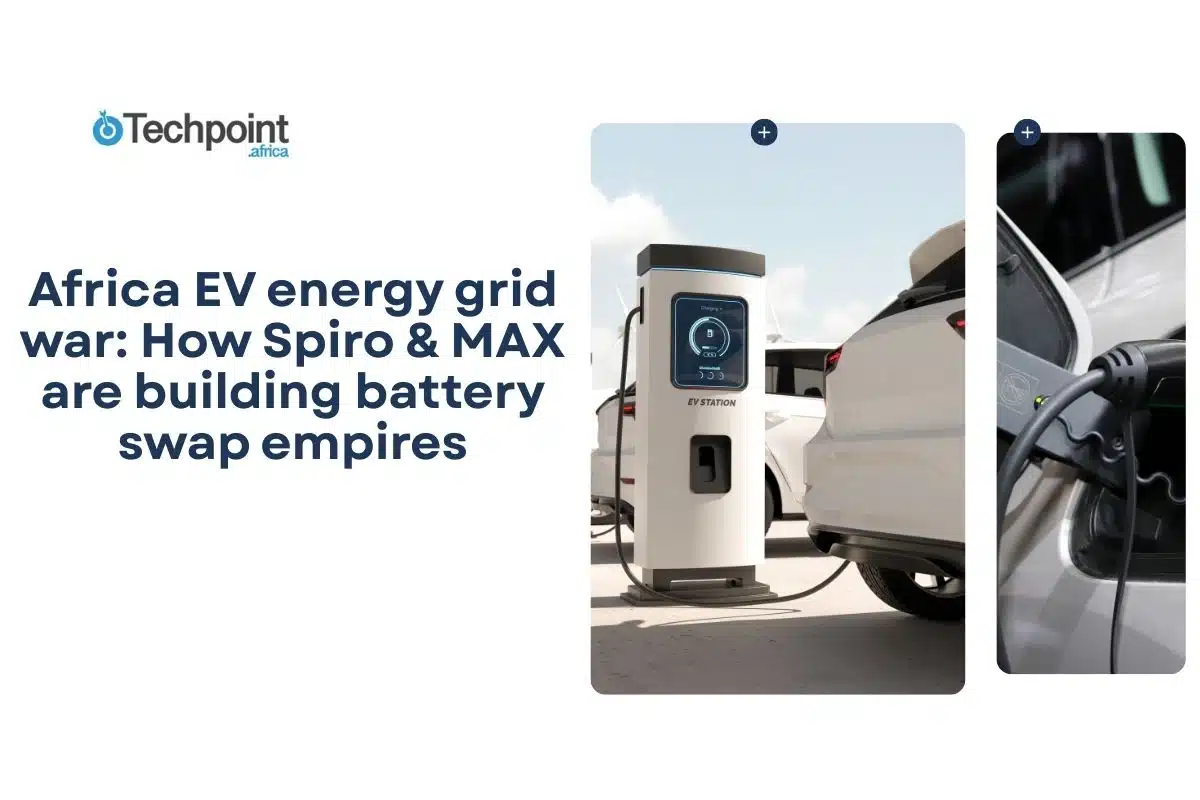


The real prize in Africa’s EV revolution isn’t the motorcycles, but the battery swap stations that will soon control how an entire continent moves.
Key takeaways
- Spiro alone has deployed over 2,500 swap stations across six countries (Kenya, Uganda, Rwanda, Nigeria, Benin, and Togo), completed more than 30 million battery swaps, and enabled over 1 billion kilometers of carbon-free travel since launching.
- With Spiro raising $50 million in February 2026 from Afreximbank, Nithio, and the Africa Go Green Fund, and MAX securing $24 million in January 2026 from Equitane, Novastar, and Triple Jump, these two players are locking down territory.
- Battery swapping solves what plug-in charging can’t in African cities. Swapping takes under two minutes, whereas commercial motorcycle drivers across the continent can’t afford to sit for hours waiting for a battery to charge.
- Swap networks are becoming infrastructure monopolies by design, since the companies that own the batteries and the swap stations control the relationship with the rider forever.
- The stakes for investors and startups couldn’t be higher, with Spiro raising over $230 million since 2022 and MAX hitting profitability in Nigeria.
Let me paint you a picture of the problem.
Across Africa’s cities, millions of motorcycle taxis (okadas or boda bodas) keep economies moving. But these bikes are mostly petrol-guzzlers, and the transition to electric has hit a wall for three reasons:
- Charging infrastructure is a nightmare.
- Grid power is unreliable, with frequent outages.
- In many neighborhoods, there’s nowhere to plug in at all.
With battery swap stations, however, riders roll up to a kiosk, slide out the depleted pack, and slot in a fully charged one in less than five minutes, instead of waiting hours for a dead battery to recharge. This is fundamentally changing who controls energy in African cities. Spiro and MAX are the two companies leading this charge.
I’ll walk you through why battery swapping is winning over plug-in charging, how Spiro and MAX are racing to build infrastructure monopolies, and what this means for everyone else.
EV charging vs. battery swap infrastructure
| Factor | EV charging stations | Battery swap stations |
| Which scales faster | Slow: requires grid upgrades and lengthy installation | Fast: modular stations can be deployed rapidly |
| Vehicle downtime | 1–4 hours for a full charge | 2 minutes or less |
| Infrastructure cost | High per unit, but declining | Higher upfront, but lower per swap over time |
| Energy grid dependency | Total (outages mean no charging) | Low (batteries can be charged during off-peak hours or via solar) |
| Fleet operations | Disruptive, as vehicles are parked for hours | Seamless. Vehicles stay in revenue service |
| Urban scalability | Limited by real estate and grid capacity | High, since kiosks can fit in many locations |
| Adoption by delivery fleets | Low. Downtime reduces margins | High |
Africa’s EV boom is creating an infrastructure race
As funding tightens and investors get picky, the easy money of the fintech era is drying up. January 2026 was the lowest month for deal count since at least 2020, with only 26 startups raising any capital.
While everyone else was freezing, electric mobility companies were raising nine-figure rounds. February saw African tech funding more than double to $346 million, with electric vehicles and green energy at the forefront.
Three things are driving this trend:
- The numbers are getting too big to ignore. Spiro alone has now deployed over 80,000 electric motorcycles across six countries. When you add in players like MAX, ARC Ride, and Ampersand, you’re looking at well over 100,000 electric two-wheelers on African roads today.
- Urban logistics is exploding. Delivery riders are everywhere. From food and package delivery to passenger transport, the gig economy runs on two wheels. With petrol prices swinging wildly, the math on electric starts looking very attractive, very fast.
- The bottleneck has gone from the vehicles to the infrastructure. You can manufacture all the electric motorcycles you want, but if riders can’t charge them, you’ve got nothing but expensive inventory. That’s why we’re seeing capital flood into battery swapping networks specifically.
The players understand that vehicle sales are one-time transactions, whereas energy subscriptions generate recurring revenue. Hence, the race to build that energy network.
How battery swap stations work
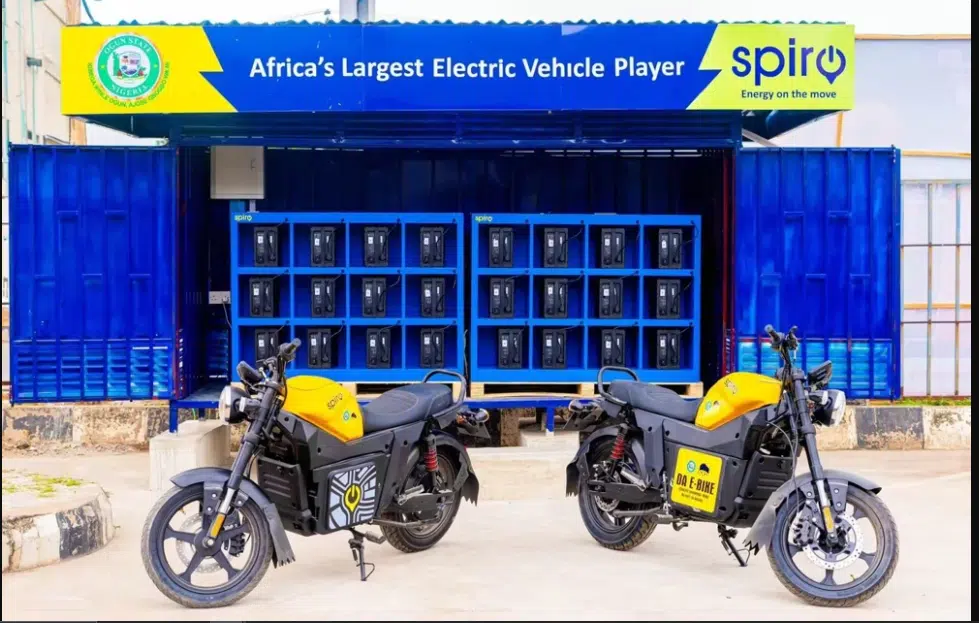
A battery swap station looks nothing like the charging stations you’re used to seeing for cars. There’s no cable, no plug, no waiting.
Instead, you’ve got a kiosk (sometimes automated, sometimes staffed) with racks of batteries charging in the background.
Operational workflow
- The rider rolls up on their electric motorcycle. The bike has one or two depleted batteries, depending on the model.
- The rider hands over the dead pack.
- The attendant or automated system pulls a fully charged one from the rack, and the rider slots it in.
That’s it. The whole exchange takes as little as under five minutes from arrival to departure.
Technology
Modern swap stations use RFID tags or barcodes on every battery to track its identity, charge cycles, and health status. When a rider swaps, the system knows exactly which battery is going out and which is coming in.
This matters because batteries degrade over time, they lose capacity with every charge cycle, and the operator needs to manage that inventory intelligently.
Modular design
Swap stations are built around standardized battery systems. Spiro, for instance, has designed its bikes and batteries so that the packs are interchangeable across its entire fleet. It means a rider isn’t tied to a specific battery.
Subscription
Riders typically don’t buy the battery up front, as that would add $500 to $1,000 to the vehicle cost, which is prohibitive for most commercial riders. Instead, they pay a subscription. It could be a per swap, weekly, or monthly fee.
Fleet advantages
When you’re running delivery bikes, downtime is literally lost revenue. A rider who sits at a charging station for two hours isn’t making deliveries. A rider who swaps in two minutes is back on the road instantly. That efficiency compounds across hundreds of bikes.
And because the stations charge batteries during off-peak hours or integrate solar, they can smooth out demand on the grid rather than spike it.
Why battery swapping works better than charging in African cities
Plug-in charging is struggling to gain traction in African cities because the context is different here.
- In Lagos or Nairobi, for instance, you can’t assume riders have dedicated parking with reliable power.
- Most riders live in dense informal settlements where overnight charging is impossible.
- The grid is unpredictable, as outages can hit at any time, leaving bikes stranded.
But the outcome significantly improves with swapping.
A rider rolls in, swaps a depleted battery for a fully charged one in under two minutes, and gets back to work. No need to wait or depend on the grid at that moment.
For commercial riders (e.g., delivery guys and taxi operators), time is literally money. A two-hour charge kills their earnings for the day, but a two-minute swap barely registers.
Here’s how the two models compare in practice:
| Factor | Charging model | Swap model |
| Time required | 1–4 hours | Usually under two minutes |
| Grid reliability dependency | Total: outages mean no charge | Low: batteries charged off-peak |
| Fleet compatibility | Poor (downtime kills margins) | Ideal (minimal revenue interruption) |
| Urban deployment | Requires dedicated parking spots | Fits on any street corner. Swap stations can go in a kiosk, a shop front, or a petrol station |
Spiro vs MAX: The battle for Africa’s battery grid
Spiro’s infrastructure strategy to build the grid before the competition catches up
With 80,000 bikes and 2,500 swap stations across six countries, Spiro has created a network effect that’s incredibly hard to replicate. A competitor entering Kenya today faces riders already locked into Spiro’s subscription model, and the company commands 60% of new EV motorcycle sales there.
The recent $50 million debt raise over equity tells you that Spiro is confident in its cash flows. They’re not giving away more ownership. Instead, they’re betting their energy subscriptions can service this capital.
Their assembly plants in Nigeria, Kenya, Uganda, and Rwanda cut costs dramatically. Import duties vanish, supply chains shorten, and margins greatly improve.
But scale brings pain. Spiro admits to battery supply imbalances, with stations sometimes running out of power during peak hours because demand outstrips their charging capacity. It’s a good problem to have, but it reveals how delicate the logistics are when you’re moving this fast.
Can MAX and the challengers break Spiro’s network effect?
MAX is holding its own in the face of Spiro’s bold play. They raised $24 million in January 2026 and, importantly, have reached profitability in Nigeria, their home market. That’s a big deal.
MAX operates a different model. They’re more vertically integrated, handling vehicle assembly in Ibadan (capacity: 3,600 units monthly), IoT systems, and financing through a single platform. They currently run in 20 cities across three countries.
Other players are active too. Arc Ride raised $5 million from IFC for East African growth. Gogo Electric picked up $1 million for Uganda. The field is fragmenting.
Could multiple networks coexist? Possibly, if batteries become interoperable. But standards don’t exist yet. Today, a Spiro battery won’t fit a MAX bike. Until that changes, riders choose one ecosystem and stick with it.
The infrastructure monopoly question
Should one private company control the energy supply for millions of commercial motorcycle riders across multiple countries?
We’ve seen this movie before. In the 1990s, private water concessions in South Africa promised efficiency but created monopolies that left governments with little control over essential services.
The same risks apply here. If Spiro or MAX dominates a market, they set pricing. They decide who swaps and when. They can even remotely disable bikes, as Kenyan riders recently discovered, prompting protests in Nairobi and Mombasa.
Kenya’s new National E-Mobility Policy takes a first step by mandating green plates and tax incentives, but it says almost nothing about open access or interoperability. Spiro’s CEO says he’s open to certified integrations, but “openly allowing any battery to enter any swap station without integration is a recipe for disaster.” He’s not wrong on safety. But the result is walled gardens.
The better path is public-private partnerships with regulated access requirements, open battery standards, and independent oversight. Ampersand is already moving in this direction, offering its network to other manufacturers in Kenya and Rwanda. That’s the model that serves riders, not just shareholders.
Risks of infrastructure monopolies in electric mobility
- Market concentration risk. If one player controls neatly two-thirds of Kenya’s EV motorcycle sales and the swap network they depend on, competition doesn’t exist.
- Pricing control. Today, swap fees are competitive. But once networks mature, and riders are locked in, nothing stops prices from creeping up. In Kenya, riders already lose up to 500 shillings (~$4) per missed swap, and they’re protesting for more stations.
- Barriers for startups. New EV manufacturers can’t afford to build competing swap networks. Without open access, they’re dead on arrival.
- Regulatory lag. Governments are moving, but policy is playing catch-up to infrastructure that’s already in the ground.
FAQs
What is a battery swap station?
It’s a kiosk where electric motorcycle riders exchange a depleted battery for a fully charged one in under two minutes.
Why are EV startups in Africa choosing battery swapping instead of charging?
By swapping, we solve the grid reliability problem and eliminate downtime for commercial riders.
Which companies dominate Africa’s battery swapping infrastructure?
Spiro leads with 80,000+ bikes and 2,500 stations across six countries. MAX is the primary challenger.
Conclusion
Africa’s electric mobility revolution is real. It’s happening on streets from Lagos to Nairobi. And it’s already improving lives: riders are saving money, breathing less exhaust, and keeping more of their earnings.
Spiro’s battery swap success brings its own challenges.
- The same network effects that make swapping efficient also create lock-in.
- The same vertical integration that ensures safety and reliability also excludes competition.
- The same capital intensity that builds infrastructure also raises barriers for new entrants.
We’ve been here before with utilities, railways, and water concessions. The lesson is consistent: private capital builds fast, but public oversight protects fairness.
Kenya’s new e-mobility policy is a start, but it doesn’t yet mandate open access or interoperability. Rwanda, Nigeria, and others are watching. The question has shifted from whether Spiro or MAX will win (they’re both winning) to whether riders, cities, and governments will have a say in how the rules are written.
Citations
- https://apnews.com/article/spiro-electric-bikes-battery-swapping-emobility-africa-e91ff820907dd8329d15a9f2ed1e2b20
- https://techpoint.africa/news/spiro-inks-debt-financing-africa-expansion/
- https://nairametrics.com/2026/01/17/nigerian-startup-max-secures-24m-to-scale-electric-vehicle-financing/
- https://www.semafor.com/article/02/25/2026/spiro-fuels-electric-vehicle-expansion-in-africa
- https://techcabal.com/2026/01/16/max-24-million-profitbale/
- https://techsudor.com/deal-drought-for-african-start-ups-as-funding-slumps-to-174m-in-january-2026/
- https://techmoran.com/2026/03/09/african-tech-rebound-in-february-2026-funding-doubles-to-346m-as-electric-vehicles-and-green-energy-lead-the-way/
- https://techpoint.africa/guide/venture-capital-african-solar-microgrids/
- https://www.ecofinagency.com/news-industry/2502-53242-electric-motorcycle-startup-spiro-raises-50-million-to-scale-battery-swapping-in-africa
- https://ieeexplore.ieee.org/document/11013035/authors#authors
- https://techcabal.com/2025/10/21/spiro-secures-100-million-in-new-funding/
- https://techpoint.africa/news/ev-spiro-launches-nigeria-ogun/
- https://businessday.ng/technology/article/equitane-novastar-triple-jump-back-maxs-24m-raise-for-african-ev-scale-up/
- https://techcabal.com/2026/02/17/keny-arc-ride-ifc-5-seriesa/
- https://www.africaprivateequitynews.com/p/edfi-electrifi-injects-further-1m
- https://www.emerald.com/jmapl/article-abstract/161/4/147/436420/Public-private-delivery-of-urban-water-services-in?redirectedFrom=fulltext
- https://apnews.com/article/kenya-uganda-rwanda-ebikes-motorcycles-battery-964b13f58358201a2b51818c9af2dd6c
- https://techpoint.africa/news/kenya-set-approve-first-green-mobility/
- https://www.seattletimes.com/business/electric-motorcycle-riders-in-kenya-demand-more-flexible-battery-networks/
- https://www.ampersand.energy/mediacentre/ampersand-energy-becomes-first-in-africa-to-open-battery-swap-network-to-worldwide-vehicle-manufacturers
- https://www.bastillepost.com/global/article/5593917-electric-motorcycle-riders-in-kenya-demand-more-flexible-battery-networks#:~:text=%E2%80%9CThis%20open%2Dplatform%20approach%20means,coverage%20areas%20at%20AP.org.
Disclaimer!
This publication, review, or article (“Content”) is based on our independent evaluation and is subjective, reflecting our opinions, which may differ from others’ perspectives or experiences. We do not guarantee the accuracy or completeness of the Content and disclaim responsibility for any errors or omissions it may contain.
The information provided is not investment advice and should not be treated as such, as products or services may change after publication. By engaging with our Content, you acknowledge its subjective nature and agree not to hold us liable for any losses or damages arising from your reliance on the information provided.
Always conduct your research and consult professionals where necessary.