




When Jump n Pass launched in Nigeria, it felt like a glimpse into the future of African retail. Scan your items, skip the queue, pay a small fee, and walk out. No waiting. No cashier drama. No long holiday lines stretching to the back of the store.
On paper, it was brilliant. In reality, adoption has been slower than many expected despite its partnership with Justrite. Retailers were cautious; customers were curious but inconsistent. And like many friction-reducing technologies, the idea seemed more exciting than the execution.
Now, thousands of kilometres away, a Nigerian founder in Canada believes the experiment deserves another shot — just not in Nigeria.
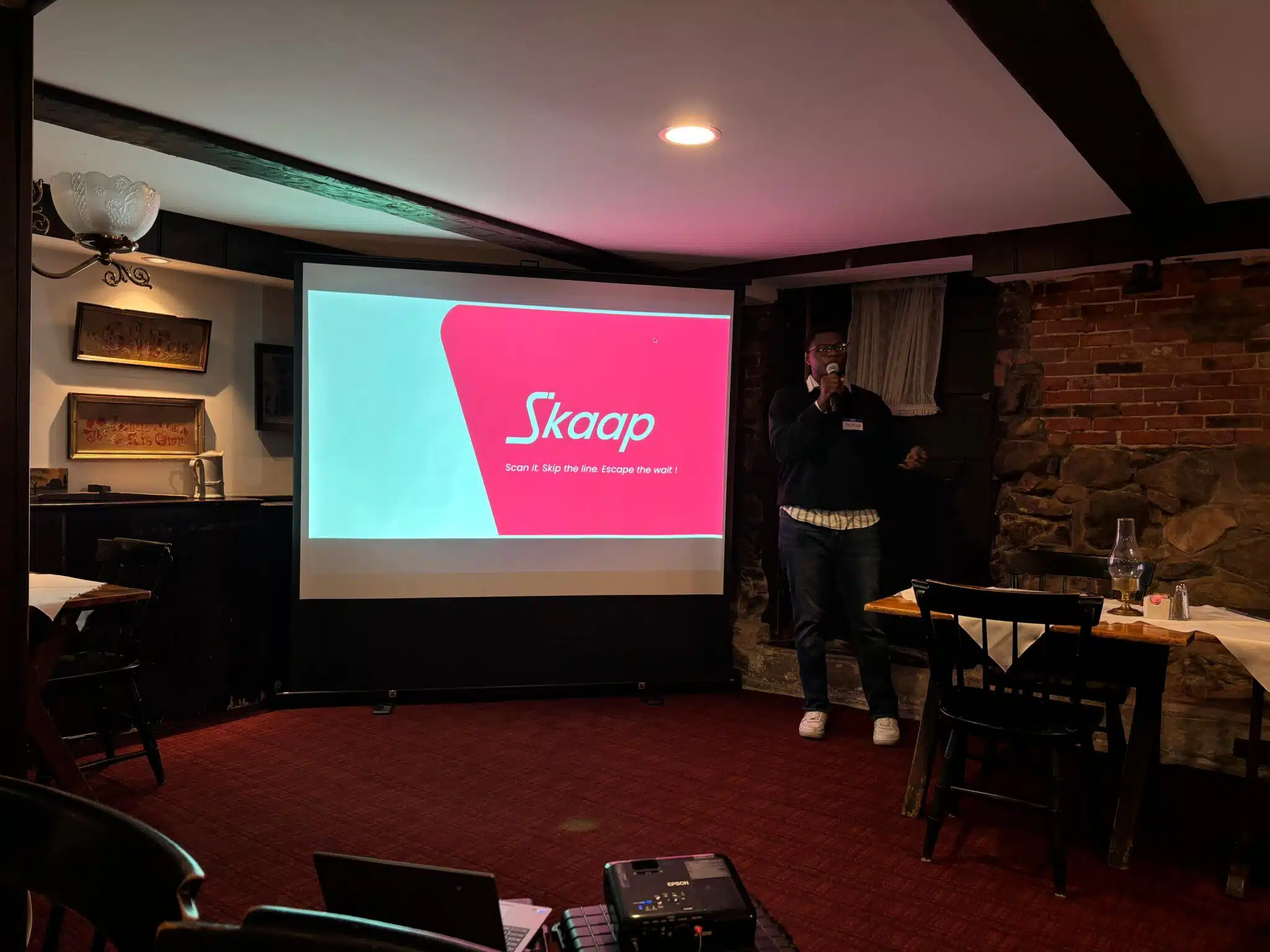
SKAAP, founded by Lagos-born entrepreneur Samuel Ayo Oyedemi, is building a similar scan-and-go system, first in Canada and now with its eyes firmly set on the US.
But Oyedemi says this isn’t a copy-and-paste job. He already had the idea; Jump n Pass just validated it. Perhaps the solution could be more promising outside Nigeria.
“I saw a company in Nigeria doing something similar, and I said to myself, if this technology can exist there, then there’s definitely a problem worth solving.”
From Agege to Saskatchewan
Before Canada, Oyedemi was born and raised in Lagos, growing up in a household where entrepreneurship wasn’t a buzzword; it was survival. As a teenager, he sold doughnuts in secondary school, sometimes making ₦2,500 a week.
He washed cars. He experimented. He partnered with his father to co-found a borehole installation business. He tried an adire clothing venture that failed. He ran a small lending operation with his mother. At one point, he worked at Access Bank, learning how money moves and how investment works.
In 2023, he relocated to Canada. His first job was a commission-based sales role for a US startup expanding northward. It taught him that Canadians value trust; if you break it, you don’t get a second chance.
Then he joined athletic apparel giant Lululemon, and that’s where SKAAP was born.
“It was a peak holiday rush, and the queues were long queues. Customers waited up to 30 minutes just to pay. One lady walked in; I helped her with the mobile POS, and she was out in like ten minutes.”
This experience led him to think about a solution to the long queues at retail stores. Something that could allow customers to simply check out themselves.
What he came up with was similar to Jump n Pass and validated the idea in his mind, but he added a twist that would work better in a more advanced market.
How SKAAP works
Like Jump n Pass, SKAAP is promising a seamless shopping experience that Oyedemi sums up as scan, skip, escape.
When you walk into a store, you scan a barcode that identifies the store you are in and gives you access to its inventory. When you pick up an item, you scan it and add it to your shopping cart.
“When you’re done shopping, you can pay instantly with App Pay if you have it connected to your phone. Then, as soon as you pay, an exit pass is generated for you.”
This exit pass is what confirms that you’ve paid for the goods in your cart. However, it still doesn’t protect the retail store owner against theft.
Jump n Pass faced similar troubles, and the solution was to have a store attendant inspect the items bought, ensuring they were paid for — an alternative that defeats the entire premise of the business.
It was conceded that the self-checkout platform would be used only for people who weren’t buying many items.
But SKAAP is recording some traction. During beta testing across about 10 stores in Calgary, Edmonton, and Saskatchewan, SKAAP onboarded roughly 200 users, but this hasn’t translated into high transaction volumes
“Transaction volume has not been the highest. The focus has been on a frictionless experience. It is important to get local retailers comfortable with someone just walking in, scanning, and leaving.”
It is not just the retailers that need to get comfortable using the product. One early discovery was the need for a SKAAP-specific QR code at store entrances. Once scanned, it loads the inventory of that specific location, eliminating confusion and preventing misuse.
There was also a need to iterate the product for young shoppers.
“We’re experimenting more with Gen Z because they want things faster. They don’t just want speed at checkout; they want speed at launch. Opening the app and navigating through menus felt like friction. They want it to behave like Snapchat — camera first, action first.”
Oyedemi also scrapped an earlier plan to build a full inventory management system. Instead, SKAAP now positions itself as a layer, not a replacement, sitting on top of existing retail systems while surfacing insights such as fast-moving versus slow-moving products.
Interestingly, Odeyemi’s decision to bring what can be described as asset-light self-checkout to Canada and the US isn’t without competition
Companies like Walmart, 7-Eleven, Sam’s Club, BJ’s Wholesale Club, and even U-Haul already offer scan-and-go technology, but according to Odeyemi, they all operate within their own closed ecosystems.
“If Walmart has its own app and 7-Eleven has its own app, you can’t expect people to download 20 different apps just to shop.”
However, SKAAP isn’t necessarily in competition with the big retail stores and supermarkets. In a sense, it is building retail technology for the small stores that don’t have the resources to build it themselves.
“Self-checkout machines are very expensive, and small to medium retailers can’t afford to have multiple machines in their stores, so we are their cost-effective option.”
Canada to America
After early wins, including acceptance into Saskatchewan’s Cultivator programme and later into DMZ, described as Canada’s equivalent of Y Combinator, Oyedemi began to notice that Canada might not be the best place for a self-checkout solution.
“There was a gap in the market, but there wasn’t much market in the gap. Canada is great, but a lot of the cities don’t have the population density, meaning there isn’t heavy foot traffic.”
Higher population density generally leads to more people in urban and suburban areas. This means there’s potential foot traffic volumes per store. According to Intelpoint, there are about 38 people per km² in the US vs roughly 4 per km² in Canada.
Because of this, he decided to move to the US. While research on which city to launch is still ongoing, Oyedemi plans to launch SKAAP in the US in Q2 2026 and generate revenue by charging retailers a subscription fee. SKAAP hasn’t gotten investment yet, but whether the US market will embrace what Nigeria didn’t remains to be seen.