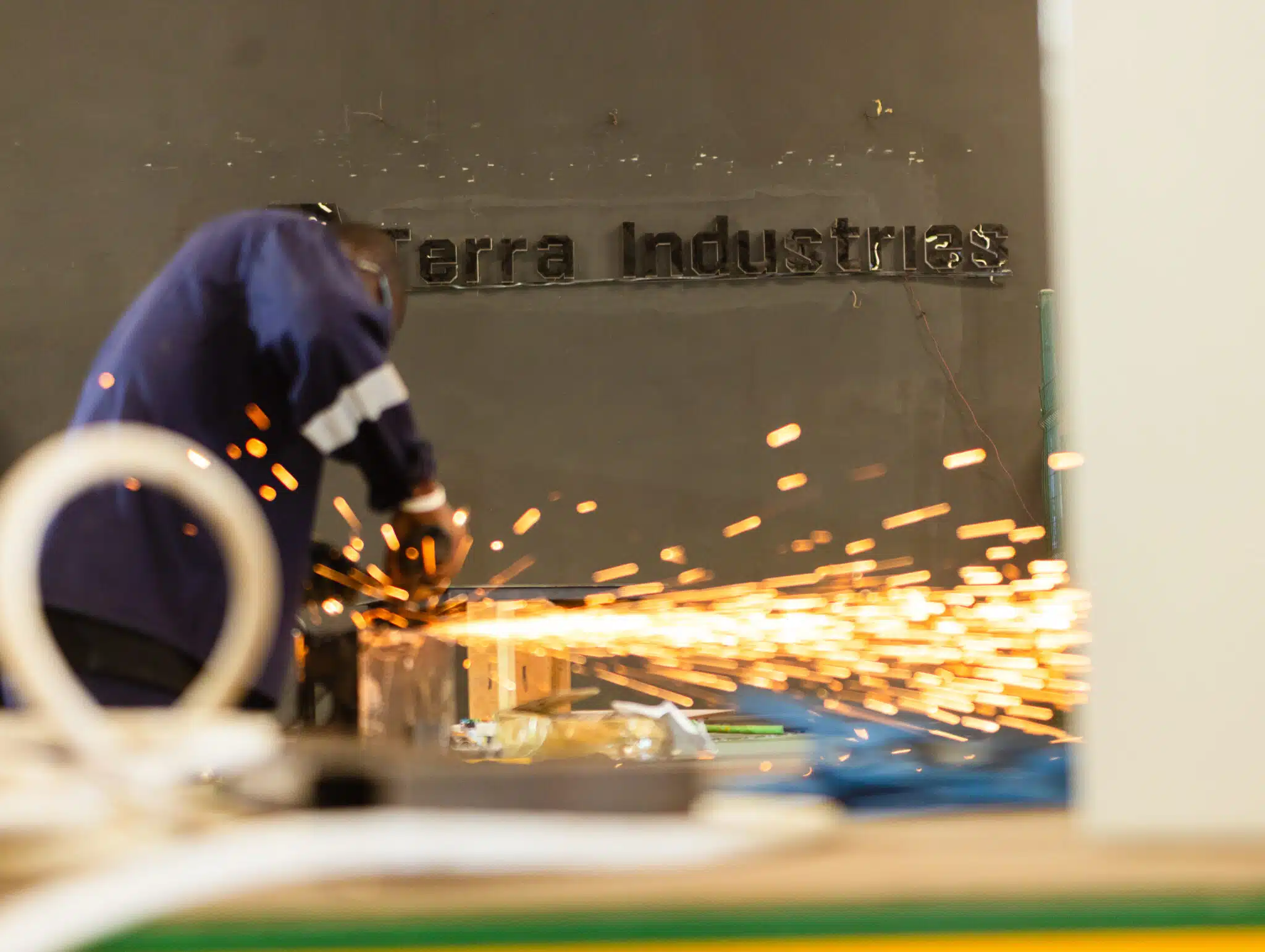




In June 2025, Nigerian drone startup Terra Industries (formerly Terrahaptix) achieved a remarkable feat: it outbid an Israeli consortium to win a $1.2 million contract for hydropower plant security. Terra’s drones, designed and manufactured in Abuja, proved cheaper, faster to deploy, and better suited to Nigeria’s terrain than foreign alternatives. According to Nathan Nwachuku, Terra’s CEO, the competitive advantage came down to “data sovereignty and a full-stack ecosystem.”
The contract involves deploying about 12 autonomous drones and over 35 surveillance towers to monitor critical infrastructure. Nathan went on to say the plants being secured ‘have been used as hideouts by bandits and even some terrorists,’ making this look like a frontline military defence project, even though it is packaged as commercial ‘infrastructure security.’ The reason for this framing is actually interesting.
The double bind: foreign capital, foreign control
One of Terra’s founders, Maxwell Maduka, was in fact a former Nigerian Navy drone engineer. Considering Nigeria’s security crisis, the necessity of a company like Terra in improving Nigeria’s defence cannot be overstated. However, in May 2024, Terra reportedly shut down its defence division, announcing that it would no longer develop or research military systems.
The closure announcement cited “ethical considerations,” but the timing might tell a different story. Terra had just raised $ 800,000 in pre-seed funding from mostly US-based VCs. Terra was building military drones. Then they stopped. “…We do not want ethical disasters in our hands,” CEO Nathan Nwachuku said in the press release. “We want to produce low-cost, mobile robots and automate core industries globally, not fight wars.” Six months later, Terra won a $1.2M contract to protect hydropower plants that, according to the CEO, had been “used as hideouts by bandits and even some terrorists.” Their drones now monitor threats, relay real-time intelligence, and provide persistent aerial surveillance. The only difference? The contract is labelled “infrastructure security,” not defence.
US investors didn’t need to dictate Terra’s roadmap; the terms of capital appear to have done that, based on how defence and dual‑use startups are typically financed, and this is where foreign influence becomes structural, not conspiratorial. When asked directly about investor restrictions, Nathan was emphatic: “None, we live in a different world. The likes of Anduril and Palantir paved the way for global defence startups.” He attributes the closure solely to ethics, noting it “could change if we feel Africa truly needs it.” Yet even as Terra recently raised what Nwachuku calls ‘a historic round for Africa’ (to be announced in January 2026), the company continues operating in the infrastructure security space rather than returning to explicit defence work. The venture capital model for dual-use technology, with its ESG exclusions, LP restrictions, and compliance regimes, creates structural constraints that operate regardless of whether individual founders perceive them as such. Terra isn’t backed by defence contractors or sovereign wealth funds; it’s backed by venture funds whose limited partners often have explicit restrictions on defence investments, particularly in foreign militaries.
The Leahy Law is a law in the U.S. prohibiting military aid to foreign security force units with credible evidence of committing “gross violations of human rights” (GVHRs) like torture, extrajudicial killing, or rape, aiming to prevent U.S. funds from supporting such abuses. For a decade, this law has been used to dictate what the Nigerian military can purchase. US officials vetoed Israel’s 2014 resale of US‑made Cobra gunships to Nigeria, and in 2021, senators froze an $875 million package of 12 AH‑1 attack helicopters, engines, and precision weapons under the Leahy Law. The same US system that restricts arms exports also supplies the venture capital whose ESG and compliance regimes make overt weapons work almost untouchable for Nigerian founders, especially those that require external funding.
The asymmetry is structural: the US sells Nigeria military equipment under strict conditions at premium prices, then the US and other external capital prevent Nigerian startups from building alternatives. Ironically, Nathan cites Anduril and Palantir as proof that the landscape has changed for defence startups. However, those companies operate within the US market, securing Pentagon contracts and selling to their own military. Terra would be a foreign defence contractor selling to a military subject to these very export restrictions and Leahy Law vetting. The ‘different world’ Anduril inhabits doesn’t extend to Nigerian startups building for the Nigerian military.
So Nigeria neither truly controls its weapons supply nor the development of new systems. Companies like Terra survive by routing capability through “infrastructure security” contracts that appear and function like defence, because labeling them as such would disrupt their funding model.
Why it’s difficult for startups to work with the military
On 1 December 2015, Colonel Dasuki, Nigeria’s former National Security Advisor, was arrested after a $2 billion arms procurement deal corruption was exposed. He was accused of awarding phantom contracts to purchase 12 helicopters, 4 fighter jets, and ammunition. The equipment was meant for the fight against Boko Haram Islamist militants.
In the same light, Transparency International’s defence integrity ratings place Nigeria in a very high risk category (Band E), including a critical risk in defence procurement. In May of this year (2025), 18 soldiers and 15 police officers were arrested for selling military weapons to armed groups, demonstrating that the corruption isn’t just high-level but at various layers of the government. Former NSA Monguno admitted in 2020 that ‘the president provided enormous funds, but equipment was not purchased.’
As recently as 2024, Transparency International Defence and Security reported $8.9 million in stolen defence funds was seized by the Royal Court in Jersey, money meant for Boko Haram equipment that never arrived.
Terra raised $800,000 and was reported to have generated approximately $1 million in revenue in its first year from commercial deployments. That sort of fast revenue ramp is unlikely if the core business were military procurement, especially in Nigeria, where payments take years, contracts get tangled in investigations, and there is no guarantee the equipment will be used properly. So, even if Terra somehow decided to work with the Nigerian military, procurement may be so broken that venture-backed startups can’t survive it.
The decision to close down their defence arm cannot be reduced to ethics, profit, or patriotism; it’s primarily about operational reality. To put it plainly, a venture‑backed startup pursuing rapid growth would struggle to hit those numbers if it relied primarily on Nigerian military contracts.
Why “infrastructure security” is actually national security
Over a single “weekend of horror” 20-30 November 2025, per Premium Times, armed groups attacked four northern states (Kogi, Sokoto, Kwara, Kano) hitting churches, a wedding, farms, homes, and traditional institutions, the most curious of these attacks was at Ejiba, Kogi, where attackers were allegedly to have used a commercial-style drone to surveil a Cherubim and Seraphim church service before storming it, kidnapping the pastor, his wife, and congregants.
Nigerian security reporting already points to insurgents in the north‑east z and experimenting with commercial‑style drones, demonstrating the threat landscape Nigerian infrastructure faces, mirroring how armed groups across the Sahel, Syria, and Iraq have adapted off‑the‑shelf tech. Whether Terra is protecting a ‘private’ hydropower plant is irrelevant; Nigerian infrastructures are strategic targets for terrorists and bandits, a Telco cable cut or hydropower outage crashes communications, pipeline attacks cut revenue and affect the flow of resources to citizens, and mining disruptions fund insurgents.
So, Terra’s contract isn’t just commercially focused; protecting hydropower protects military logistics, surveillance over remote terrain provides intelligence gathering, real-time threat monitoring serves as early warning, and National security capability is being delivered, albeit not by the military and not through defence procurement.
The workaround is effective, but it relies on informal relationships rather than established institutional frameworks. We need to ask some sincere questions, for example, who owns the surveillance data that Terra and companies like them collect? Is it shared with security agencies? Under what framework? If Terra gets acquired by external players or hacked, who controls strategic intelligence about Nigeria’s critical infrastructure?
The model that works
The current system works; it’s better to have the likes of Terra in the ecosystem than not. Still, the current system is brittle; it’s ungoverned, with no data-sharing protocols, no integration frameworks, and competing private operators who can’t coordinate in a crisis. It works during peacetime, with low-intensity conflict, stable supply chains, and no sanctions pressure; however, things can change rapidly. What if sanctions cut off foreign components? What if a “commercial” security firm gets compromised?
There was a time when Nigeria didn’t have the technology. Now, Nigeria has the Tech, but we do not have the system. Let me paint a picture briefly; Ukraine heavily utilises commercial drones, but with military integration, government coordination, and centralised procurement, all elements we need to drastically improve.
When asked about the distinction between infrastructure and defence work, Nathan is direct: “Infrastructure security is at the heart of defence in Africa. When terrorists attack in Africa, they typically target the lifeblood of a nation: pipelines, power plants, oil rigs, telecom towers.” His framing acknowledges what I explored in this article: that the distinction between infrastructure and defence security is increasingly meaningless in Africa’s threat environment.
Terra Industries proved Nigerian firms can compete globally on price, speed, and technical capabilities. But the story behind that $1.2 million contract reveals something more uncomfortable: capital decides what Terra can build, be it from the US or elsewhere; US policy limits what Nigeria’s military can buy, so Terra delivers military-grade surveillance under a commercial label. This workaround works until something breaks.
Nigeria has a defence capability that flows through commercial channels, shaped by foreign capital, and is governed by nobody in particular. That’s not a defence industrial base. That’s a gamble. We need frameworks that enable military-dual-tech collaboration without the legacy bottlenecks, and incentives that make it profitable for startups to build for national security. The technology exists. The system doesn’t.
About the Author
Babatunde Fatai leads emerging technology strategy and implementation at MTN Nigeria, where he builds solutions that drive digital transformation and profitability across Africa’s largest telecom market. Follow him on LinkedIn for more insights: https://www.linkedin.com/in/babatundefatai/