
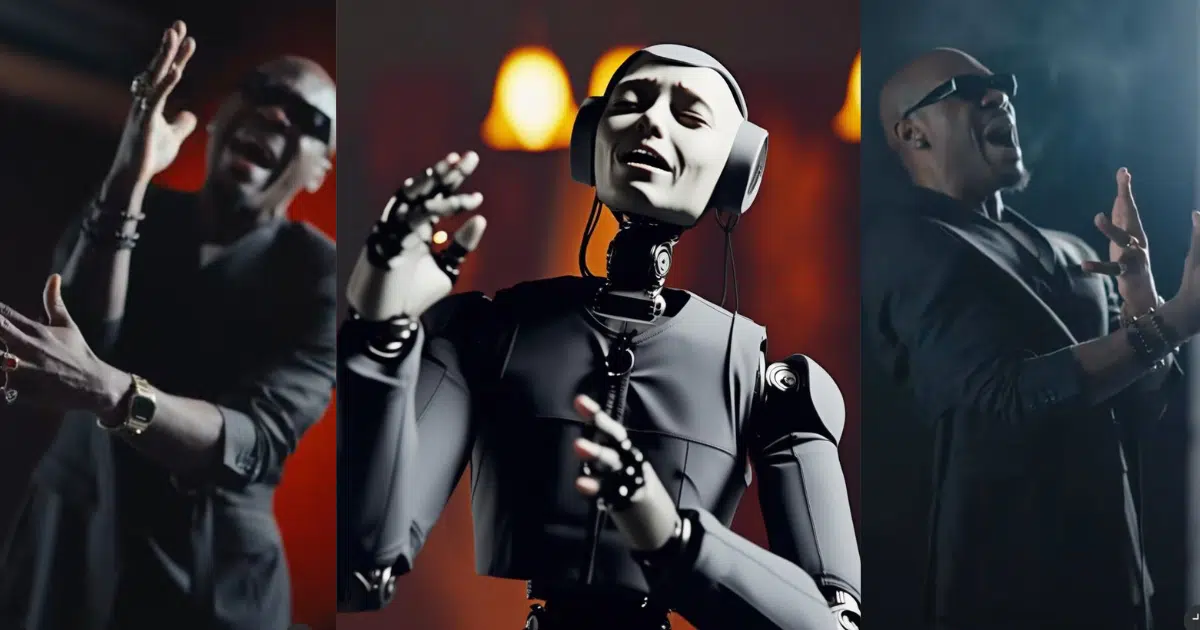

In December 2025, the Afro-soul version of the French song “Papaoutai” was released. It began trending heavily in early January 2026, peaking globally during the third week of January. By January 15, 2026, the track became the highest new entry on the Global Spotify charts, debuting at #168. It eventually climbed to #2 on the Billboard World Digital Song Sales chart.
What many did not know, however, was that it was an AI-generated remix of the original song. The original artiste is Stromae, a Belgian-Rwandan musician, rapper, and songwriter. The voice, however, is not actually Stromae’s original recording slowed down; it is an AI voice model trained on the voice of Arsène Mukendi, a Congolese-born artiste known for his appearance on The Voice France. The producers used AI voice cloning (Retrieval-based Voice Conversion) to project Mukendi’s soulful, African-inflected vocal texture onto the melody of Stromae’s original 2013 hit.
The trend was fueled by videos featuring a cinematic lip-sync by Arsène Mukendi himself, and because Mukendi is a real person and a talented singer, the visual looked so authentic that millions of users believed he had actually recorded a studio cover.
Interestingly, there has been a series of AI-generated remixes in recent times. In 2025, an unauthorised AI-generated choir version of Nigerian artiste Fave’s song Intentions created by an entity known as Urban Chords went viral on TikTok.
The AI model ingested the original vocal stems and transformed them into a multi-layered choral arrangement. Instead of a takedown, Fave entered the studio, recorded over the AI arrangement, and released it as an official remix.
While this sets a precedent for hybrid collaboration where the artiste uses the AI derivative to recapture streaming revenue, it also exposes the complexities of AI-generated remixes, especially for African artistes.
Music and media counsel, Ugwu Chikezirim, has seen this play out firsthand. One of his clients, a well-known Nigerian artiste, discovered that Urban Chords had taken their lyrics, manipulated them, and uploaded the resulting songs to digital platforms- all without authorisation. According to him, the entity had done the same to some other artistes and their tracks as well.
Litigation was considered, but the obstacle was identifying the individual behind the account. Without knowing who operates the account, pursuing legal action becomes complicated as evidence is required in court. The court filing was put on hold, but petitions to take down the tracks were sent to streaming platforms like Spotify.
“If the remixes persist, a court order may be required to compel digital platforms to disclose identifying information,” Chikezirim says.
Victoria Fakiya – Senior Writer
Techpoint Digest
Stop struggling to find your tech career path
Discover in-demand tech skills and build a standout portfolio in this FREE 5-day email course
How AI-generated music/remixes work
Most AI-generated songs are created using Generative AI models like Suno and Udio, which have been trained on millions of hours of existing music. These models don’t copy and paste audio; instead, they work like ChatGPT but for sound. They use neural networks to predict what a verse or a kick drum should sound like based on patterns.
For example, a user enters the text prompt, “A melancholic Afrobeats song about Lagos at night, 105 BPM, male soulful vocals,” then the AI synthesises the melody, harmony, lyrics, and vocals simultaneously.
Most African AI remixes use two primary methods: The retrieval-based voice conversion, which takes an existing vocal and skins it with an African artiste’s voice model, or the stem separation, which pulls the vocals out of a mastered track, allowing the AI to re-harmonise or re-beat the song, turning an Afropop song into an Amapiano track.
“The remix or the AI version is not just AI on its own.” Melody Nehemiah, founder of Songdis, explains. “It involves copyrighted material. It has lyrics, it has composition, and it exists only because of the original song. Without the original song, there would be nothing to reimagine. The lyrics, the words, the message, all of that comes from the original work.”
Who owns and who gains?
The ethical issue is that most AI-generated remixes rely on copyrighted material, often reusing lyrics, melodies, or compositions from original songs. This makes these remixes legally closer to sampling than to entirely new creations.
Sampling has long been a part of the music industry, and its rules are well established. When Burna Boy’s Last Last sampled an older song, for instance, the original rights holder reportedly took a large share of the royalties, and that agreement was still considered valid.
According to Nehemiah, music copyright is typically split into two major parts: sound recording rights, which cover the performance and recording, and composition rights, which cover the lyrics and songwriting.
“When a song is distributed, artists or labels usually earn sound recording royalties and streams. However, publishing royalties, which apply to films, adverts, and other commercial uses, require explicit permission from the original rights holder.”
Without clearance, AI remix creators cannot legally license songs for movies, adverts, or other commercial uses. In some cases, they risk legal action.
In that sense, AI-generated music can be monetised legally only when the original artiste is actively involved or has granted permission. In Papaoutai’s case, that should be the norm, but it is publicly unclear if Stromae’s permission was granted.
Today, some AI platforms allow users to generate full songs simply by inputting lyrics, and the results are often realistic enough to confuse listeners, but these tools come with hidden restrictions.
“Most people don’t read terms and conditions, but those terms clearly state that anything generated belongs to the platform,” Bukar Mamadu, an AI artiste and songwriter, says.
Several AI music platforms, like Suno, have, however, faced lawsuits from rights holders. In response, some platforms now claim ownership of all music generated on their systems, preventing users from monetising or distributing it freely. In simple terms, paid users no longer own the music; they’re only licensed to use it.
The US Copyright Office has clarified that copyright protection depends on human contribution. Users may claim copyright over elements they personally created, such as original lyrics, but not over AI-generated vocals or instrumentals.
If a user prompts an AI tool with something simple like “write a Valentine’s Day love song,” that prompt alone is not copyrightable. The creative threshold requires meaningful human input. Because of this, some creators now describe their music as “AI-assisted” rather than “AI-generated.” Writing original lyrics ensures a clearer claim to authorship.
Globally, there is no uniform standard. AI copyright remains an emerging legal field with no landmark music-specific precedent yet defining clear boundaries.
Also, the promise of passive income from streaming is often misleading, whether or not it involves AI.
According to Mamadu, he had invested over $60 in promoting one of his traditionally produced songs, but earned less than $20 in streaming revenue. One of his AI-generated songs that reached roughly 60,000 streams generated under $10.
Stream payouts vary by country. In the United States, a stream is worth fractions of a dollar. In Nigeria, it is even lower.
Spotify, Apple Music, and Deezer have moved away from a one-size-fits-all payout for AI content. They now categorise tracks into three distinct tax brackets. There’s the fully human-made content, which stands at a royalty rate of $0.003 to $0.005 per stream. AI-assisted or hybrid content receives a reduced rate of approximately 50% of the standard rate. While the fully AI-generated content rates at minimal (almost 0).
This means that earning substantial income requires millions, and sometimes billions, of streams. For purely AI-based artistes without live performance, brand identity, or institutional backing, long-term financial sustainability is uncertain.
When some users like Mamadu first uploaded songs to Suno, the terms suggested ownership and commercial freedom. Later, licensing terms changed.
The updated agreements showed that if a song becomes successful, the platform may still claim a percentage. Once a user uploads content and agrees to the terms, they remain bound by future modifications. Previously uploaded material cannot simply be withdrawn from the agreement, and platforms may also retain the right to use uploaded material for their own purposes, potentially even to create similar works.
The legal stance
Nigeria currently has no specific law regulating AI-generated music. Instead, the country relies on its existing copyright framework.
This is not unique to Nigeria alone. Even in more developed jurisdictions like the United States, regulators are still trying to define clear boundaries. In 2023, the US Copyright Office reviewed cases involving AI-generated songs that replicated the voices of Drake and The Weeknd. The songs generated revenue before the original artistes were even aware of them.
The emerging position in the US is that copyright protection depends on human authorship. If a work contains sufficient human originality, it may qualify for copyright protection. However, if it is entirely AI-generated and lacks meaningful human contribution, it may not be eligible for copyright protection.
Nigeria and other African countries have not formally adopted this position, but the principle of human authorship remains central to their existing copyright frameworks. Nigeria relies on the Copyright Act 2022, international labels are increasingly using the US ELVIS Act (2024) to protect African stars. While copyright protection is automatic once a creative work is fixed in a tangible form, AI introduces a critical complication.
Many AI systems are trained on existing datasets, and so if an AI tool produces a song based on that data, the originality of the new work is questionable. If authorship cannot be clearly linked to a human creator, establishing ownership becomes difficult.
“In music, two separate rights exist: the musical composition, which covers lyrics and melody, usually controlled by the publisher, and the sound recording or mastering, usually controlled by the label or financier of the recording. If AI-generated content uses either of these without authorisation, it may amount to infringement,” Nehemiah explains.
Beyond financial rights, moral rights are also at stake. Entertainment lawyer, Oluwadamilola Salako, explains that the motive also matters when it comes to AI generative works.
A song licensed for one purpose cannot automatically be used for another. For instance, using a worship song in a secular or inappropriate context could violate the creator’s moral rights, even if the music itself was lawfully accessed.
“The approach matters,” Salako explains. “Instead of looking at it like AI is infringing on my work and rights, it can be that AI is giving more opportunities. As long as the alteration is not done in such a way that it destroys the work or takes away elements of the work.”
How streaming platforms are responding
When AI-generated remixes or derivative works infringe on existing songs, liability can extend beyond just one party.
The primary infringer—the person who created or uploaded the content —may be sued. However, digital streaming platforms that distribute the infringing content may also face liability if they fail to conduct adequate compliance checks.
Some music companies are beginning to introduce contractual safeguards.
“New agreements may include AI clauses requiring artistes to disclose whether AI tools were used to create a work. Failure to disclose AI usage, especially if it results in infringement, could lead to penalties, fines, or contract termination,” Chikezirim says.
When Suno first emerged, it trained its models on existing music without consulting record labels. As the platform gained popularity, major labels including Universal Music Group (UMG), Sony, and Warner realised their catalogues had been used to train AI systems without compensation, and so legal action followed.
Suno has since entered preliminary licensing agreements with some of these labels. In late 2025, UMG reached settlements under which Suno and Udio now pay a licensing fee to a pool that, in theory, pays the artists. Warner Music Group (WMG) also settled its AI suits by creating a system where artistes can “opt-in” to have their voices used for AI remixes in exchange for 50/50 royalty splits.
In its early phase, AI music was largely unregulated. Users on Suno could generate songs, download MP3 files, and distribute them to Spotify, Apple Music, Boomplay, Audiomack, or other digital service providers (DSPs) through distributors. Now that freedom is narrowing.
Some AI platforms have restricted downloads, requiring users to listen to music within the AI platform itself rather than distributing it externally. Suno has taken a more flexible approach, recognising that restricting downloads limits creators’ ability to share their work.
But flexibility does not equal ownership.
French streaming platform Deezer introduced an AI-tagging system after approximately 50,000 AI-generated songs were reportedly uploaded daily. That scale far exceeds what human creators can produce.
Subscription and advertising revenue are collected into a shared pool and distributed based on stream share. If tens of thousands of AI songs generate massive streams, they draw from the same revenue pool as human artistes who may have spent years creating only a handful of songs.
Should artistes opt in or out?
According to Boubacar Djiba, a music-tech professional and the founder of Senmixmaster, we are entering what he describes as “an interesting age.”
While he isn’t opposed to AI artistes, he stresses the need for regulation. Human artistes still play a crucial creative role, but the economics of the industry may shift dramatically.
“I think it’s a huge opportunity for artists, especially those who are able to understand it and take advantage of it,” Djiba explains. “On the other hand, it’s going to be very challenging for artists who don’t understand how generative AI music works. There are also a lot of blurred lines on the copyright and licensing side, and these are things that need to be clearly addressed, especially when people are using other artists’ work to generate music.”
AI somehow now offers artistes a new creative tool. Generative AI can breathe new life into older songs, similar to sampling. It allows fans and creators to reimagine existing music in innovative ways.
Rather than resist AI outright, he argues that artistes should adapt strategically. His view is that artistes should consider creating licensed AI versions of their own voices.
“Your voice is your fingerprint as an artist,” Djiba says.
Controlled, properly licensed voice cloning could allow artistes to earn revenue when their AI voice is used in projects. Similar licensing models already exist internationally, where recognisable voices are legally licensed and monetised. In this framework, AI does not replace the artiste, it extends them.
It also creates what he calls a potential “new economy” around artistes. Fans who cannot afford live performances could still legally use AI versions, while artistes continue to earn royalties. But without regulation, that same technology can easily be exploited.
Intellectual property lawyer for Arts and Music, Germaine Umanah, advises that artistes should take the necessary steps to safeguard their works.
“While copyright protection is automatic, formal registration with the Nigerian Copyright Commission strengthens evidentiary standing in court. Artistes should register their works formally, obtain copyright certificates, maintain documentation and timestamps, watermark or encrypt demos, and limit the circulation of unprotected drafts,” Umanah states.