



Knowing how to write a press release is one of the most useful skills for founders, marketers, and PR professionals. Yet studies and newsroom feedback suggest that up to 97% of press releases never receive media coverage. Most are ignored within the first few seconds.
This does not mean press releases are outdated. They still matter for credibility, SEO visibility, investor signaling, and media trust.
Additionally, journalists rely on well-written press releases to quickly understand what is happening and why it matters.
In this guide, you will learn how to write a press release that journalists will actually read. We will walk through the correct press release format, a proven 7-step writing process, real examples, common mistakes to avoid, and a copy-paste press release template you can use immediately.
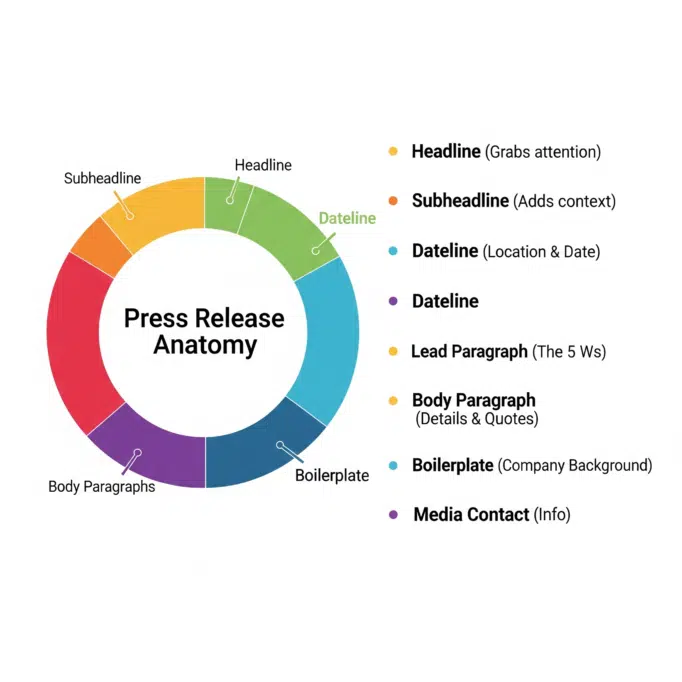
Quick-Glance: press release anatomy
Before writing, it helps to understand the basic structure of a press release. Journalists expect a familiar format so they can scan quickly.
| Component | Purpose | Word Count | Placement |
|---|---|---|---|
| Headline | Grab attention | 10–15 words | Top |
| Subheadline | Add context | 15–25 words | Below headline |
| Dateline | Location & date | 5–10 words | Before lead |
| Lead paragraph | Who, what, when, where, why | 40–60 words | First paragraph |
| Body paragraphs | Details, quotes, benefits | 200–400 words | Middle |
| Boilerplate | Company background | 50–100 words | Second to last |
| Contact info | Media contact details | 20–40 words | End |
7-Step process to write a press release
Step 1: Decide if your news is newsworthy
The first step in writing a press release is deciding whether you should write one at all.
News that is usually press-worthy includes:
- Funding announcements
- Product launches
- Major partnerships
- Acquisitions or mergers
- Significant milestones (users, revenue, expansion)
What usually does not qualify:
- Minor feature updates
- Promotional discounts
- Opinion pieces
- Internal team changes without broader impact
Ask yourself the “So what?” test. If a journalist read this headline, would their audience care?
If the answer is no, it may be better suited for a blog post rather than a press release.
Step 2: Write a compelling headline
Your headline determines whether your press release is read or ignored.
Good press release headlines:
- Lead with the news, not the company name
- Use active voice and strong verbs
- Include specific numbers or outcomes
Bad example: Company X Announces New Feature
Good example: AI Startup Raises $10M to Automate Legal Contracts
The goal is clarity, not cleverness. Journalists want facts, fast.
Step 3: Write a strong lead paragraph
The lead paragraph is the most crucial part of your press release.
In the first 2–3 sentences, answer:
- Who
- What
- When
- Where
- Why
While you may be tempted to include as much information as possible, it is best to place the most important information first and keep it under 60 words.
Sample template:
“[Company] today announced [what] to [primary benefit]. The [product or news] will [impact] starting [when].”
If a journalist reads only this paragraph, they should still understand the whole story.
Step 4: Add supporting details in the body
After the lead, the body paragraphs provide context and depth.
The structure below works best:
- Paragraph 2: Expand on the announcement
- Paragraph 3: Quote from leadership explaining why it matters
- Paragraph 4: Data, customer impact, or partner perspective
- Paragraph 5: Next steps, availability, or timeline
Keep the paragraphs short: 3 to 4 sentences maximum. This improves readability and makes scanning easier.
Step 5: Include meaningful quotes
Quotes help journalists add a human perspective to a story, but only if they add value.
Avoid generic quotes like: “We’re excited to announce…”
Good quotes explain why the news matters. They should provide insight, data, or industry context.
Always include:
- Full name
- Job title
- Company name
Example:
“This technology reduces contract review time from five hours to fifteen minutes, giving legal teams back 80% of their day,” said Jane Doe, CEO of LegalTech Co.
Aim for 2–3 quotes maximum.
Step 6: Write a clear boilerplate
The boilerplate is a short “About the Company” section.
It should be 3-4 sentences that answer:
- What you do
- Where you are located
- When you were founded
- Your key achievements or metrics
Boilerplate template:
“[Company] is a [location]-based [industry] company founded in [year]. The company’s [product or service] helps [customer type] [achieve outcome]. Since launching, [Company] has [key achievement]. Learn more at [website].”
Update your boilerplate regularly as the company grows.
Step 7: Format properly and add contact information
A professionally formatted press release signals credibility. It shows it wasn’t put together in a hurry.
Checklist:
- Start with FOR IMMEDIATE RELEASE.
- Use a readable font and single spacing.
- Keep total length to 400–600 words.
- Include media contact details: email address, phone numbers, and names.
- End with ### or – END – to signal where the press release ends.
Missing contact details is one of the fastest ways to lose media interest.
Press release template (copy-paste ready)
FOR IMMEDIATE RELEASE
[COMPELLING HEADLINE IN TITLE CASE]
[Optional subheadline providing additional context]
[CITY, STATE] – [Month Day, Year] – [Lead paragraph with who, what, when, where, why in 2-3 sentences.]
[Body paragraph 2: Expand on key details of the announcement.]
“[Quote from CEO/founder explaining why this matters to customers or industry],” said [Full Name], [Title] of [Company].
[Body paragraph 3: Additional context, data, or benefits.]
“[Quote from customer, partner, or another stakeholder],” added [Full Name], [Title] at [Organization].
[Body paragraph 4: Next steps, availability, pricing, or call to action.]
About [Company Name]
[Company boilerplate: 3-4 sentences about what you do, when founded, key achievements.]
Media Contact:
[Full Name]
[Title]
[Email]
[Phone]
[Company Website]
###
What makes press releases get picked up
Newsworthy elements journalists look for
- Big numbers: funding amounts, user milestones, revenue growth.
- Industry firsts: first company to achieve X in the sector.
- Celebrity/big-name involvement: known investors, advisors, partners.
- Social impact: job creation, sustainability, community benefit.
- Contrarian angle: challenging industry norms.
Timing tips
- Press releases are best sent between Tuesday and Thursday, 10 am-2 pm, for maximum pickup.
- Avoid Mondays (journalists catching up) and Fridays (planning weekend)
- Never release during major news events or holidays
- Embargo for exclusive coverage to top-tier outlets
Distribution Channels
- Direct email to your target journalist is most effective.
- Paid services: Brand Press, PR Newswire, Business Wire ($300-800).
- Free distribution: PRLog, 24-7 Press Release.
- Post on the company blog and social media.
- List on the company press page.
You can also offer embargoed access to top reporters for exclusive coverage.
Common mistakes to avoid
- Writing the press release like an advertisement instead of news.
- Burying the lead. Always put the most crucial part of the news in the headline and the first line.
- Using jargon, buzzwords, or unclear language.
- Exceeding 600 words.
- No quote or generic “excited to announce” quotes.
- Sending the release to the wrong journalists.
- Typos, broken links, or missing contact info.
- Releasing non-newsworthy updates.
Each of these reduces your chances of coverage.
Press release examples by type
Funding announcement example: “[Company] Raises $15M Series A to Expand AI-Powered [Product].”
Product launch example: “[Company] Launches [Product], First [Innovation] for [Target Market].”
Partnership example: “[Company] Partners with [Big Name] to Bring [Solution] to [X] Users”
Milestone example: “[Company] Hits 1 Million Users, Triples Growth in 6 Months”
Frequently Asked Questions
How long should a press release be?
An ideal press release should be between 400 and 600 words. Journalists want concise information; anything over 800 words is rarely read in full.
When should I send a press release?
Tuesday-Thursday, 10 am-2 pm local time for your target media outlets. Avoid Mondays, Fridays, holidays, and significant news cycles.
Do I need to pay for press release distribution?
Not always. Direct outreach to targeted journalists is most effective. Wire services help with SEO and reach, but don’t guarantee coverage.
How do I find journalists to send my press release to?
Research reporters covering your industry on X (formerly Twitter), read their articles, use tools like Muck Rack or Cision, or check publication mastheads.
Can I write my own press release?
Yes. Most startups and small businesses write their own. Follow this guide, use the template, and have someone proofread before sending.
Conclusion
A strong press release follows a proven structure, leads with real news, and makes a journalist’s job easy. When you understand how to write a press release, you increase your chances of media coverage, visibility, and credibility.
Use the template in this guide, avoid common mistakes, and focus on why your news matters.