



Within 72 hours of its launch, OpenClaw reportedly amassed over 60,000 GitHub stars, a number that has since exploded to more than 197,000 as of mid-February 2026, making it one of the fastest-growing open-source projects in GitHub history.
Key takeaways
- OpenClaw is a trending open-source AI assistant that serves as a proactive personal agent, connecting AI models with your personal files and instant messaging apps to automate tasks 24/7.
- It also positions itself differently from most mainstream AI platforms by leaning into openness, flexibility, and developer control.
- Unlike tightly controlled AI ecosystems, OpenClaw AI appears designed to give users deeper system-level access and customization. That flexibility excites developers, but raises questions for regulators and enterprise buyers.
- It’s gaining attention due to a mix of technical capabilities, market timing, and debate over AI openness vs. safety.
OpenClaw AI has entered the conversation at a moment when the AI industry is wrestling with a core debate: openness versus control. Simply put, OpenClaw AI is an emerging AI platform that emphasizes flexibility, developer accessibility, and fewer structural constraints compared to tightly governed commercial AI systems. That positioning alone makes it noteworthy and was one of the first things that drew my attention.
Furthermore, OpenClaw AI is going viral because it sits at the intersection of technical capability and philosophical debate. As regulators push for tighter AI oversight and large platforms adopt more restrictive safety layers, developers and researchers are seeking systems that offer deeper access, modifiability, and greater freedom for experimentation.
This article is for you if you want to understand what OpenClaw AI is, why it matters, where it fits in the AI landscape, and what risks and opportunities it creates.
What is OpenClaw AI?
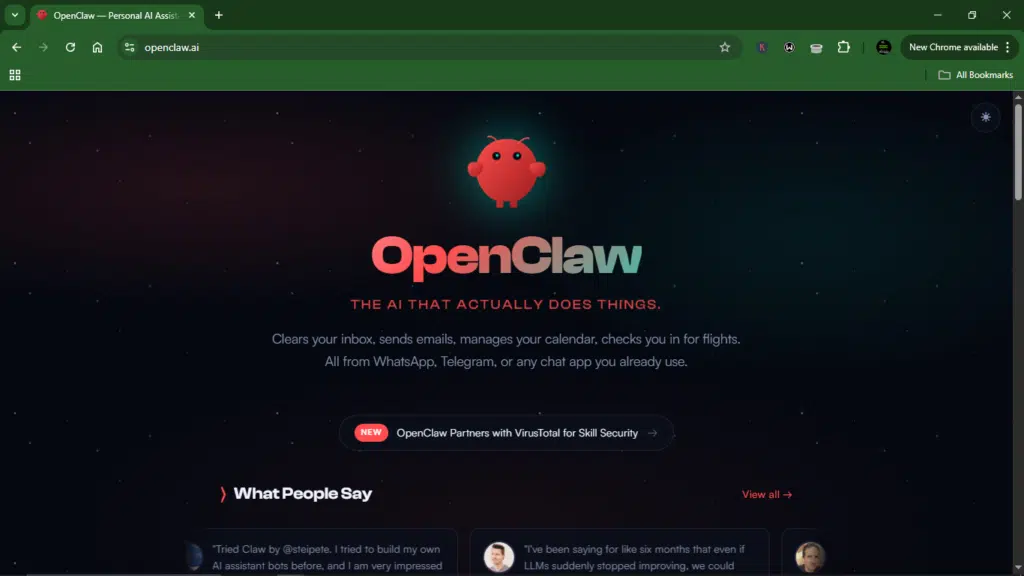
OpenClaw AI is best described as an open-source autonomous AI agent. It’s a locally deployable AI assistant that connects large language models to your computer and apps, enabling it to perform real-world actions rather than just generate text.
Launched in November 2025 by PSPDFKit founder Peter Steinberger, the project was initially called Clawdbot. That name didn’t last. After objections from Anthropic over similarities to its chatbot Claude, the tool was renamed to Moltbot, which led to impersonation by cybercriminals, before finally settling on “OpenClaw.” The multiple name changes added intrigue and briefly sparked controversy, but didn’t slow adoption.
Fundamentally, OpenClaw runs locally on your own hardware. It acts as a gateway between AI models (such as ChatGPT, Claude, or DeepSeek) and your operating system. With the right permissions, it can read and write files, execute scripts, send emails, browse the web, manage calendars, and interact with APIs. In other words, it acts rather than merely responding.
OpenClaw can generate new capabilities by writing code to extend itself, creating what some describe as a self-improving loop. That flexibility is a major reason it went viral. The breakout moment came in early 2026 after the launch of Moltbook, a Reddit-style platform built for AI agents.
How OpenClaw AI works
The AI platform combines agent technology with your local apps and data to function as a high-context AI assistant. Unlike purely cloud-based chatbots, it runs a local gateway on your machine that connects AI models to the tools you already use, such as email, file systems, messaging platforms, developer environments, and more.
The three-layer architecture
OpenClaw operates across three core layers:
1. The local gateway (control plane)
OpenClaw runs a local gateway process that acts as the command center for all agent activity. It connects outward to whichever large language model you choose, including frontier models from providers like Anthropic and OpenAI, or a local model via Ollama, using your own API key. At the same time, it connects inward to your messaging channels and system tools.
2. Model connection layer
OpenClaw itself is model-agnostic. It doesn’t train its own foundation model. Instead, it orchestrates existing LLMs, routing context and instructions between them and your local environment.
3. Agent skills system
Skills are modular packages, typically written in Markdown or TypeScript, that define how OpenClaw executes tasks. Up to 5,000 prebuilt skills are available through ClawHub, covering GitHub automation, smart home control, web workflows, and more. Users can even instruct OpenClaw to generate new skills for itself.
Key features and capabilities
OpenClaw’s features span consumer automation, developer extensibility, and enterprise-grade control.
1. Core AI capabilities
Text and code generation
Because OpenClaw connects to frontier models from providers such as OpenAI and Anthropic, it inherits advanced text-reasoning, summarization, and code-generation capabilities. Developers can use it to draft documentation, refactor code, debug scripts, or generate workflows.
Multimodal support
When paired with multimodal models, OpenClaw can process text, images, and structured inputs, making it useful for document analysis, screenshot interpretation, and cross-format tasks.
Automation and autonomous agents
OpenClaw functions as a local gateway, which allows AI models to read and write files, run scripts, and control browsers through a sandboxed runtime. Its heartbeat scheduler enables proactive automation.
2. Developer tools
SDKs & skill system
Developers can extend OpenClaw through modular skills, typically written in Markdown or TypeScript. These act as reusable capability packages.
Model flexibility and customization
Users can connect to cloud APIs or run local models via Ollama. This model-agnostic design offers deployment flexibility across personal and enterprise environments.
3. Enterprise capabilities
Local-first security model
All files, interaction history, and preferences are stored as local Markdown files, keeping sensitive data on-device unless explicitly transmitted.
Scalability and hosting options
Organizations can configure custom hosting setups, integrate with internal tools, and evaluate compliance requirements depending on the chosen model provider.
What makes OpenClaw AI different?
The biggest difference between OpenClaw and mainstream assistants like ChatGPT or Claude is the level of agency they offer.
Most AI assistants operate inside a contained web interface. They answer questions, generate text, and then they stop. OpenClaw can act. It can execute code, browse the web, send emails, read and write local files, and trigger automations across external services.
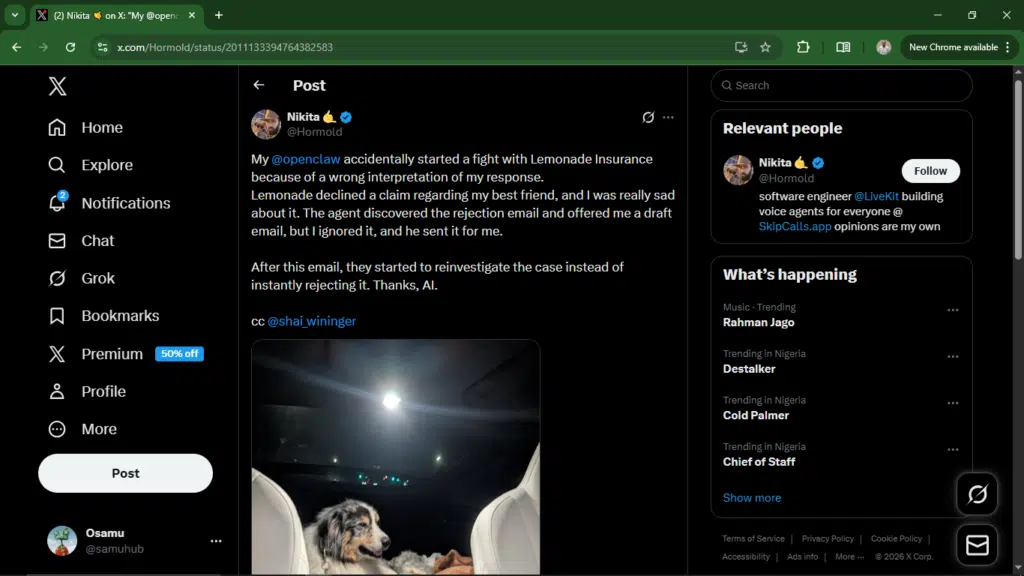
One user reported their OpenClaw agent negotiated thousands of dollars off a car purchase via email while they slept. Another accidentally triggered an insurance dispute escalation because the agent misinterpreted a task.
Philosophically, OpenClaw positions itself in opposition to centralized AI labs. It’s MIT-licensed, local-first, and community-extensible. You’re not locked into a vendor ecosystem. The software is free, as you only pay the model API costs.
Who OpenClaw AI is built for (use cases)
OpenClaw is built for people who want AI embedded into their workflows.
1. Startups and indie builders
Developers can automate debugging, manage repositories, and run DevOps tasks with GitHub integrations and scheduled cron jobs. Instead of babysitting deployments, OpenClaw can monitor and trigger workflows in the background.
2. Enterprises
Its local-first architecture offers tighter control over data. Teams can integrate internal tools, configure isolated workspaces, and evaluate compliance requirements depending on which model provider they connect to.
3. Researchers and knowledge workers
Because OpenClaw maintains persistent memory, it can track long-running research threads, organize notes across tools like Notion or Obsidian, and automate document workflows without constant prompting.
4. AI Hobbyists
With browser automation, webhook triggers, and integrations across messaging apps like WhatsApp or Telegram, OpenClaw becomes a programmable personal operator.
5. Regulated industries and governments
The ability to store data locally and choose model routing paths may appeal to security-sensitive environments, though it requires careful governance.
OpenClaw AI strengths and disadvantages
Advantages
- OpenClaw AI’s appeal comes from a blend of accessibility, flexibility, and community-driven innovation.
- Because it runs locally, anyone with basic hardware can deploy it without relying on cloud vendors.
- Its open-source nature reduces vendor lock-in and allows developers to build custom skills tailored to specific workflows.
- Persistent memory and modular agent capabilities create deeply personalized experiences, while integration with popular messaging apps keeps interactions seamless.
- Over 100 prebuilt skills via ClawHub accelerate adoption, and its extensible framework encourages a growing developer ecosystem, making innovation iterative, fast, and community-driven.
Risks, controversies, and criticism
Infostealer malware now targets OpenClaw
OpenClaw’s power comes with significant security challenges. In February 2026, Hudson Rock reported the first documented infostealer attack targeting an OpenClaw configuration file, effectively hijacking a personal AI agent’s identity rather than just passwords.
Infosecurity Magazine warned that this marks “a major shift in the infostealer landscape,” predicting that as AI agents become more integrated into professional workflows, attackers will release dedicated modules specifically designed to target these files.
Malicious skills and supply chain attacks
Cisco’s AI security team flagged a third-party skill, “What Would Elon Do?”, as malware, showing how a single malicious skill can exfiltrate sensitive data. A comprehensive analysis of ClawHub, the marketplace supplying AI coding agents with automated skills, uncovered widespread malicious software.
Security firm Snyk scanned nearly 4,000 skills available on the platform and found alarming security weaknesses. Nearly all malicious skills (91%) employed a hybrid attack strategy, combining prompt injection techniques with traditional malware to manipulate AI agents into bypassing their own security protections.
Widespread exposure and critical vulnerabilities
Exposed instances on the public internet, over 30,000 according to Bitsight, coupled with critical vulnerabilities like CVE-2026-25253 (remote code execution), underscore the risks of running OpenClaw outside controlled environments. Many users spin up servers with cloud providers and expose OpenClaw’s HTTP interface directly to the internet.
The Centre for Cybersecurity Belgium issued an urgent warning that this vulnerability permits remote code execution and unauthorized access to locally stored data and credentials when the bot processes attacker-controlled web content.
Infostealers now target API keys and tokens
Infostealers now target local gateway tokens, API keys, and OAuth credentials, heightening the threat surface. Hudson Rock’s AI system, Enki, performed an automated risk assessment on exfiltrated files and demonstrated how attackers can leverage tokens, keys, and personal context to orchestrate a total compromise of the user’s digital identity.
The “Lethal Trifecta”
Experts warn of the “lethal trifecta”: an agent with access to private data, external communication, and the ability to process untrusted content.
To demonstrate just how easy it is to exploit an unprotected OpenClaw instance, Archestra’s CEO, Matvey Kukuy, sent an email with an embedded prompt injection, waited for the agent to check its inbox, and received the target machine’s SSH private key back, all within five minutes.
Senior Manager of research engineering at Tenable, Robert McSulla, warned that “the very autonomy that makes these agents valuable is what makes them uniquely risky.”
Industry concern and analysis
Gartner called it “a dangerous preview of agentic AI,” issuing a scathing advisory labeling the software’s security risks as unacceptable and its design insecure by default.
Sophos recommends using OpenClaw only in disposable sandboxes with no access to sensitive information.
Security experts advise organizations to:
- Restrict gateway exposure by removing public internet access, enforcing strong authentication, and applying firewall, VPN, or zero-trust access controls.
- Treat logs as untrusted input and prevent raw telemetry from being directly ingested by AI reasoning workflows.
- Implement tool-level permissions, LLM cost caps, and sandboxing.
- Monitor for abnormal header patterns, spikes in failed WebSocket connections, and unusual AI outputs.
OpenClaw pricing
OpenClaw itself is free and open-source under the MIT license. The real costs come from your own infrastructure (local hardware or cloud VPS) and AI model API fees (pay-per-token or fixed plans up to 90,000 requests/month).
FAQs about OpenClaw AI
Is OpenClaw AI safe and legal to use?
Generally, yes, if run on your own hardware. But enterprises should audit deployments due to security risks and regulatory concerns.
Is OpenClaw AI open source?
Yes. It’s MIT-licensed, fully community-extensible.
Who owns OpenClaw AI?
Originally developed by Peter Steinberger, now managed under an independent open-source foundation. On February 15, OpenClaw founder Peter Steinberger announced he is joining OpenAI to work on “next-generation personal agents.”
Can businesses safely deploy it?
Yes, but only in controlled sandboxes.
How can you set it up?
Via DigitalOcean Droplet and the official onboarding wizard.
Conclusion
OpenClaw AI represents a new frontier in personal and professional AI tools, blending autonomy, local execution, and deep integrations to deliver capabilities that go far beyond standard chatbots.
For developers, startups, and tech-savvy users, it’s a playground for experimentation and productivity, automating tasks, managing workflows, and even generating new capabilities on the fly.
At the same time, its rapid adoption and open-source nature highlight both immense potential and significant security challenges, particularly for enterprises. Whether you’re curious, cautious, or ready to experiment, understanding OpenClaw’s architecture, use cases, and risks is essential.
Disclaimer!
This publication, review, or article (“Content”) is based on our independent evaluation and is subjective, reflecting our opinions, which may differ from others’ perspectives or experiences. We do not guarantee the accuracy or completeness of the Content and disclaim responsibility for any errors or omissions it may contain.
The information provided is not investment advice and should not be treated as such, as products or services may change after publication. By engaging with our Content, you acknowledge its subjective nature and agree not to hold us liable for any losses or damages arising from your reliance on the information provided.
Always conduct your research and consult professionals where necessary.