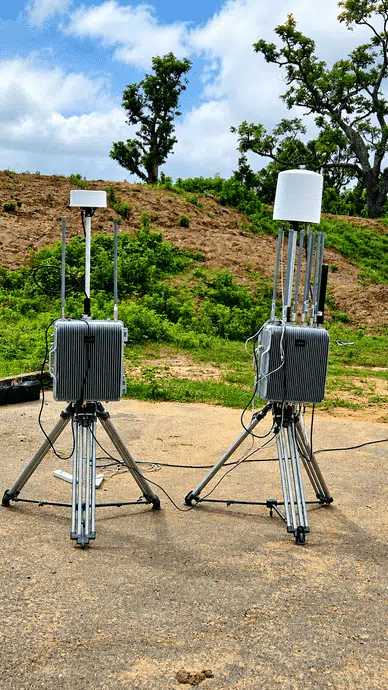
Babasky Technologies, the defence technology arm of UNICCON Group, has once again pushed the boundaries of what indigenous African engineering can deliver, this time with the demonstration of a fully integrated drone detection, pilot-location and jamming system capable of identifying unmanned aerial threats within an 8-kilometre radius, pinpointing the location of the operators controlling them, erecting a no-fly zone on demand, and neutralising any drone that dares to cross into it.
The exercise, conducted before senior officers of the Nigerian Army and the Nigerian Air Force, marks one of the most consequential live demonstrations of counter-drone capability the country — and arguably the continent — has seen from a locally built system.
A Layered Answer to an Escalating Threat
What sets this system apart is not merely that it jams drones. Radio-frequency jammers are not new. What is new, and what makes this demonstration significant, is the layering of capabilities into a single operational pipeline: detect, locate the pilot, cordon the airspace, then jam. Each of those functions typically exists as a standalone capability in most counter-UAS systems fielded around the world. Babasky’s demonstration folded them into one continuous kill chain.
Identifying a hostile drone is one thing. Identifying where the person flying it is standing is another matter entirely — and it is the far more valuable piece of battlefield intelligence. A jammed drone can simply be replaced. A located pilot can be captured, interdicted, or forced to relocate, disrupting an adversary’s tempo far more effectively than taking out a single airframe. For a country contending with insurgent and non-state actors increasingly turning to commercial and improvised drones for surveillance and attack, the ability to trace a threat back to its source is a genuine tactical advantage.
The system’s capacity to dynamically declare a no-fly zone and enforce it — automatically jamming anything that breaches the perimeter — also points toward the kind of protective-bubble capability more commonly associated with critical infrastructure defence in far more resourced militaries. Deployed around a forward operating base, a pipeline corridor, an airport, or a public event, that kind of automated airspace enforcement changes the calculus for anyone attempting to use a drone for reconnaissance or attack.
Why This Matters for Nigeria and Africa
Drones have become one of the defining tools of contemporary irregular warfare, from their use by insurgent groups in the Sahel and the Lake Chad Basin to their weaponisation in conflicts far beyond Africa’s shores. Off-the-shelf commercial drones, once dismissed as toys, are now routinely modified to carry explosives, conduct surveillance on troop movements, and probe the defences of military installations across the region.
Until now, African militaries responding to this threat have largely depended on imported counter-drone systems — expensive, slow to procure, and often poorly suited to local terrain, climate and threat profiles. A Nigerian-engineered system that performs detection, geolocation and neutralisation as a single unit signals a shift away from that dependency. It suggests the beginnings of an indigenous electronic warfare capability that can be iterated, maintained and scaled locally rather than being at the mercy of foreign supply chains and export restrictions.
For the Nigerian Army and Air Force officers who monitored the exercise, the implications extend beyond a single piece of hardware. It represents validation that homegrown defence technology can meet the operational bar required for real battlefield deployment — a milestone with weight for procurement planning, for military doctrine around counter-UAS operations, and for the broader push toward defence self-reliance across the region.
Building on Recent Momentum
This demonstration lands only weeks after Babasky Technologies showcased its fibre-optic controlled loitering munition — a kamikaze drone that replaces vulnerable radio-frequency control links with a hardwired fibre-optic tether, making it fully resistant to jamming and signal spoofing. That system addressed the offensive side of the electronic warfare equation: a strike drone that cannot itself be jammed. This latest demonstration addresses the defensive side: a system that can detect, trace and jam everyone else’s drones.
Taken together, the two showcases position Babasky Technologies as a company operating on both edges of the same sword — offence and defence in the drone-versus-counter-drone contest that is rapidly becoming central to modern conflict. Few defence technology firms anywhere in the world can claim to have fielded both an unjammable strike platform and an integrated detection-location-jamming system within the same short stretch of time. That Babasky has done so as a Nigerian company, using indigenously developed technology, is what makes this moment stand out on the African continent specifically.
The Bigger Picture
UNICCON Group, Babasky’s parent company, has built a reputation over the past year for producing “firsts” — from Omeife, one of Africa’s earliest domestically developed AI-driven humanoid robots, to the UNIKAM series of loitering munitions built in partnership with the Defence Industries Corporation of Nigeria (DICON). This latest demonstration extends that pattern into electronic warfare and counter-drone defence, an area where global demand — and global investment — is only accelerating.
For Nigeria, the significance is twofold: a credible answer to a real and growing security threat, and proof that the engineering talent to build that answer already exists at home. For Africa more broadly, it is a marker that the continent is no longer only a buyer in the global counter-drone market, but increasingly, a builder.
The story of indigenous African defence technology is still being written. With this demonstration, Babasky Technologies has made clear it intends to be one of the ones writing it.