



Last month, Lagos State officials hailed a new pact with the National Union of Road Transport Workers (NURTW) and the Road Transport Employers Association of Nigeria (RTEAN) as a historic breakthrough to digitise the city’s chaotic danfo (bus) fleet. Under the deal, both unions signed on to the state’s Bus Industry Transition Programme (BITP), which folds informal operators into a regulated network with digital fare collection.
But a venture-backed startup named GONA unlocked that exact efficiency seven years ago, only to face stiff resistance from those very same unions.
For many years, the danfo ecosystem — a sprawling fleet of yellow minibuses operated by private owners — has been defined by arbitrary fare surges during downpours, high-speed battles for passengers, and an extortionate governance structure enforced by park bosses (agberos) collecting cash levies at bus stops.
In 2018, a group of Chinese tech founders with experience at Huawei Africa, Didi, and Morgan Stanley arrived in Lagos intent on disrupting this system. By January 2019, they had launched GONA, a mobile payments app that started by replacing cash-based bus fares with digital ticketing
To validate passenger behaviour, GONA established a sandbox environment at the University of Lagos (UNILAG), leveraging the campus population’s high smartphone penetration.
The model proved an immediate hit with students, emboldening the company to scale onto commercial city routes, an expansion drive that triggered a cascade of union friction that ultimately determined its future.
The pilot
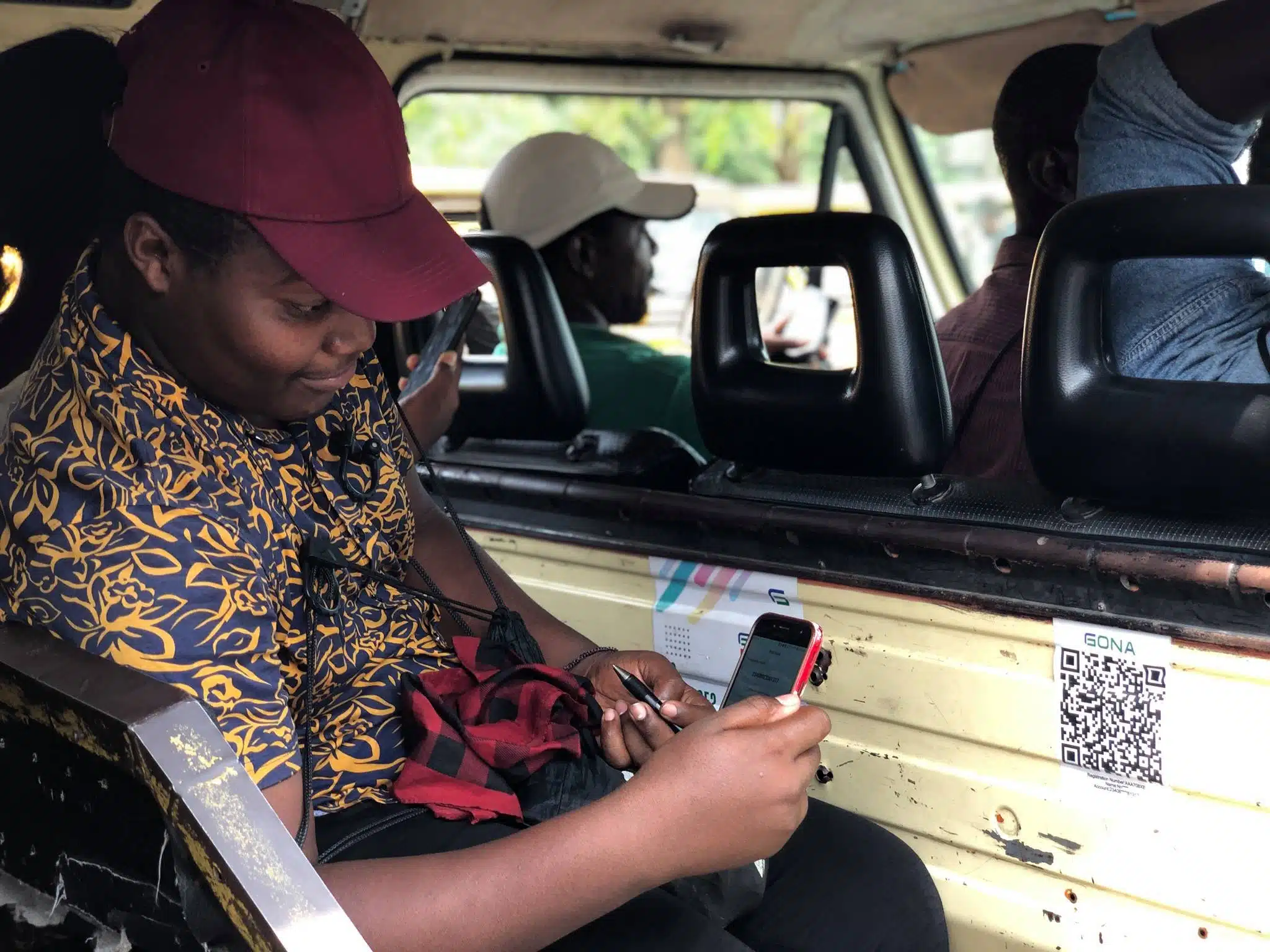
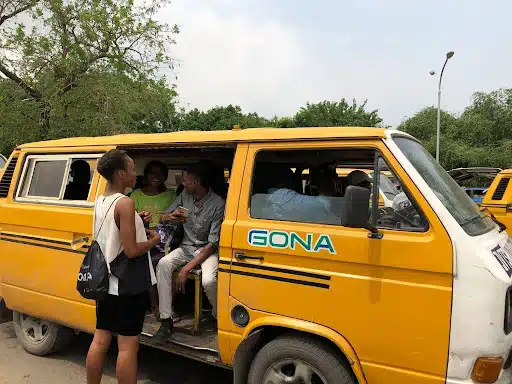
Branded with bold corporate logos, the danfos on GONA’s network were instantly recognisable among the sea of traditional yellow buses operating along the Yaba–UNILAG corridor. Fare collection relied on in-app scanning of QR codes mounted on seatbacks and dashboards.
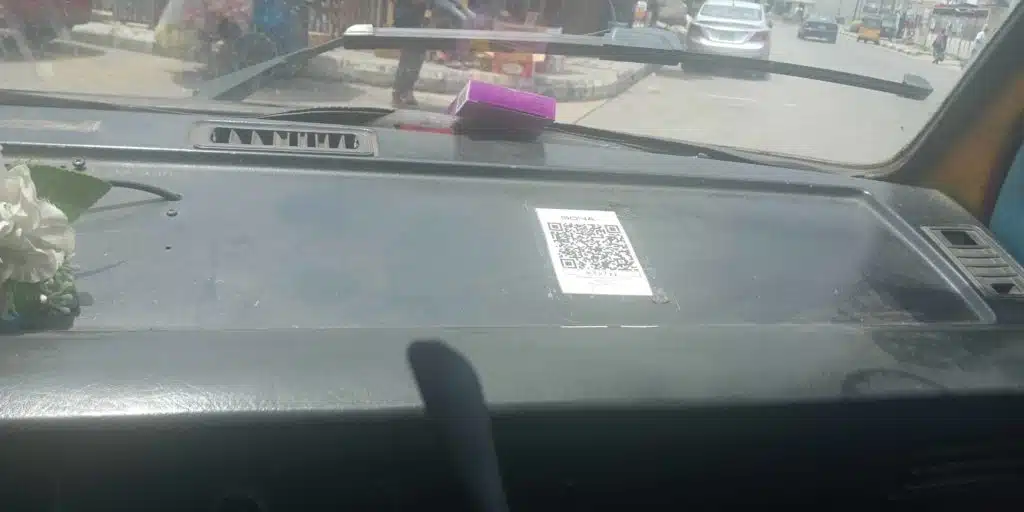
The university’s orderly boarding queues gave passengers ample time to scan and pay without disrupting traffic flow, while a formal partnership with the UNILAG campus shuttle union provided a safe, frictionless testing ground.
“The system worked perfectly,” recalls Tunde Awe (not his real name), a member of GONA’s technical team. “The revenue and return on investment (ROI) were obvious.”
Growth was fuelled by a student ambassador network, which earned stipends by onboarding peers and spreading brand awareness.
In February 2019, just its second month of operations, GONA expanded its UNILAG route out to Bariga. The company incentivised adoption among general commuters through free ride promotions and marketed its digital wallet as the cure for Lagos’ chronic “ko si change” problem.
A series of operational tweaks along the Yaba corridor laid the groundwork until GONA decided to launch a more aggressive, citywide expansion.
Union friction
In August 2019, the startup announced a multi-million-dollar pre-A round led by Chinese firm Shaka VC and reported processing nearly 10,000 transactions daily across a growing user base. It launched GONA Premier, deploying a fleet of air-conditioned Toyota HiAce buses along the Obalende-Victoria Island route.
The buses offered seamless payment, comfort, and above all, safety. Passengers chose them over the traditional, hot danfo buses, much to the chagrin of local park bosses and transport-union enforcers, according to Opeyemi Adebayo (not his real name), an operations manager with GONA.
“The agbero [local name for union enforcers] guys started beating up the drivers whenever they stopped at certain bus stops,” Adebayo says. “They felt people no longer took the danfos and were instead waiting for the neat HiAce buses.”
The enforcers chased GONA’s passengers away, Adebayo adds.
In a bid to stay afloat, the company abandoned its hired Toyota HiAce fleet and shifted strategy, seeking direct partnerships with the unions to digitise existing buses, a model that had worked on campus. It then trained the danfo drivers on the use of its app and even bought smartphones for those who didn’t have one. GONA agents stood at the doors of danfo buses, giving commuters the choice to pay via the app.
Unaccustomed to digital accounting, however, many drivers struggled to track electronic payments. Some would demand cash midway from passengers who had already paid on the app. Some would cancel digital payments altogether to save time during rush hours.
“GONA then thought of something,” recalls Adebayo. “What if we allowed all customers to pay through the app while the company paid drivers in cash?”
The idea soon ran into a bottleneck. Knowing that GONA agents held a lot of cash to pay drivers with, the agberos started targeting and robbing them.
“They harmed them, especially in Oshodi, forcing many of the agents to quit,” Adebayo says.
By late 2019, GONA had begun scaling back operations and laying staff off. Beyond escalating union demands, the layoffs were fuelled by internal fraud as field agents struggled to meet steep daily onboarding quotas. Juliet Grace (not her real name), a former agent in Ikeja, admits to rigging the platform after falling behind on her metrics.
“There was a clear rule against submitting fake users,” she reveals. “One day however, desperate to hit our target, my friend and I submitted details for people outside our station. We were fired almost immediately.”
According to Adebayo, the operational retreat left GONA running just one active route: CMS–Ajah. Stranded users who had purchased in-app coins found their digital balances useless across the rest of the city, sparking a wave of angry complaints on GONA’s Facebook page.
Chukwunweike Nmakwe, a customer in Oworonshoki, wrote in September 2019: “When GONA came, we thought it was going to be the final answer to the people living in Oworonshoki (Berger Bus Stop) [and] working on the Island… I can’t believe these days I stay in the GONA queue for more than one hour waiting for a bus to come.”
The pact
Despite its eventual failure, a direct partnership with local unions came with a price tag. GONA paid union leaders on a weekly basis, a decision Awe says was made by the company’s business development unit.
“We made a pact with NURTW to actually bribe them to accept our agreement,” he admits. “You know, they see money every day and collect loading fees. So, now removing cash from the whole system was a challenge for them.”
“GONA poured millions of naira into union pockets,” Adebayo corroborates.
According to him, in corridors like Ikeja, where drivers were relatively cooperative, GONA initially managed with modest weekly payments. But in union strongholds like Oshodi and Berger, securing passage required massive payoffs. As word spread about the payouts in Oshodi, union bosses at other parks raised their rates, trapping the company in an endless cycle of monetary demands.
GONA finally folded during the early months of the COVID-19 pandemic in 2020. According to Awe, the Chinese founders abruptly departed, leaving behind their rented office, operational equipment, and company smartphones issued to staff.
The company’s country manager, Noah Gu, wrote on LinkedIn that he took a break to travel and “reconsider the ultimate goal of my life.”
An attempt to speak with Gu was not successful.
Beyond the MoU
Lagos State spent, by LAMATA’s account, more than 30 months bringing NURTW and RTEAN into the BITP, succeeding where many private players would struggle. Two and a half years of continuous political manoeuvring is nearly impossible for a VC-backed startup, which relies on rapid speed-to-market.
Yet, signing an agreement on paper is different from changing behaviour on the asphalt. To a Lagos driver accustomed to routinely spiking fares during peak hours, fixed digital rates feel like money taken directly out of their pocket. Without an automated mechanism to compensate drivers for lost surge revenue, digital ticketing may force operators into immediate non-compliance.
More critically, a transparent, cashless fare collection model threatens to plug the opaque financial channels union bosses depend on. A landmark 2021 investigation by the International Centre for Investigative Reporting (ICIR) found that the NURTW in Lagos extracts over ₦123 billion annually in cash levies, funds believed to be used for political patronage during election cycles.
Ultimately, reforming Lagos’s transit ecosystem is not merely a software challenge; it is a deeply political and cultural one. If state regulators hope to succeed where private capital failed, they must confront the street-level cash economy and the political interests that depend on it or watch the initiative suffer the exact same fate as GONA.
As of publication time, the Lagos State executives of the NURTW and RTEAN have not responded to requests to comment on the allegations of extortion and violence against their members.
Editor’s Note: “Kosi change” is Yoruba for “there’s no change.” In Lagos’s cash-based bus system, conductors announce it to passengers before they board, warning them to have the exact fare. Boarding and alighting happen fast, and a passenger who waits until their stop to demand change will find little patience for it.
“Agbero” is a local Nigerian term for informal toll collectors and street-level enforcers associated with transport unions like the National Union of Road Transport Workers (NURTW).