

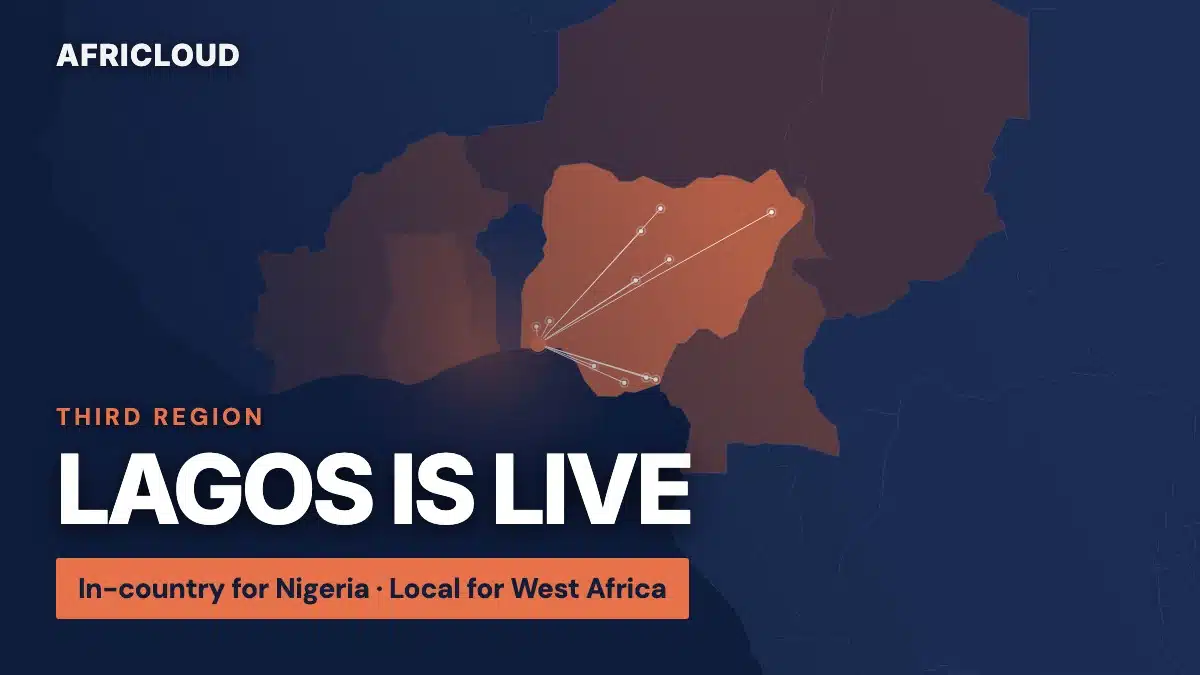
AFRICLOUD builds cloud infrastructure for Africa: virtual servers, dedicated servers (bare-metals), storage and networking, sold self-service rather than through a sales cycle. We have run regions in Lisbon (Portugal) and Johannesburg (South Africa). Lagos (Nigeria) is the third.
What being in-country actually changes
Until now, a Nigerian product with Nigerian users almost certainly answered a request by sending it to Europe or North America and waiting for it to come back. That journey is the single largest fixed cost in the page load, and no amount of caching removes it.
With the server in Lagos, that journey stops being intercontinental. A request from inside Lagos is answered and returned in a fraction of a millisecond. From Abuja it is back in under ten. From Kano, the far end of the country, in under twenty. Those are best-case measurements from our own Lagos region and real-world figures might run higher depending on your carrier and route.
The second thing that changes is the answer to a question Nigerian founders are asked more and more often. Since the Nigeria Data Protection Act took effect, “where does the data actually live?” turns up in bank vendor reviews, government procurement and enterprise security questionnaires. Residency alone is not a compliance badge and specific obligations always need your own legal assessment. But it is a different conversation when the answer is Lagos Nigeria rather than a diagram of European jurisdictions.
We are not renting someone else’s network
The part we would most like a technical reader to check is the network, because it is the part nobody can fake.
AFRICLOUD operates its own autonomous system, AS209179, and exchanges traffic directly with more than 700 networks across four internet exchanges, including IXPN in Lagos. More than 500 of those networks are African, spread across 33 African countries. That is an adjacency graph with an African majority, which is unusual, and it is publicly verifiable.
Direct peering is what decides whether traffic between two Nigerian networks stays in Nigeria or takes a detour through Europe or elsewhere before coming home. It is invisible on a pricing page and it is most of the reason local hosting either feels local or does not.
Three regions, and a path between them
Lagos joins Lisbon and Johannesburg, and the three divide the map by measurement rather than marketing. Lagos serves Nigeria and much of West Africa. Johannesburg serves Southern and East Africa. Lisbon serves North Africa alongside Europe and Brazil.
For a growing company that is a route, not a menu. Keep Nigerian customer data in Lagos. When the first South African or Kenyan enterprise deal lands, serve it from Johannesburg. If Europe opens up, Lisbon is already there under EU jurisdiction. Same account, same API, nothing to rebuild.
What you actually get
AMD EPYC processors and NVMe storage throughout. Full root access. IPv6 included on every order, not sold as an extra. Block storage, snapshots and backups, floating IPs, and an API that can do everything the dashboard can, so infrastructure can be built in code rather than clicked. Dedicated servers are available on the same self-service basis when a workload outgrows shared compute.
Cloud Server ordering takes minutes and does not involve a conversation with anyone, unless you want one.
Paying from Nigeria
Prices and invoices are available in Naira, and local payment methods are supported at checkout. International cards, PayPal and more than 300 cryptocurrencies are also accepted.
Where to start
If you are weighing where your data should live, the Nigerian details are at africloud.com/ng – if you need to discuss your bespoke custom server requirements, we are always open to that conversation.