



For people living with diabetes, taking insulin isn’t just a medical routine. It has to be stored properly, often in a refrigerator, making power supply just as important as the drug itself. In countries where electricity can be unreliable or where temperatures regularly climb above what insulin or life-saving vaccines can safely tolerate, keeping them effective becomes another challenge patients have to live with.
Many patients have been on regular injections for years, a routine that can become uncomfortable enough for some to skip doses altogether.
For Martins Otun, founder of Algonix AI Limited, those weren’t abstract healthcare problems. They were realities he encountered while training and working as a pharmacist.
That became the basis for Algonix AI, a startup that sits at the intersection of healthcare and artificial intelligence. Its focus is drug delivery and formulation, helping scientists find excipients that could one day make biologic medicines, such as insulin, more stable outside refrigeration and easier to deliver via alternatives such as patches.
The goal isn’t to replace scientists or to claim the breakthrough has already happened. It’s to give researchers better tools to find answers faster than traditional trial and error allows.
From the pharmacy to artificial intelligence
Unlike many AI founders, Otun didn’t begin with software. His entry point was pharmacy. Studying at Obafemi Awolowo University exposed him to the realities of healthcare delivery and research. Drug discovery is expensive, often requiring billions of dollars and years of laboratory work before a medicine reaches patients. For researchers in many African countries, limited funding makes that journey even more difficult.
“I started looking for how technology could shape healthcare, particularly drug discovery and scientific research,” he says. “If Africa doesn’t have the resources, technology can actually bridge that gap.”
To him, artificial intelligence wasn’t simply another technology trend. It represented a way to reduce some of the cost and time involved in early-stage pharmaceutical research.
The idea for Algonix AI began taking shape during his time practising as a pharmacist since 2019. His experience in pharmacy exposed him to a practical limitation of insulin and other biologics storage that would later inspire the company’s mission .
Because insulin is a biologic, unopened stock has to be held between 2 and 8 degrees Celsius, which makes refrigeration essential throughout storage and transport, an obvious challenge where power supply cannot be guaranteed.
But even after working in healthcare in the United Kingdom, Otun realised the problem wasn’t only about electricity. Many patients simply struggled with long-term injections. Over time, repeated injections can become uncomfortable enough that some patients stop following their treatment schedule consistently.
The real challenge isn’t insulin. It’s finding the right materials
One of the biggest obstacles to reliably developing more biologic medicines is identifying materials that can keep them stable. Researchers know that suitable materials may exist, but the difficult part is determining which candidates are worth testing. Biologix goes a step further: rather than only identifying promising materials from existing ones, the platform uses agentic AI and physics-based modelling to generate novel material candidates for laboratory synthesis and validation.
Until now, much of that process has depended on extensive laboratory work, in which scientists synthesise and test different materials before identifying promising candidates. At the centre of the challenge are polymers, which scientists use to help stabilise medicines. The difficulty is knowing which polymers might work.
Biologix is designed to shorten that process. Otun is careful not to describe Algonix AI as a company that has already created fridge-free insulin. Instead, he describes it as building the research tools that could help scientists move closer to that outcome.
The platform works by putting a language model in charge of a set of scientific tools rather than asking it to know chemistry on its own. It mines the research literature and grounds its reasoning in the retrieved information, an approach known as retrieval-augmented generation (RAG), in which the system draws on specific, citable knowledge sources rather than relying solely on a general model’s internal knowledge.
It then proposes candidate polymer structures and evaluates their interactions with the target biologic using physics-based molecular simulations. The results feed back into the agent’s reasoning, allowing it to refine its hypotheses and explore new regions of the chemical design space. Promising candidates can then be prioritised for laboratory synthesis and experimental validation.
The physics stage is the part Otun considers most important, because it is where the AI can be proved wrong. A language model can name a polymer that sounds entirely reasonable and does not exist, or propose a structure that could never pack into a real material. This is why scientists still carry out the experiments themselves, but instead of starting with hundreds of possibilities, they begin with informed suggestions generated by the platform. Otun has also built in retrosynthesis, so the platform can work backwards from a promising structure and propose possible precursor materials
The platform is built for researchers, pharmaceutical scientists, universities, and materials scientists rather than consumers, making it a research tool rather than a finished healthcare product.
Rather than arriving as a single breakthrough, Otun says the company grew through years of research, experimentation, and improvements as new technologies became available. Development accelerated around 2022, while a research preprint describing the work was published in 2023, generating about 300 expressions of interest.
As newer AI techniques emerged, the platform became more capable. Among those additions is retrieval-augmented generation (RAG), which allows AI systems to retrieve information from specific knowledge sources rather than relying only on general language models. The team has also incorporated retrosynthesis, enabling the platform to work backwards from a desired chemical outcome and suggest possible precursor materials researchers can use during synthesis.
Building a research tool for scientists
Through the web-based platform, researchers describe the experiment they intend to carry out; Biologix then returns candidate polymer structures worth investigating, along with possible precursor routes derived computationally through retrosynthesis, which a chemist can then evaluate for feasibility. If they’re looking for materials that could help stabilize insulin at higher temperatures, for example, they can define that objective within the platform.
Because the platform deals with pharmaceutical research, the company intends to restrict access through internal reviews and safeguards to ensure it is used for legitimate scientific work.
Although the platform is still in its early stages, Otun says researchers have already begun testing it computationally. According to him, academics in pharmaceutics, polymer chemistry, and material science have expressed interest in the platform.
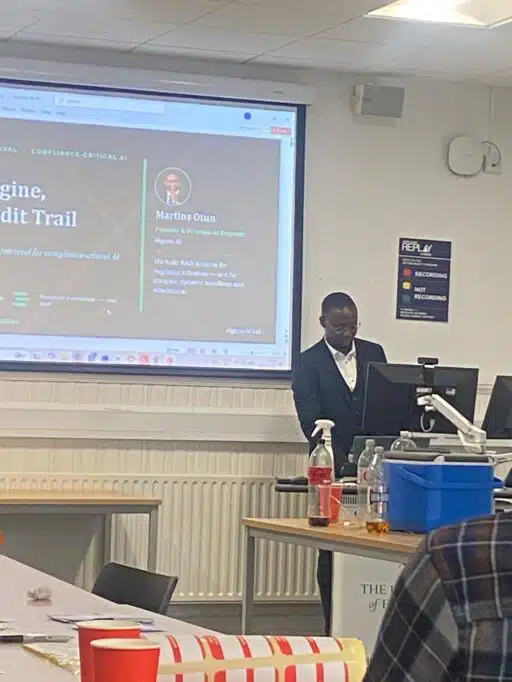
The company recently presented its approach to applying AI in highly regulated industries in Edinburgh, United Kingdom. The presentation focused on retrieval-based AI systems that can access, ground, and reason over complex regulatory and scientific information—an important part of the broader technology platform Algonix AI is building. This work reflects the company’s wider focus on developing AI systems that can combine reliable knowledge retrieval with specialised scientific tools to support decision-making in highly regulated environments. The presentation attracted interest from researchers working across regulated industries.
The company’s next milestone is finding laboratory partners capable of synthesising and validating the materials generated by Biologix. Over the next two years, he hopes researchers across Africa, Europe, and North America will begin using the platform as part of their own work.
He also expects the company to move beyond computational modelling and into pre-clinical validation, bringing the platform closer to demonstrating that its AI-generated recommendations can translate into real laboratory results.
“Right now everything we have is a prediction,” he says. “The whole point of the next phase is finding out which of those predictions survive contact with a laboratory.”