



African startups raised $887 million across 84 deals between January and April 2026, per TC Insights, up from $803 million in the same window of 2025, but across fewer than half as many deals. Last year recorded 173.
Debt led the latest rounds, with equity coming a close second. In what seems like a continuation of 2025, investors are writing fewer cheques, and only to companies with strong traction, retention, and solid unit economics.
For early-stage founders, that has shifted the definition of growth-stage readiness.
Unfortunately, not enough resources provide hands-on support for startups to gain the traction needed for growth and further scaling.
This challenge is tied to the unglamorous work of building repeatable commercial systems, and providing startups with the tools to do that work and build the right systems is the solution.
Venture growth and innovation firm, Clarus is partnering with Norrsken East Africa to solve this problem with the first cohort of a GTM accelerator program called the Scale Velocity Lab.
Victor Ekwealor, founder of Clarus, maintains that “startups don’t fail or struggle because of a lack of marketing. They struggle because of a lack of repeatable processes.”
What is actually different about Scale Velocity Lab?
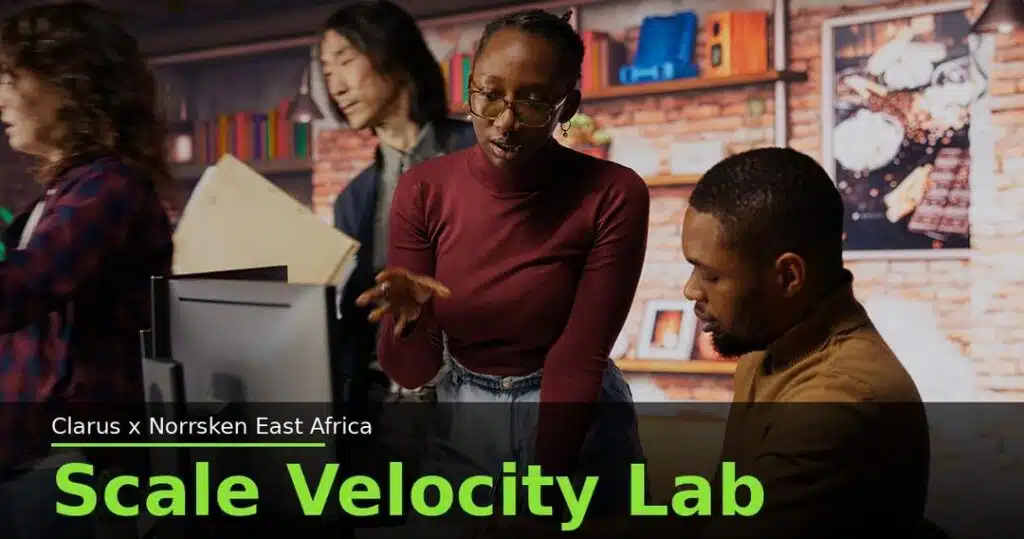
Scale Velocity Lab is built around GTM and co-building with traction-stage startups.
Clarus has designed the programme to run for four weeks with specialist partners and mentors taking the inaugural cohort through a virtual sprint.
Key partners supporting in expert capacities include: advertising technology company Dochase, and AI engineering lab Visolab.
These sprints will combine diagnostics, founder mentoring, and execution work on specific growth levers, positioning, building faster operations with artificial intelligence, storytelling, and distribution and revenue systems.
Everything will culminate in an activation showcase that highlights the startups’ readiness for their respective markets.
Why East Africa, why Norrsken, and what’s in it for Clarus?
The choice of partner and geography is not incidental.
Norrsken East Africa, anchored at Norrsken House in Kigali, has become one of the region’s most visible startup hubs since opening in 2019, hosting more than 1,300 members from over 20 countries.
Through Norrsken22, its growth fund, and the Norrsken Africa Seed fund, the wider Norrsken platform has backed companies including Stitch, Raenest, Sabi, Tyme, Workpay, and Nala, among others.
That ecosystem reach addresses one of the gaps in Africa’s accelerator landscape: programmes can teach, but distribution to founders, investors, and strategic partners is uneven.
For Clarus, partnering with Norrsken means access to a cohort pipeline anchored in a hub it does not have to build.
According to Abraham Augustine, Ecosystem and Marketing Manager at Norrsken East Africa, “what founders need are the right platforms, networks, and growth tools.” According to the team, the Scale Velocity Lab promises all of these.
In January, Ekwealor mentioned that Clarus Growth Labs is a way to embed GTM thinking earlier in the venture-building process by partnering with investors, accelerators, and startup studios rather than working with a single company at a time. Scale Velocity Lab is the first formal expression of that ambition.
What comes next
Applications for the first cohort close on May 14, with the partners expecting strong representation from the Rwandan, Kenyan, Ugandan, and Tanzanian startup ecosystems.
For founders, the more immediate test is if a structured, time-bound execution sprint can produce the kind of repeatable commercial systems that loose mentorship and pitch prep have struggled to deliver.
Those who will be lucky to participate in this cohort are about to find out.