




On April 4, 2026, Jesutofunmi Oniyide was crowned the winner of Red Bull Basement Nigeria, beating over 3,000 students and entrepreneurs from across the country.
Red Bull Basement is a global innovation programme that empowers student founders and first-time entrepreneurs to turn bold ideas into real-world solutions. It offers mentorship and global exposure, helping young innovators build products that can impact industries and communities.
Oniyide’s idea stood out. Judges, including Odunayo Eweniyi of PiggyVest and software engineer Mercy Thadeus, described it as both practical and innovative—qualities that ultimately secured his win.
Vital-Tag for livestock farmers
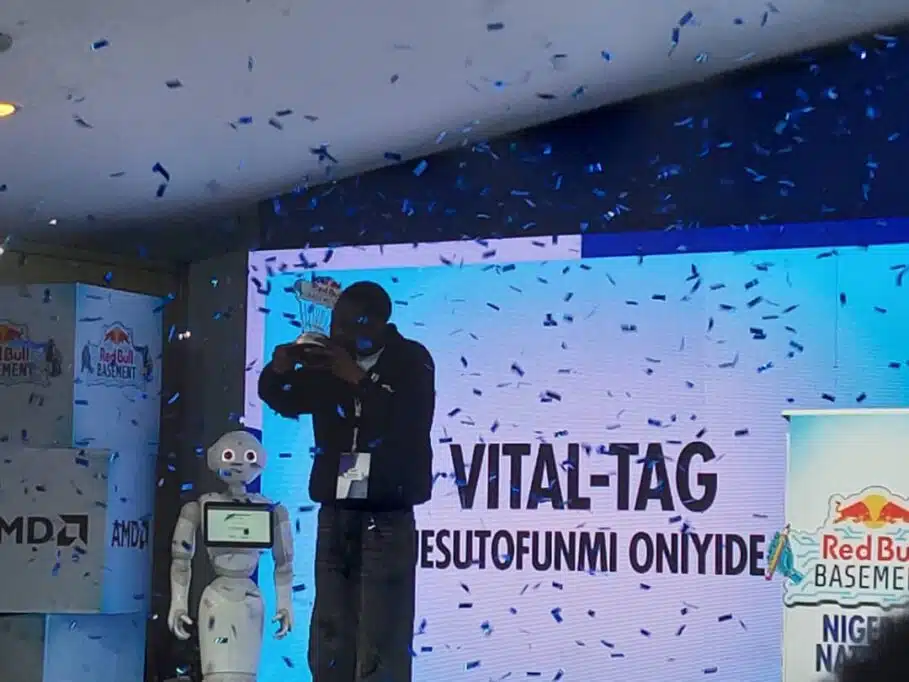
Oniyide, a third-year Mechatronics Engineering student at the Lagos State University of Science and Technology, says he was driven by a simple observation: livestock deaths can be financially devastating for farmers.
“I thought it didn’t make sense that with the amount of technology available today, things like this still happen,” he said while pitching his solution.
Vital-Tag is a smart IoT device designed to be attached to livestock such as cows, pigs, and sheep. Worn around the animal’s neck, it tracks key health indicators such as temperature, heart rate, and jaw movement, then sends this data to farmers via SMS at intervals.
These vitals are core indicators veterinarians rely on to assess livestock health. Research shows that changes in temperature and heart rate are often among the earliest detectable signs of disease, sometimes appearing before visible symptoms.
What makes Vital-Tag more compelling, however, is the addition of behaviour. By tracking jaw movement, the device attempts to monitor feeding patterns, which is an important signal.
In livestock research, reduced feeding or rumination is widely recognised as an early warning sign of illness.
Still, these signals are not foolproof. Temperature and heart rate can fluctuate due to stress, heat, or activity. This means systems like Vital-Tag are most effective when they can establish a baseline for each animal and flag meaningful deviations rather than isolated spikes.
A battery that lasts three years
According to Oniyide, Vital-Tag can run for up to three years without charging. He says the device is powered by an industrial-grade nickel-based battery rather than the more common lithium-ion alternative.
“This is engineered by an industrial-grade battery, not that lithium battery.”
At first glance, that kind of longevity sounds ambitious, but not impossible. In low-power IoT systems, battery life depends less on the battery type itself and more on how efficiently the device manages power.
Sensors that spend most of their time in sleep mode and transmit data only occasionally can last for years on a single battery.
That efficiency, however, comes with trade-offs. Frequent data transmission, real-time monitoring, or higher sensing accuracy can significantly reduce battery life. A three-year lifespan likely means the device sends updates at intervals or only when it detects anomalies.
Environmental factors also play a role. Heat, humidity, and physical wear can degrade battery performance over time.
Even with these constraints, the approach remains notable. In contexts where unreliable power supply makes frequent charging impractical, a device that can operate for years without intervention could significantly improve adoption.
Other interesting solutions from the finals
While Vital-Tag took the top prize, several other ideas stood out at the competition, highlighting the range of problems young Nigerian innovators are trying to solve.
Navidyne
Daniel Balogun, a Petroleum and Gas Engineering student, teamed up with Mechatronics Engineer David Ojabo to build Navidyne, a company developing underwater robots that detect and repair oil pipeline leaks.
The team aims to address Nigeria’s persistent oil spill problem. Ojabo noted that the country records tens of thousands of barrels lost to spills each year, with severe environmental and health consequences for affected communities.
Their solution uses an AI-powered robot trained on thousands of subsea pipeline images to detect anomalies faster than traditional methods.
Liferoute AI
Medical students Enribi Salami and Anjola Akinsoyinu built Liferoute AI after witnessing delays in emergency response times.
“I saw how a few extra minutes could have saved someone’s life,” Salami said during her pitch.
Liferoute AI functions as a navigation system tailored for ambulances. Beyond finding optimal routes, it directs emergency responders to hospitals with the lowest patient load at a given time, potentially reducing delays in critical situations.
Although not all of these solutions will make it to market, they give a glimpse into how young entrepreneurs think. With the Nigerian government already awarding grants of up to ₦50 million to student entrepreneurs, we might just see unicorns being built within the four walls of a dorm room.
Editor’s note: An earlier version of this article said Jesutofunmi Oniyide is a final year UNILAG student; this is an error. He is a third-year Mechatronics Engineering student of LASUSTECH.