

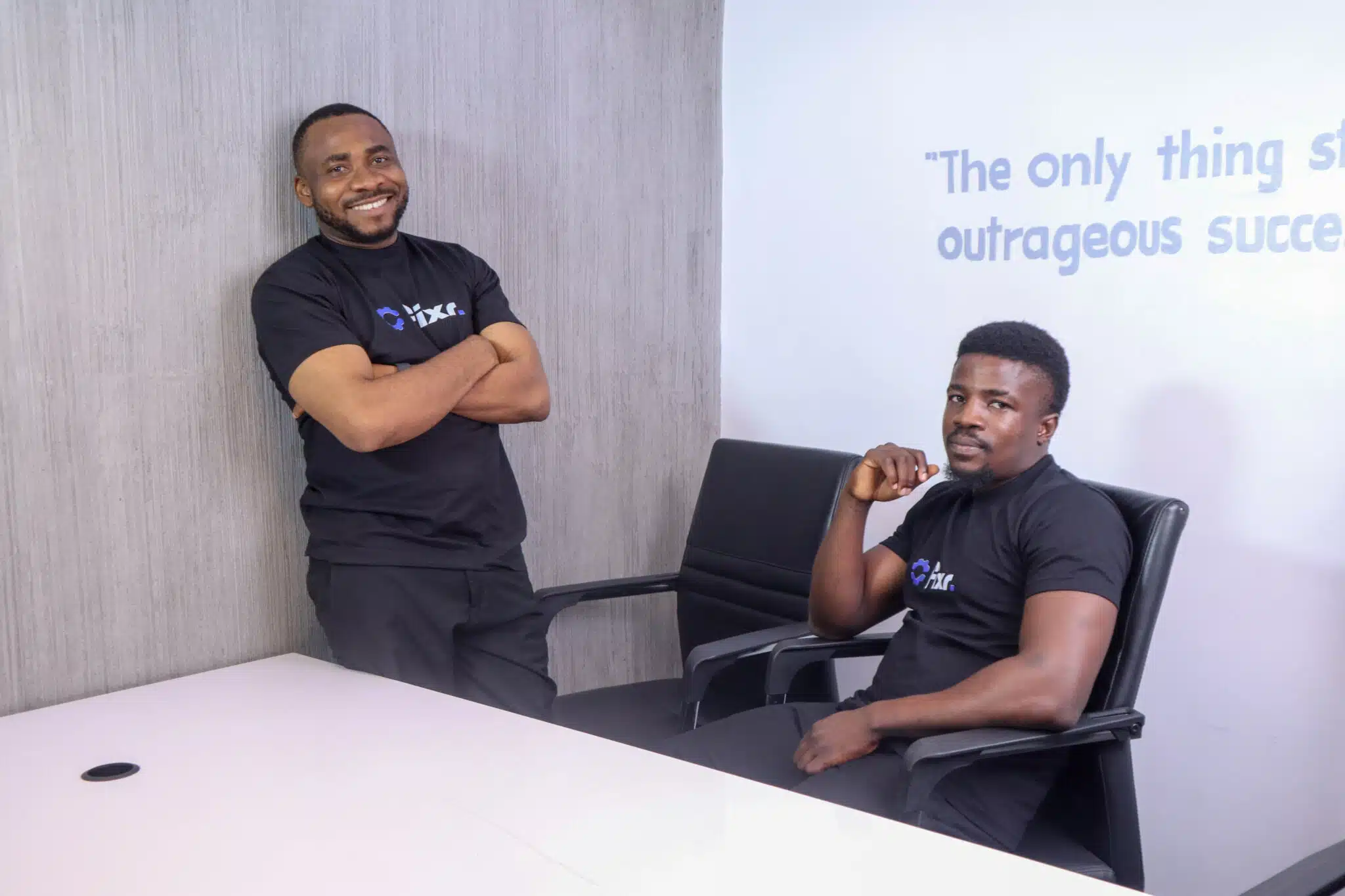


Ikechi Adolphus did not set out to build a startup. He set out to build a business that could be trusted and could eventually be layered with technology to scale. When he speaks about Fixr Technologies, the Lagos-based engineering services company he co-founded with Olamide Akangbe, he explains that he does not want Fixr to be called a marketplace. He does not want it misunderstood as a platform that connects customers with technicians.
Since pivoting to a technology-focused structure in early 2023, the company now operates across multiple geopolitical zones in Nigeria, with a presence in Ghana and Nairobi. It employs roughly 400 technicians, a majority of whom are full staff members on salary; manages five to six dark stores for component warehousing; runs an in-house logistics operation; and has processed close to ₦5 billion in gross merchandise value (GMV) on its renewable energy financing arm alone.
By Adolphus’ account, the business grew seven times year-over-year in its last full year and is on track to grow ten times that figure in 2026. And it has done all of this without a single naira of outside investment.
Not a marketplace, a contractor
Nigeria has seen its share of attempts at service marketplaces — platforms that onboard technicians, list them for hire, and take a cut of whatever transaction follows. The model is familiar, and, according to Adolphus, fundamentally broken.
In the conventional marketplace model, a technician who does excellent work at a client’s home becomes a liability to the platform. The satisfied customer takes the technician’s number, cuts out the middleman, and calls him directly the next time something breaks. On the other hand, if the technician does poor work, the customer simply does not return. In either scenario, the platform loses. Adolphus tried this model. It did not scale.
“We’ve tried that model, and it does not scale. Whether customers come to us directly or we assign a technician to a customer, we lose,” Adolphus says.
The answer Fixr arrived at was to stop acting like an agency and start acting like a contractor for engineering services. When a customer requests a service through Fixr, they have no direct relationship with the individual technician. Fixr handles assignment, part procurement, job reporting, customer communication, and payment from start to finish.
“The customer comes to our platform or requests a service through us, and they don’t have any business with the technician. Fixr has full control.”
To enforce this model and make it sustainable, all of Fixr’s technicians are full-time salaried employees. This is not a trivial decision for a company operating without outside funding. Salaries create a fixed cost base that must be covered regardless of job volume. But they also give Fixr the authority to direct where technicians go, how they work, and what happens when a job needs to be revisited, something that many marketplace models cannot control.
The rate of technicians circumventing the company to work with clients directly is roughly 0.1%.
Seven service categories
Fixr operates across seven engineering service categories: HVAC (heating, ventilation, and air conditioning), renewable energy and solar, electrical and fitting, electronics, CCTV and surveillance, fibre optics and communications, and home automation. The list is specific and deliberate. These are not simply the services that were easiest to offer; they are categories chosen for their scalability and their long-term market relevance.
“We carefully picked those seven categories because there are areas where we can scale, and areas that have very good addressable markets, considering that there are global opportunities, and they are critical now and in the future.”
The renewable energy segment has proven particularly significant. Fixr not only installs solar systems but has also developed a financing product that allows customers who cannot afford upfront payments to access solar on loan. Through partnerships with finance institutions, including Checkoff Finance and Sterling Bank, the company facilitates asset-backed credit.
During the repayment period, Fixr provides post-installation support to ensure performance. Interest is set at a flat rate of 4% per month, with repayment terms ranging from three to six months for shorter cycles and up to twelve months for larger installations. Customers who pay off early are charged only for the months the credit was active.
This product alone has generated close to ₦5 billion in gross merchandise value over the past two years, a figure that speaks to both the size of Nigeria’s unmet demand for reliable power and Fixr’s ability to position itself at the intersection of installation services and consumer credit.
The technology underneath
Adolphus is emphatic that technology at Fixr is a means, not the mission. The company did not begin as a software company; it began as a shop. His co-founder, Akangbe, ran an electrical repair outlet before they met. Akangbe came to fix Adolphus’ washing machine and spent the visit asking for help building a website. Adolphus saw a different opportunity.
“I felt that it’s not about doing websites, it’s about the business itself. It’s about how we build an efficient business and then layer in technology. Technology is not about websites. Technology is about democratising value. It’s about scaling value.”
Fixr has since built three layers of technology to run its operations seamlessly. The first is internal operations software: a suite of tools used by the team to track jobs, manage technician assignments, monitor service subscriptions, track component procurement, follow up with customers, and flag when scheduled maintenance visits are due.
The second is the technician-facing application. Though not available to the general public, it gives Fixr’s field staff visibility into their assigned tasks, logistics support (including disbursement of transport funds), and a performance points system that rewards completion rates and job quality.
The third layer is the customer-facing application, which allows customers to request services, manage annual maintenance contracts, review inspection reports, check component costs, and track their solar loan status. The app has been most consistently useful for Fixr’s subscription customers (those on annual maintenance contracts covering an appliance or system for 12 months) and for the growing cohort of customers using the solar financing product.
Built on debt and discipline
Fixr has not raised venture capital. Adolphus explains that the company has been built on a combination of consistently reinvested operating profits and structured debt facilities from banking partners, including Sterling Bank and Checkoff Finance.
This approach has required careful financial discipline. The company has restructured its internal cost allocation to stay liquid through growth cycles, relying on credit lines for working capital and reinvesting margin rather than distributing it. It is a model that constrains the pace of expansion while also insulating the company from equity dilution and investor pressure that have destabilised faster-growing but less well-grounded African startups.
The growth numbers suggest the model is working. The business launched in its current form in early 2023, and in 2025, its revenue exceeded ₦3 billion. Adolphus expects 2026 to deliver a tenfold increase in revenue.