

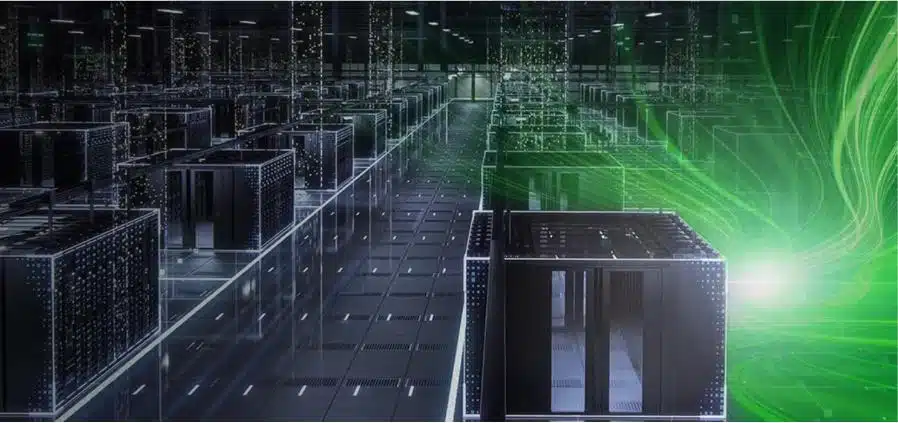
The data center industry has evolved through successive waves of innovation—from visualization to cloud computing, and now to Artificial Intelligence. Yet, Artificial Intelligence marks a transformative new phase; it is one that couples extraordinary computational capability with an equally unprecedented appetite for energy.
According to Bloomberg, the market for generative Artificial Intelligence is expected to reach USD 1.3 trillion by 2032. Furthermore, PwC projects that Artificial Intelligence could contribute up to USD 15.7 trillion to the global economy by 2030, making it one of the most significant drivers of productivity this decade. In Nigeria, where the digital economy is a primary pillar of national development, Artificial Intelligence workloads are projected to consume a significant portion of all installed data center capacity.
This relationship between Artificial Intelligence and energy is no longer one-directional. Data centers must deliver the power to sustain these workloads, while Artificial Intelligence itself can optimize energy use and accelerate decarbonization. It is a two-way energy conversation: energy for Artificial Intelligence, and Artificial Intelligence for energy.
Intelligent Power: From Energy-Hungry to Energy-Aware
Artificial Intelligence training racks can draw between 100 and 140 kilowatts each, creating unpredictable, high-density loads. Simply increasing power supply is not a viable solution in Nigeria, where grid constraints are common. Addressing inefficiencies is the only way to prevent waste and rising emissions. Instead, energy management must become intelligent.
Predictive algorithms now enable operators to forecast energy spikes, adjust dynamically, and smooth out load variability to protect grid stability. In the Nigerian context, smart scheduling allows energy-intensive training tasks to run when renewable supply is abundant or during off-peak hours, reducing operational costs. Flexible power management also lets workloads scale up or down according to computational needs.
When guided by Artificial Intelligence, data centers can evolve from energy-hungry to energy-aware ecosystems. As highlighted in the Schneider Electric “AI for Energy Transition” Guide, the capacity of Artificial Intelligence to optimize energy systems—from microgrids to industrial processes—enables smarter and faster decision-making.
Cooling as an Energy Resource
Cooling has always been one of the most energy-intensive aspects of data center operations. Artificial Intelligence high-density workloads have made it even more critical. As power densities rise, traditional air systems are reaching their limits, driving the shift toward liquid cooling—a method that removes heat directly at the chip level far more efficiently than air.
Effective cooling design today must balance efficiency and water stewardship. For instance, closed-loop systems minimize water consumption, which ensures operational continuity in regions facing resource constraints. Schneider Electric recently launched its Liquid Cooling Portfolio with Motivair, which combines advanced cooling engineering designed for high-density, AI-driven environments.
This end-to-end capability supports new power densities while improving thermal efficiency and reliability at scale. These advancements strengthen the foundation for AI-ready infrastructure that treats cooling as a strategic lever for sustainability rather than a mere cost center.
Resilience in the AI Era
In the age of Artificial Intelligence, resilience extends beyond uptime. It is about adaptability to variable power profiles and evolving regulations. Through geo-shifting, Artificial Intelligence workloads can pause in one region and resume in another where renewable energy is more abundant or affordable.
“Building for Artificial Intelligence in Nigeria requires a focus on resilience and scalability. By integrating liquid cooling and collaborating on reference designs, we can ensure that local data centers are not only ready for the next generation of processors but are also contributing to a greener, more efficient ecosystem,” said Ajibola Akindele, Country President, Schneider Electric Anglophone Africa
Integrating grid supply with on-site renewable generation and battery energy storage strengthens resilience. As explored in the Schneider Electric “Looming Power Crunch” report, close collaboration between data centers and utilities will be critical in addressing grid constraints by aligning new builds with microgrids that bridge the gap between sustainability and reliability.
AI-Ready by Design: From Grid to Chip and Chip to Chiller
Meeting these demands requires a unified architecture where power, cooling, and digital management operate in harmony. Reference designs co-engineered by Schneider Electric and NVIDIA illustrate this integrated approach—combining liquid cooling with advanced power management to support racks of up to 142 kilowatts while maintaining efficiency.
By embedding intelligence across every layer—from grid to chip to chiller—data centers can scale for accelerated computing without letting energy consumption spiral. The findings from Schneider Electric White Paper 212: “Bending the Energy Curve” reinforce this point, showing that even modest improvements in power usage effectiveness (PUE) can collectively bend the industry energy growth curve by up to 17%.
The Long View: Data centers as Energy Ecosystems
The data center of the future in Nigeria will be defined by how it contributes to the broader energy ecosystem. AI-ready facilities are poised to act as partners to the grid by balancing demand through flexible operations.
Circular thinking—prioritizing efficiency, reuse, and adaptability—will define the next generation of infrastructure. The leaders will be those who successfully align energy for Artificial Intelligence with Artificial Intelligence for energy.
Sustainable Intelligence at Scale
Artificial Intelligence is reshaping the data center landscape, driving energy demand to new heights while providing the intelligence to manage it responsibly. Sustainability must now be embedded across every dimension—from power distribution to grid collaboration.
Through innovation and co-engineering, Schneider Electric is empowering AI-ready data centers to achieve sustainable intelligence at scale. This is the future of digital infrastructure: where technology and energy evolve together, intelligently and sustainably.