




Sampson Ovuoba believes building a website is fundamentally a visual process, so the idea of writing heavy code to achieve something artistic never quite sat right with him.
“UI (user interface) shouldn’t be too code-heavy,” he says. “It is a visual thing, not logic.”
He is not advocating for the complete removal of code, but rather a middle ground — a way for developers to visually create what they want and then generate production-ready code. That idea led him to launch Windframe in July 2021.
Building Windframe
It took Ovuoba and a friend seven months to build Windframe, and it was not an easy process, especially considering it came a year before ChatGPT took off and AI became mainstream.
At the time, AI was not part of the plan. The focus was on templates.
“I built a large collection of templates, and we also added a feature that lets users import their own templates into the platform,” he says.
To make it work, Ovuoba had to learn how browsers function and build a custom rendering engine capable of handling different types of code and design. The effort paid off. Within two days of launch, Windframe had its first 100 users.
He launched it on Product Hunt and shared it on Reddit. Getting a paying user on the first day signalled something important; what started as a personal frustration was clearly a problem other developers wanted solved.
Today, Windframe has 16,000 users and has grown into more than just a side project for Ovuoba.

Victoria Fakiya – Senior Writer
Techpoint Digest
Make your startup impossible to overlook
Discover the proven system to pitch your startup to the media, and finally get noticed.
By 2023, AI had entered the picture. With APIs from OpenAI becoming widely available, he began exploring how to integrate AI into the product.
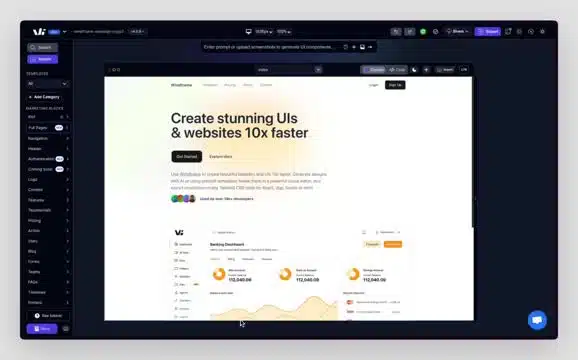
Now, Windframe uses generative AI to turn simple text prompts into fully structured UI layouts, complete with responsive components. The result is a tool that moves users from idea to interface in minutes, producing not just inspiration but production-ready output.
Freelancer to startup builder

Ovuoba has had brief stints at startups like Curacel and San Francisco-based Vial, but he has spent most of his career as a freelance software developer. According to him, freelancing pays better, but now he wants to build something of his own.
Interestingly, Windframe is not his first attempt at entrepreneurship. At 13, when he first encountered software development, he realised he had a knack for it, picking it up faster than his peers. Before finishing secondary school, he made his first attempt at building a startup.
At the time, between 2010 and 2011, accessing school results online was not common, so he set out to change that. He started with his school, building a platform where teachers, principals, and other members of the management could create accounts, log in, upload results, and make updates.
While he was proud of what he built, it never took off.
“I was quite young back then, and I didn’t understand the politics that come with building something like that. Things started dragging when we got to the money part,” he says.
By “politics,” Ovuoba means the informal incentives often needed to influence adoption within school management. In hindsight, he believes he was better off not learning that system. With Windframe, the product largely speaks for itself, and developers have responded positively.
In an email, a developer at Andreessen Horowitz described Windframe as a strong tool for prototyping, noting that it translates designs into code more effectively than Figma.
Windframe operates a freemium model, with paid plans starting at about $25 per month for individual users and rising to around $150 per month for teams, alongside higher-value lifetime licences and add-ons such as AI credits.
With 16,000 users, even a modest conversion rate of five to 10% could translate to between 800 and 1,600 paying customers. At its base pricing, that suggests monthly revenues in the range of $20,000 to $40,000, excluding higher-tier plans and one-off purchases.
While Ovuoba did not disclose revenue figures, the pricing suggests a business already generating meaningful recurring income, particularly as AI features introduce additional monetisation layers.
Unsurprisingly, the product has attracted investor interest, but Ovuoba wants to keep it bootstrapped. With a team of just three — himself, a friend, and a part-time SEO specialist— he plans to expand only when it is necessary and sustainable.
Having previously worked at a startup that laid off staff after raising $100 million, he is keen to avoid a similar outcome.
Still, building at this scale with such a small team is notable, echoing companies like Decide, which was recently ranked among the best globally for spreadsheet tasks.
The future
With new tools like Google Stitch, released in early 2026, Windframe is entering an increasingly competitive space. However, Ovuoba says the product’s architecture gives it an edge, as it does not rely heavily on API calls that quickly consume AI credits.
Because it was built before the AI boom, developers can still derive significant value from the product without depending entirely on AI usage. This efficiency is likely driving its growing B2B adoption. Its next iteration, Brandframe, is designed primarily for businesses.
Brandframe uses an agent-like system to extract a company’s design language directly from its website and generate new UI components that align with its brand. By inputting a URL, the tool analyses visual patterns and produces designs that stay consistent with the company’s identity.
For Ovuoba, Windframe is no longer just about making UI design easier; it is about rethinking how software is built, with less friction, less code, and a lot more intuition.