


There’s a version of HubSpot that sells CRM software; then there’s the version quietly building one of the most interesting media operations in B2B, and the latter version just made its most creator-native move yet.
Key takeaways
- HubSpot Media acquired Starter Story, the creator-led entrepreneurship brand founded by Pat Walls in 2017
- Starter Story brings 1.6 million total audience, 800,000 YouTube subscribers, and a 300,000 newsletter to HubSpot’s media portfolio.
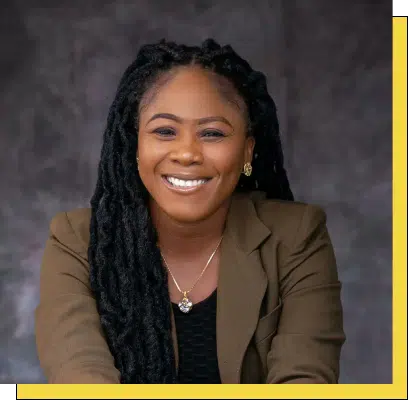
- The entire three-person team: Pat, his sister Sam, and producer Gus Tiffer, is joining HubSpot Media
- Financial terms weren’t disclosed, but Starter Story was already profitable with seven-figure revenue.
- This is HubSpot’s clearest bet yet on media-driven demand generation as a growth strategy.
If you haven’t been tracking HubSpot’s media moves, now’s a good time to start paying attention.
On Monday, HubSpot Media, the company’s in-house media division, officially acquired Starter Story, the creator-led entrepreneurship publication built by software engineer-turned-founder Pat Walls. Jonathan Hunt, HubSpot’s VP of Media and Content, confirmed the deal to Adweek, though financial terms weren’t disclosed.
Since Walls launched Starter Story in 2017, it’s grown into something genuinely rare: a video-first brand with over 800,000 YouTube subscribers, a 300,000-person newsletter, and a total audience of roughly 1.6 million, all built on the kind of transparent, numbers-out-in-the-open founder storytelling that most companies are too polished to attempt. It’s profitable, generates seven-figure revenue, and runs entirely on three people: Walls, his sister and chief operations officer (COO) Sam, and producer Gus Tiffer. All three are coming over to HubSpot Media.
HubSpot already owns The Hustle, co-produces My First Million, and recently added Mindstream to its roster. Starter Story fills a very specific gap in that portfolio: the founder-facing, early-stage, aspirational end of the funnel. And that’s not an accident.
What exactly is Starter Story?
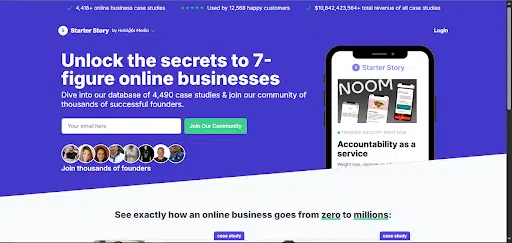
It’s important to note that, according to Pat Walls, he didn’t set out to build a media company in the beginning.
In 2017, he was working a full-time job as a software engineer, which he aspired to quit and start his own business. But he had so many questions about starting and no way to get answers. That was when he thought he could turn these questions into a product for people with questions like his.
He started researching answers to his question, published them in a blog, and shared them with everyone who also wanted to learn. People loved them. By October 2017, Starter Story was live, built from a Starbucks, fueled by genuine curiosity, and growing in exactly the kind of organic, word-of-mouth way that would feel right at home on its own pages.
Soon, one of the stories went viral on Reddit, users crashed his site, and thousands joined his newsletter. He kept going. Six months later, he monetised the newsletter. Later, the business became profitable through sponsorships.
Fast forward to today, and the numbers tell a story that’s hard to ignore:
- 783,000+ YouTube subscribers.
- 300,000 newsletter subscribers.
- 600,000+ social followers.
- 4,500+ founder case studies published.
- 100 million+ content views annually.
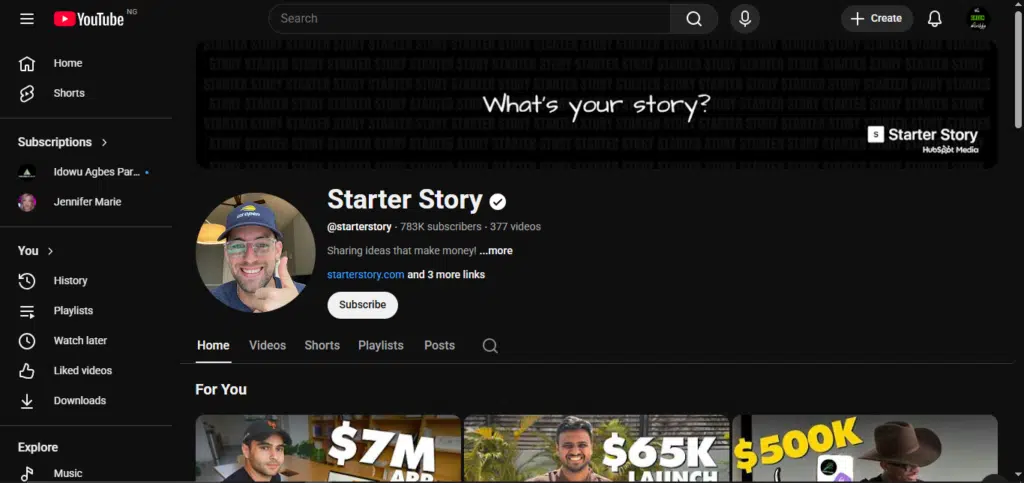
Beyond scale, what makes Starter Story matter, especially to the bootstrapped founder community, is the trust it’s built. Getting featured on Starter Story has quietly become a rite of passage for early-stage builders. The stories were honest, numbers-out-in-the-open breakdowns of how founders found their first customers, what nearly broke them, and what finally clicked.
That combination of radical honesty and genuinely useful insight is rarer than it seems. And it’s exactly what HubSpot just bought.
Why HubSpot bought Starter Story
Reason 1: Media-led growth is the new demand engine
Something quietly broke in the traditional marketing playbook, and most companies are still playing catch-up.
The ads cost more. The organic reach pays out less. The content farms that once churned out SEO fodder are getting buried; first by algorithm updates, now by AI overviews eating the search results page entirely. If your entire customer acquisition strategy lives inside Google and Meta’s ad auctions, you’re building on borrowed ground.
HubSpot figured this out early. The smarter play isn’t to keep outbidding competitors for the same shrinking pool of ad inventory but to own the place where your future customers already spend their time. That’s what The Hustle and Mindstream was. And that’s exactly what Starter Story represents: a direct line to founders before they’re even thinking about buying software.
Reason 2: Their audiences overlap
What makes Starter Story’s audience interesting is that they aren’t passive readers. They’re early-stage founders in the thick of building something: figuring out pricing, chasing their first 100 customers, Googling whether to incorporate as an LLC or an S-Corp. These entrepreneurs are making real decisions in real time, and Starter Story is one of the few places they actually trust for straight answers.
That’s the profile of someone who will, at some point soon, need a CRM. Or a marketing tool. Or both. HubSpot doesn’t need to interrupt that person with an ad; it just needs to already be in the room when the question comes up. With Starter Story in its portfolio, this naturally happens.
Before the acquisition, roughly 75% of Starter Story’s seven-figure revenue came from its own products, including subscriptions, courses, and a paid community of more than 10,000 members, rather than advertising.
With Starter Story, HubSpot’s combined YouTube subscriber base now reaches 2.9 million, surpassing Morning Brew and more than doubling Salesforce’s YouTube footprint
Reason 3: Strengthening an already impressive media portfolio
HubSpot Media currently drives over 50 million monthly engagements and tens of thousands of leads monthly. YouTube-driven lead generation grew 68% year over year, and newsletter-driven leads grew 53%. These are proof that the model works.
From The Hustle to Mindstream, they kept their editorial independence, voices, and communities. Starter Story slots into this portfolio at a specific, deliberate position: the founder-facing, early-stage, aspirational end of the funnel. Where The Hustle speaks to business-minded professionals broadly, Starter Story goes deeper with the builder crowd.
The risk, of course, is real. The moment Starter Story content starts feeling like HubSpot advertising, the trust that makes it valuable may evaporate. This makes editorial independence a critical asset here.
What this means for founders and marketers
If you’re building a business
The most immediate change for founders from Starter Story’s acquisition is the resources behind the content, not the content itself. A three-person team running a 1.6 million-person media operation has real ceilings. With HubSpot’s infrastructure behind it, those ceilings get raised. More case studies, more production quality, potentially more tools woven into the content itself.
Also important, though subtler, is that HubSpot now has a direct, trusted channel into the founder community at the exact moment founders are shaping their opinions about which tools deserve a spot in their stack. If you’re building right now, expect the Starter Story content you consume to eventually connect more deliberately to the software ecosystem around it.
If you’re on a marketing team
This acquisition should hit differently if you work in demand generation. HubSpot just showed its hand, and the hand says that the most defensible customer acquisition channel in 2025 is an audience that already trusts you.
Community and content aren’t soft brand investments anymore. They’re pipeline. The companies treating them that way are pulling ahead.
What this says about where B2B is heading
Trend 1: The GTM playbook is getting rewritten
For a long time, the standard B2B go-to-market motion looked like this: build a product, run paid ads, optimize for demos, close deals. It worked well enough when ad costs were manageable, and Google sent you reliable traffic. Neither of those conditions reliably holds anymore.
The companies winning the next decade of B2B growth are the ones building audiences before they need to sell to them. They’re showing up in the YouTube videos founders watch at 11 pm, in the newsletters they read on Saturday morning, in the communities where they ask each other for tool recommendations. By the time a purchase decision is made, the relationship is already in place.
Trend 2: Owned media is now a core strategic asset
Most companies still frame their content as “brand play,” “top of funnel,” “hard to measure.”
Meanwhile, HubSpot has spent four years quietly dismantling this framing. When your media properties generate a measurable pipeline, your newsletter drives leads that convert, and your YouTube channel outgrows your competitors’ entire social presence, the conversation changes.
The brands that figure this out next will have a real advantage. The ones still debating whether content is worth the investment are already behind.
FAQs
Did HubSpot disclose what it paid for Starter Story?
No, the financial terms weren’t part of the announcement.
Will Starter Story change now that HubSpot owns it?
According to HubSpot, the plan is to keep the former team, the same mission, and the same voice, while adding the resources to grow faster.
What exactly is HubSpot Media?
It’s HubSpot’s in-house media division, a portfolio of editorial brands built specifically to reach founders and marketers outside the traditional sales funnel. It comprises The Hustle, Mindstream, My First Million, and now Starter Story.
Conclusion
I’ve watched a lot of acquisitions get announced with big language about “synergies” and “strategic alignment,” and then quietly disappear into a parent company’s org chart, never to be heard from again. This one feels different.
Whether you’re a founder, a marketer, or just someone building something on the side, this marriage is worth paying attention to.
Disclaimer!
This publication, review, or article (“Content”) is based on our independent evaluation and is subjective, reflecting our opinions, which may differ from others’ perspectives or experiences. We do not guarantee the accuracy or completeness of the Content and disclaim responsibility for any errors or omissions it may contain.
The information provided is not investment advice and should not be treated as such, as products or services may change after publication. By engaging with our Content, you acknowledge its subjective nature and agree not to hold us liable for any losses or damages arising from your reliance on the information provided.
Always conduct your research and consult professionals where necessary.