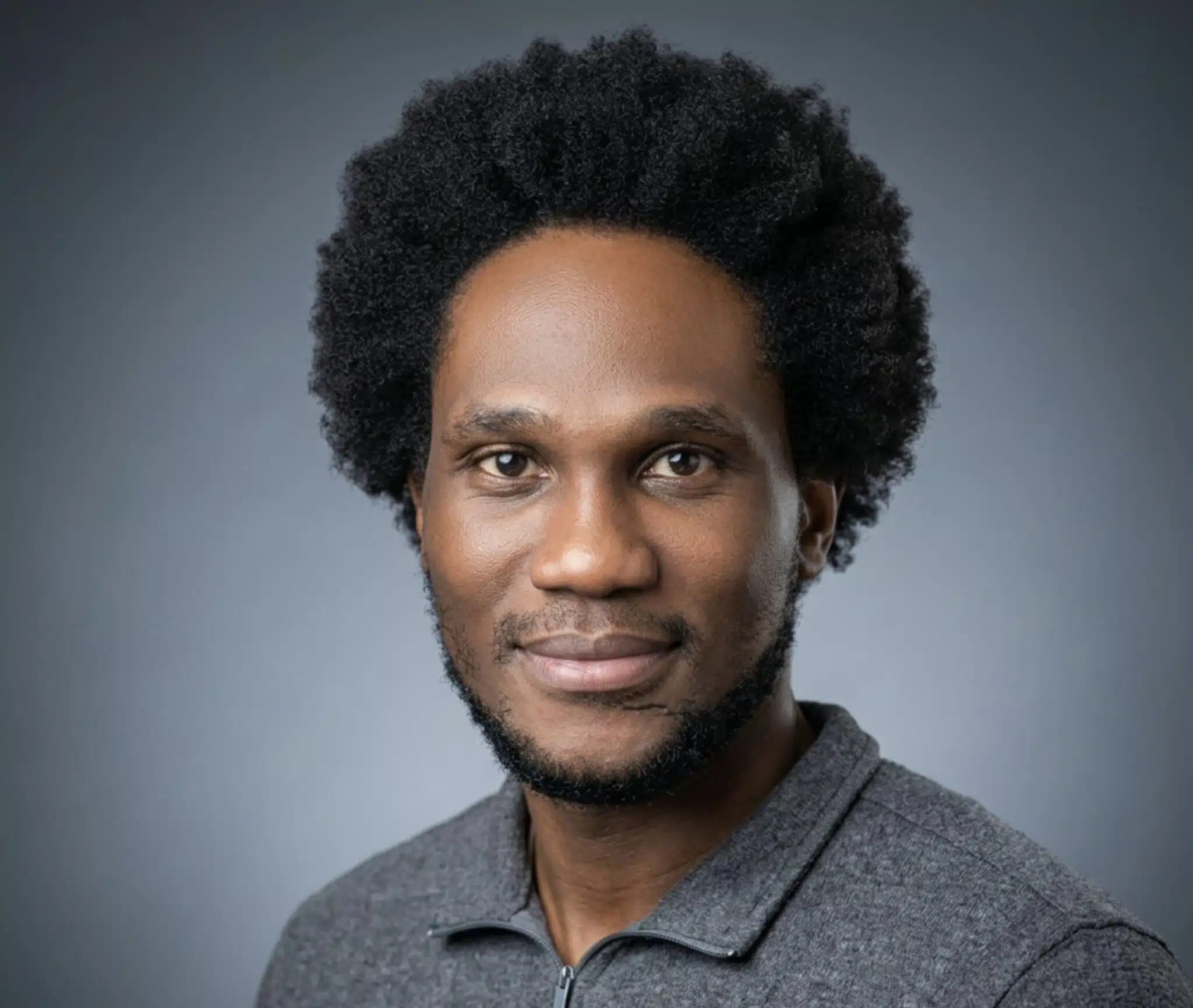





Iniubong Obonguko’s introduction to technology was domestic, influenced by his father’s role as a computer science lecturer. In an era where personal computers were not yet in every household, he found himself exploring the family desktop, moving between educational software like Encarta Kids and typing tutors like Mavis Beacon.
However, his interest went beyond consumption. He recounts a childhood habit of looking through his father’s wardrobe to find books on web development and operating systems, even before he could fully grasp the concepts.
As he entered secondary school, the family computer was no longer functional, forcing him to learn programming manually. Because he lacked a personal computer, he used his mobile phone as his primary coding tool. When power outages or battery issues occurred, he did not stop working; instead, he moved to a physical notebook.
This required him to write code by hand and visualise its execution without a compiler.
“I would have to practice what I had learned on paper because I didn’t have a computer at the time,” Obonguko explains. “So, I could only use my phone when it was on, and when it was off, I would resort to practising on a notebook.”
Once the power returned, he would transcribe the handwritten code back to his phone to test-run it.
This resourceful approach is a common thread among many Nigerian tech pioneers who began their journeys during the late 2000s and early 2010s. During this period, personal computers were not widespread, and power supply was inconsistent, forcing a generation of mobile-first developers to build mental compilers long before they had access to high-end workstations.
The decision to depart from a traditional path
While many view a university degree as the mandatory first step in an engineering career, Obonguko found that the traditional system at the University of Nigeria, Nsukka (UNN), was in direct conflict with his professional growth. Studying Electronics Engineering, he reached a breaking point in his third year. The friction between his burgeoning career and the inefficiencies of the school system led him to a difficult but calculated decision to drop out.
“It was a conflict of interest. On the one hand, I had this exciting thing: I was building projects that people were using. On the other hand, I had to get up and go to class. Sometimes, I would go to a class, and it would be cancelled.”
This is a persistent systemic issue in many Nigerian public universities, where there is often a disconnect between the curriculum and industry standards. Additionally, administrative strikes can turn a four-year degree into a six-year ordeal.
For high-performing students in fields like software engineering, this disconnect between archaic coursework and the modern job market often makes an early exit the most logical career move.
But Obonguko’s decision was not a complete abandonment of education; it was a pivot toward a more flexible model. Today, while working at a senior level, he is completing a computer science degree through a German university offering distance learning, showing that his departure from UNN was about the learning method rather than the subject.
Professional evolution: From Uyo to Europe
Obonguko’s professional career began with an internship at a small IT firm in his hometown of Uyo, where he worked on WordPress sites and school management systems. This provided the groundwork, but his subsequent role at Hoshis Tech served as a significant catalyst for his growth.
Joining as a founding engineer, he was quickly thrust into a high-stakes environment where he was responsible for the frontend of an event ticketing platform. When the more senior engineer on the team left, Obonguko, with only a year of experience, had to take over. This period forced him to accelerate his learning curve to meet the demands of large-scale clients during peak seasons.
Recalling the intensity of that time, particularly a major project for a partner company in December, he notes the weight of the responsibility.
“Everything rested on my shoulders because a lot of things were dependent on me getting my work done. That experience taught me that I’m always willing to go the extra mile to get things done.”
This experience prepared him for the transition to international roles, first at Papershift in Germany, where he focused on employee management and HR tools, and eventually to his current role as a Senior Frontend Engineer at heyrise.
Curiosity as a career driver and the future of his craft
Beyond his technical ability in frontend engineering, which he describes simply as “the part of the internet that you can see and touch,” Obonguko credits his advancement to an innate curiosity.
He believes that this drive is what separates engineers who merely do the work from those who evolve with the industry. For him, curiosity isn’t just a personality trait but a professional survival skill in an industry that changes daily.
Looking ahead, his interests are shifting toward the deeper layers of software development. While he has built a career on the frontend, his vision for the future is to learn to build better tools for other developers and to improve web performance at a more fundamental level. He identifies developer experience and productivity tools as his next frontier, recognising that building for other engineers is a unique challenge.
“My vision for the future is to master systems-level programming with Rust to build faster and better tools, and this translates to faster, better tools for the web,” he says.
This shift from building user interfaces to building the infrastructure that powers them marks the next logical step in a career defined by self-study and a refusal to settle for the status quo.
The evolution of the African tech export
The story of Iniubong Obonguko is more than an individual success story; it serves as a blueprint for the contemporary talent export model that has defined the Nigerian tech ecosystem over the last decade.
Obonguko’s growth highlights a shift in how global companies view African talent. In the mid-2010s, remote work for African engineers was often seen as a cost-cutting measure by Western startups outsourcing small tasks. Today, as evidenced by Obonguko’s senior roles in global tech companies, the narrative has shifted toward specialised expertise.
Furthermore, his decision to abandon the Nigerian university system for a distance degree in Germany underscores a growing crisis in local higher education. As the digital economy accelerates, the skills gap in traditional Nigerian institutions becomes more apparent. By seeking education that mirrors his professional reality, Obonguko illustrates a pragmatic trend among high-tier engineers who prioritise global accreditation and flexible learning over local prestige.
His journey suggests that for the modern engineer, the campus is no longer a physical location in Nsukka or Lagos, but a global network of documentation, open-source repositories, and digital-first universities.
Ultimately, Obonguko’s trajectory reinforces a singular truth in the modern era: the most valuable currency in technology isn’t a degree; it’s the demonstrated ability to learn, build, and communicate in a world that never stops changing.