




From Okra to Edukoya and Lydia, news of startup shutdowns often sparks intense scrutiny and speculation, but according to Iyin Aboyeji, “failure is the default outcome of a startup,” and he wants investors and founders to make peace with it.
Aboyeji, General Partner and co-founder of Future Africa, made this point at the Africa Deep Tech Conference 2026, during a conversation with renowned operator Adia Sowho.
The conversation kicked off with a discussion of how to fund deep-tech companies in Africa.
Sowho emphasised the importance of leverage and building products people are willing to pay for. In her experience working at large corporations, including 9mobile (now T2 Mobile) and MTN Nigeria, smaller players rarely get favourable treatment unless they walk into the room with something valuable.
For founders seeking partnerships, customers, or investors, that leverage can be as simple as building something people are already willing to pay for.
“Build something your mother will pay for. Make sure you can see the cash in the product before you go out for money. The only way you hold onto ownership is if you have a path to survivability.”
Meanwhile, Aboyeji argued that deep tech innovation does not always follow the typical startup playbook.
Unlike consumer apps or simple digital services, deep tech products can take years of research and substantial capital before they become commercially viable. In those cases, waiting for early customers may not always be realistic.
However, the issues circled back to how founders and investors perceive startups. This perception has shaped what we build, how we build it, and how we fund it.

Victoria Fakiya – Senior Writer
Techpoint Digest
Make your startup impossible to overlook
Discover the proven system to pitch your startup to the media, and finally get noticed.
Builders and investors have their problems
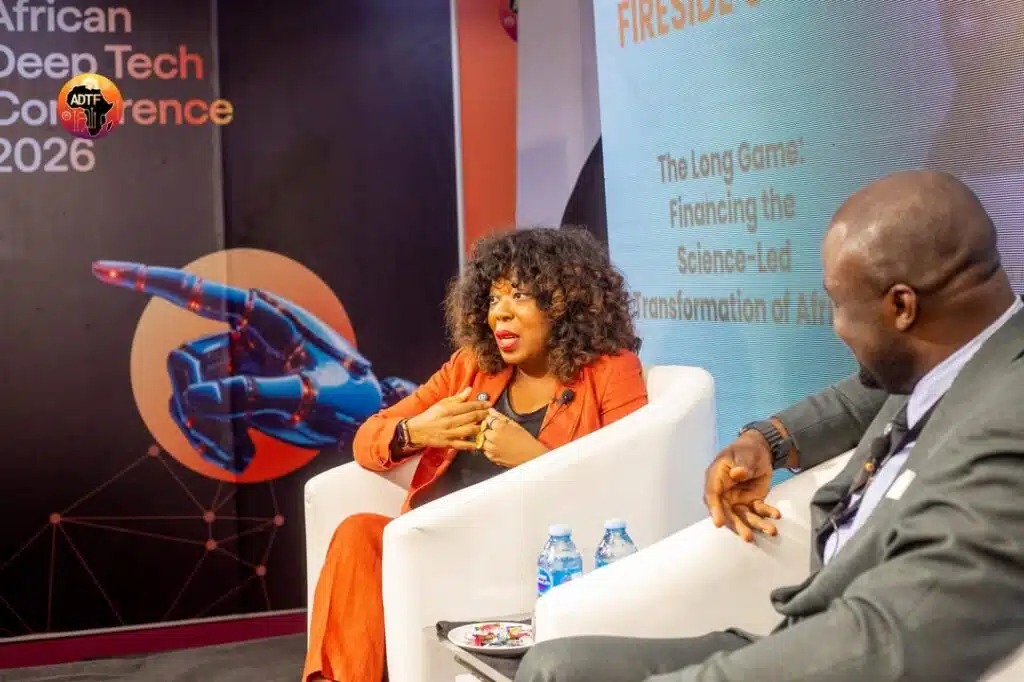
When it comes to building and investing in startups in Africa, Sowho and Aboyeji highlighted a number of problems. According to Sowho, many builders do not build to global standards.
“We don’t chase standards; everybody wants to build their own thing, but we need to establish a common language of what good looks like. Because of hardship and urgent 2k, we build whatever works, and if it sort of looks like it works, then it passes.”
Sowho attributes this lack of standard to why big African corporations will rather go for foreign solutions rather than settle for one built by an African. Although Aboyeji pointed out that African solutions sometimes succeed in the global market, Sowho responded that Africans sometimes fear their own authenticity.
“Until we start to own what is ours confidently, we’re not going to give birth to solutions that don’t have to travel outside before they’re validated.”
Aboyeji agrees, but the problems he highlights when it comes to building in Africa are more from an investor’s perspective, and one of the main issues he points out is that most people don’t invest with failure in mind.
Make failure less expensive

“People say venture capital does not work because we start from the premise that businesses are supposed to succeed. We need to come to the market with some humility. Failure is the default outcome of a startup.”
He’s not wrong. Globally, startup failure is far more common than success. Several studies estimate that about 90% of startups eventually fail, while only about one in ten survives long-term. Even among venture-backed companies, roughly 75% fail to return investors’ capital.
Aboyeji’s argument is not about avoiding failure or just expecting it; he wants VCs to make failure less expensive.
One way to do that, he suggests, is to reduce the cost of experimentation. Instead of concentrating large sums of money in a small number of startups, investors could spread resources across more early-stage ideas and allow founders to test them quickly.
In some cases, those resources may not even need to be traditional venture capital. Something as simple as access to GPUs, Internet connectivity, or shared workspaces could give builders enough runway to test their ideas before raising larger rounds.
Lowering the cost of experimentation could be particularly important for deep tech startups, where developing meaningful solutions often requires time and specialised infrastructure.
In ecosystems where building is expensive, failure can be financially devastating for founders and investors alike. But when experimentation is cheaper, founders can try again without being permanently sidelined by a single unsuccessful venture.
Return of investment is more important than return on investment
One of the main problems of VCs, according to Aboyeji, is the limited partners (LPs), and he sums up the problem as “return of capital is more important than return on capital.” A point of view still tied to the fact that startups are expected to succeed.
He said in typical VC fashion, or what can be described as the Silicon Valley model, LPs give money to VCs to make that money back and an additional 80%, but also understanding that the investment may be lost completely.
However, in Nigeria, LPs make similar bets, but even when the 80% or any form of profit is not guaranteed, the return of the initial capital must be guaranteed.
“What this means is that as a GP, I’m more incentivised to make sure a startup succeeds as opposed to becoming a digital casino.”
Interestingly, this has both good and bad sides. On one hand, VCs will bring more to the table than just funding, but on the other hand, it means VCs make fewer bets and end up becoming entrepreneurs rather than investors.
Whether Aboyeji finds the behaviour of LPs in Nigeria favourable or not is unclear, but one thing he wants them to do is sell their stocks to release liquidity into the market.
“LPs need to let the industry go. They need to put their stock on the market at fire sale prices, cut their losses, so that liquidity comes back to the market at reasonable prices. The VCs are not going to make money on those deals anyway, so there’s no point holding them by the neck.”
Aboyeji also wants more realistic valuations in the African startup ecosystem. According to him, most of the valuations he sees are prophetic, and anyone investing above $5 million in a startup must know something he doesn’t.
What it all means
For all the structural problems in Africa’s startup ecosystem, Aboyeji’s central point may be less controversial than it first sounds. Venture-backed innovation has always been a game of probabilities. Most startups fail not because founders are incompetent or investors are careless, but because building something is inherently uncertain.
The challenge for Africa is that capital is limited, exits are rare, and the distance between startups and large corporations remains wide. In that environment, every failure can feel like a setback for the entire industry rather than a normal part of experimentation.
But if Aboyeji is right, the question may not be how to prevent startup failures but how to design an ecosystem where failure is survivable.
That could mean investors spreading smaller bets across more founders, corporations becoming more open to working with startups, and builders gaining better access to real industry problems.
Failure may be the default outcome of a startup. But ecosystems that produce enduring companies are often the ones where failure is not the end of the story, but just another step in the process of building something that eventually works.