

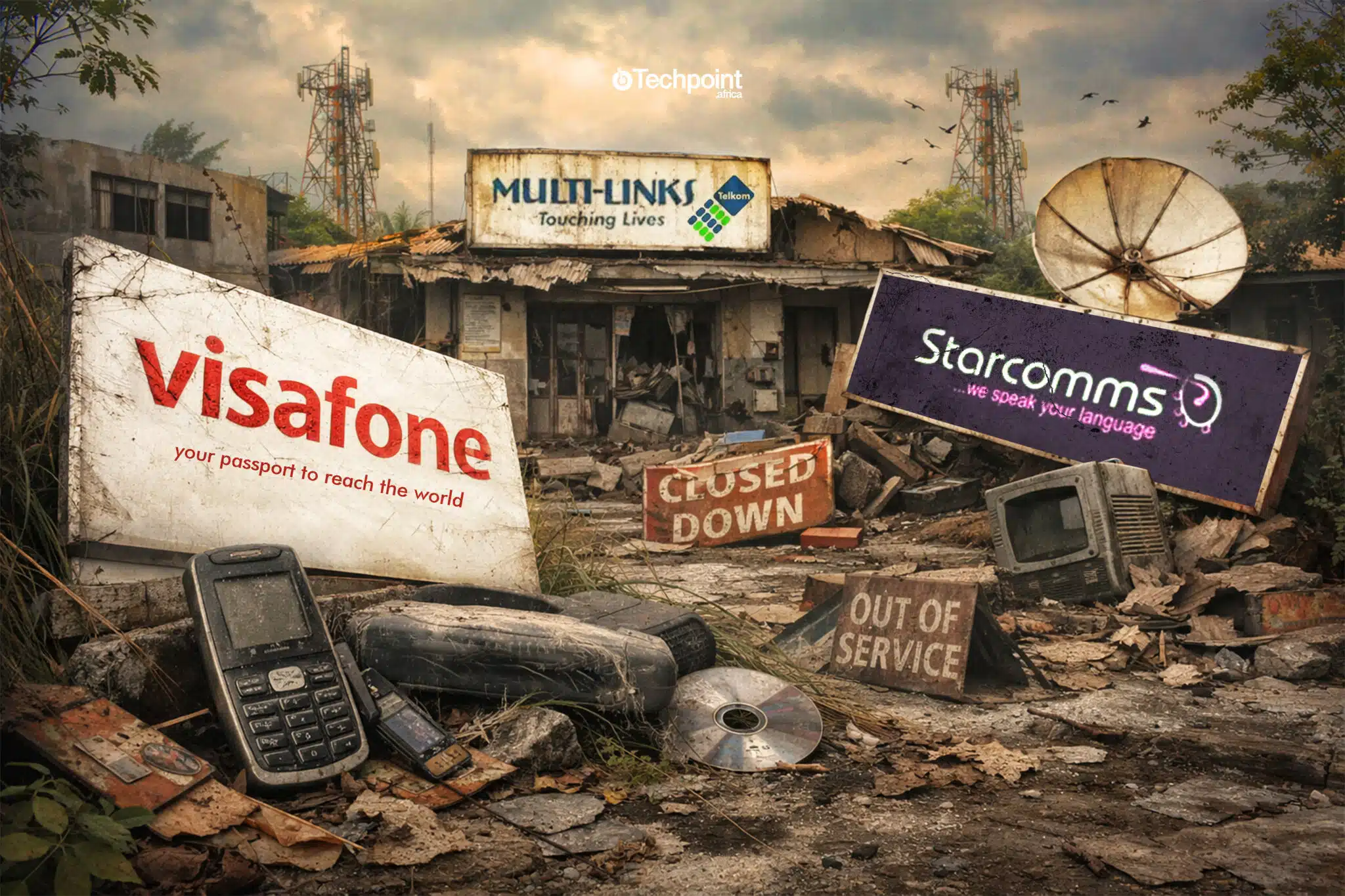


Before MTN, Airtel, and Globacom took over Nigeria’s telecoms scene and became status symbols in the early 2000s, a much quieter telecom revolution was already underway. In the years before the Global System for Mobile Communications (GSM) era formally began in August 2001, a handful of companies were giving ordinary Nigerians access to reliable telephone connections: something that was quite radical at the time.
They were the CDMA operators — Code Division Multiple Access networks built on a technology that many people still argue was superior, in several important aspects, to the GSM alternative that would eventually bury them.
The first movers of mobile technology
Between 1985 and the late 1990s, in Nigeria, if you wanted a personal telephone in your home or office, you needed a fixed telephone line (often referred to as a land line) connected to a socket in the wall, routed through cables to a pole outside, and finally to the Nigerian Telecommunications Limited (NITEL). NITEL, Nigeria’s only telephone company at the time, was largely unreliable due to poor infrastructure maintenance, a lack of investment, congested networks, frequent disconnections, and waiting lists stretching into years. Entire cities outside Lagos and Abuja barely had coverage.
But all of these came to an end in the late 1990s, when the Nigerian Communications Commission (NCC) licensed several Private Telecommunications Companies (PTOs) to improve telecoms services in the country, ending NITEL’s monopoly and introducing Code-Division Multiple Access (CDMA) technology in Nigeria.
This license opened the door for some of Nigeria’s oldest telecoms companies, which provided fixed and mobile telephony services using CDMA technology. Multilinks was the first CDMA network company to receive a license in 1996 and began operations in December 1998, followed by many others, including Intercellular, Starcomms, and Visafone. MTS First Wireless, which had launched Nigeria’s first mobile phone network in 1992, also repositioned itself as a CDMA operator by 2002.
For the first time, Nigerians had a choice, and it was revolutionary.
CDMA’s core strength was that it shared the available airwaves among all users simultaneously, rather than carving out a dedicated lane for each user. This made it more efficient with spectrum, which translated to better call quality and faster data speeds compared to early GSM.
Starcomms, which became the first CDMA operator listed on the Nigerian Stock Exchange in 2008, was also the first company on the continent to launch EV-DO high-speed broadband services. At its peak in late 2008, Starcomms had reached 2.7 million subscribers and was described as the fourth-largest telecoms operator in the country.
The CDMA ecosystem had real momentum. Visafone, founded in 2007 by Jim Ovia (also the founder of Zenith Bank), assembled its network by acquiring three existing CDMA operators: Cellcom, the Independent Telecommunications Network (ITN), and Bourdex Telecoms in Aba. Within six months of its February 2008 launch, Visafone had reached one million subscribers. By January 2009, it had announced 2.5 million. At its peak between 2010 and 2011, Visafone had approximately three million subscribers — the highest subscriber count any CDMA operator in Nigeria ever achieved.

Victoria Fakiya – Senior Writer
Techpoint Digest
Stop struggling to find your tech career path
Discover in-demand tech skills and build a standout portfolio in this FREE 5-day email course
But even at the height of that boom, the structural fault lines were already visible.
The GSM competition
One of the most consequential decisions that ultimately led to the death of CDMA network operators was not the granting of GSM licences in 2001—although this played a role. It was the structure of the licences issued to CDMA operators.
Initially, CDMA operators were issued regional licences, not national ones. This meant that while MTN or Econet (later Airtel) could roll out infrastructure and acquire subscribers anywhere in Nigeria from day one, a CDMA operator licensed for Lagos and the South West could not legally serve a subscriber in Kano or Abuja. This placed a structural cap on the subscriber numbers CDMA companies could ever achieve, and therefore on the revenue base from which they could finance expansion.
“While CDMA operators refined regional networks, GSM operators were playing a different game. MTN, Econet (later Airtel), and M‑Tel were granted a five‑year period of exclusivity starting in 2001 to build nationwide mobile networks[6]. They used that window ruthlessly well, expanding coverage, acquiring millions of subscribers, and embedding themselves into everyday Nigerian life,” one industry analysis notes.
In 2006, the NCC upgraded the CDMA operators’ regional licences to Unified Access Services Licences (UASLs), giving them the same national reach as the GSM players. But their GSM counterparts had amassed a significant subscriber base. By 2006, MTN already had 40 million subscribers, and Globacom, which launched in 2003 with the transformative promise of per-second billing, had grown to 15 million subscribers. The window for CDMA operators to catch up, had it ever existed, had closed.
Although SIM cards sold for as much as ₦30,000 when GSM launched in 2001, making CDMA operators cheaper and more accessible to many Nigerians, as prices fell and coverage expanded, this advantage began to wear off. The more fundamental problem was devices. Because GSM allowed subscribers to use their SIM cards with a variety of phones, it became more attractive than CDMA devices, which were locked to specific networks.
By the end of 2015, the two surviving CDMA operators, Visafone and Multilinks, had a combined subscriber base of just 2.1 million. During the same period, GSM subscribers grew to 150 million.
In 2019, the NCC reported that CDMA companies held 0% of the telecoms market, marking the end of the CDMA era.
The death of major CDMA companies
CDMA companies began to phase out one at a time, starting with Mobitel in 2005.
Multilinks had the opportunity of being the first private telephone company in Nigeria, but it never caught up with the GSM operators and was eventually acquired by South Africa’s Telkom in 2007 for $410 million. But the CDMA subsidiary ran at a loss, and Telkom eventually stopped funding the company.
In 2011, Telkom attempted to withdraw from its Nigerian operations by selling Multilinks to Visafone for $52 million, a fraction of what it had paid four years earlier. However, according to its annual results announcement in June of the same year, the deal fell through because “certain conditions precedent have not been met and the transaction will not proceed.”
Multilinks was eventually sold to Helios Towers Nigeria, a subsidiary of Helios Investment Partners, for $10 million in November 2011, finalising Telkom’s withdrawal.
Intercellular was among the original wave of CDMA operators that gave Nigerians their first taste of private telephony in the late 1990s. But it was too small, too regional, and too undercapitalised to survive, eventually losing all its subscribers to competitors. In 2015, it attempted a comeback, planning to offer 4G voice and data services after Telto Group, a Middle East investment conglomerate, secured a 70% stake in the company. In 2018, the NCC withdrew Intercellular’s telephone number, among 41 million others, and in 2019, Airtel acquired the company’s spectrum for $70 million.
Starcomms was the most ambitious of the operators. By 2008, it had 2.7 million subscribers, was listed on the Nigerian Stock Exchange — the first telecom company to achieve a domestic listing — and had launched the first EV-DO high-speed broadband service in Africa. But its subscriber base collapsed as GSM operators undercut its pricing and expanded into its territory.
In 2012, Starcomms, Multilinks, and MTS attempted a merger to form a single entity called Capcom. The plan fell through due to a lack of funding. By 2013, NCC data showed that Starcomms’ Internet subscriber base had fallen to 15,859 from 63,198 the previous year. In June 2014, the NCC officially declared Starcomms and eleven other operators inactive.
Visafone was the best-managed of the CDMA operators and the last to fall. At its peak, it had three million subscribers — the highest any CDMA operator in Nigeria ever achieved. But by September 2015, the entire CDMA segment controlled just 1.58% of the market.
In 2016, MTN acquired Visafone. The rationale for the acquisition was to use Visafone’s 800 MHz spectrum to launch 4G LTE services. The NCC approved the deal on the condition that MTN would revive Visafone as a fixed wireless operator, but later realised MTN had no real intention of doing so. The company migrated all Visafone subscribers to its GSM network and began offering them 4G LTE service.
The liquidation was completed in the first half of 2024, with MTN writing off ₦30.3 billion.
Why they really failed
The easy narrative is that CDMA died because GSM was better, but in truth, this is only a part of the story.
CDMA operators in Nigeria were, with some exceptions, undercapitalised, poorly managed, and hindered by licences that gave them national aspirations within regional boundaries.
A 2016 report in Nigeria CommunicationsWeek described the sector’s collapse as driven in part by corporate mismanagement, including the diversion of funds meant for expansion into unrelated ventures.
“It’s the CDMA which was ultimately responsible for their troubles with widespread corporate mismanagement, including, but not limited to, its non-compliance with laid down internal controls and operation procedures, biased recruitment exercises, and general lackluster management practices. To make matters worse, over the years, CDMA operators have regularly and consciously ignored sustained and systematic red flags as their promoters and managers diverted funds meant for expansion into frivolous projects like manufacturing, oil and gas, elections, just to name a few.”
The CDMA operators built an important foundation. They ended a monopoly and connected Nigerians who had waited decades for a phone line. They were undercapitalised, sometimes badly managed, and ultimately outcompeted.
The CDMA story is worth revisiting now because the Nigerian telecoms sector is once again at an inflection point. The same GSM operators that buried CDMA are today under pressure from regulators demanding better quality of service, from subscribers frustrated by poor networks, and from the rising cost of infrastructure maintenance in an economy battered by naira devaluation. MTN, Airtel, Globacom, and 9mobile secured a tariff increase in early 2025, the first in over a decade, arguing that without it, they could not sustain investment. The echoes of the CDMA era — underfunding, infrastructure gaps, and a hostile operating environment— have not entirely faded.