



Africa’s modern technology industry has seen breakneck growth as internet and mobile penetration deepened across the continent.
In 2022, tech startups raised nearly $5 billion across 941 disclosed deals, more than double the combined funding received in 2019 and 2020, according to TC Insights. The surge helped produce a wave of unicorns, with Nigeria emerging as the epicentre of Africa’s billion-dollar tech ecosystem.
More recently, in 2025, the industry staged another comeback after two years of correction. TC Insight also estimates that investments rose by 53% year on year to $3.4 billion, despite tighter global financing conditions. Partnerships, acquisitions and regional expansion also picked up sharply, suggesting that more companies are choosing sustainable growth over hype.
As the market enters a more mature phase, analysts expect growth momentum to continue. Yet investors have become more selective, especially in late-stage funding rounds. Could that help explain why Africa’s tech founders remain largely absent from the continent’s dollar billionaire ranks?
Industry leaders argue that the answer lies not only in valuations, but also in the structure and maturity of African capital markets.
Billion-dollar startups, missing billionaire founders
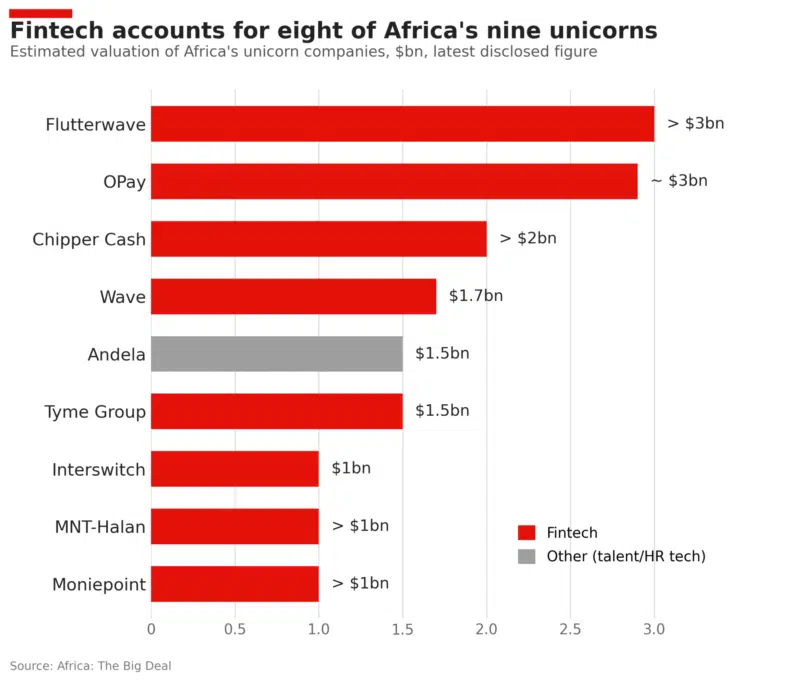
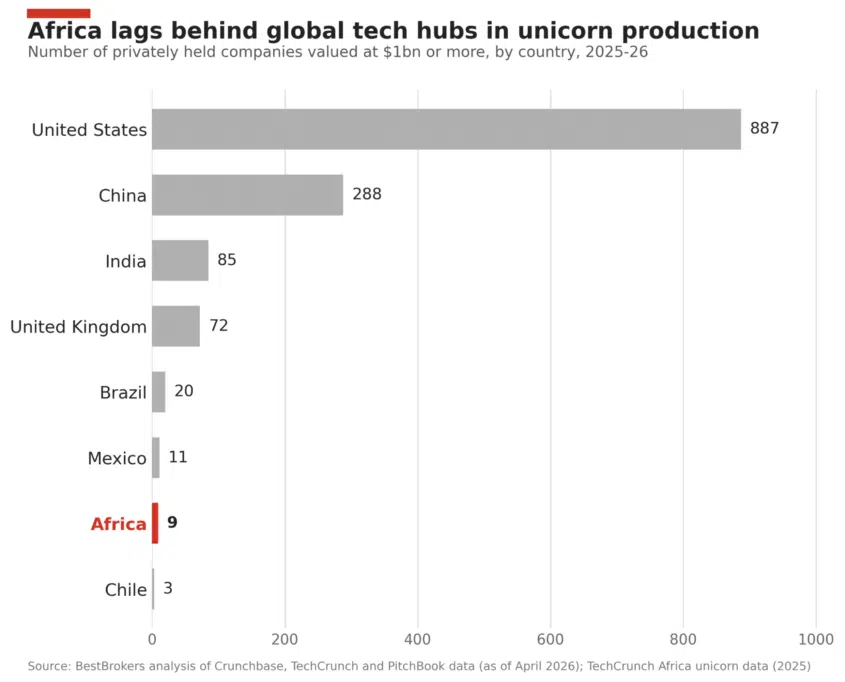
Africa has become far better at creating billion-dollar companies than it was a decade ago. As of March 2025, the continent boasted nine privately held technology companies valued at $1 billion or more, according to TechCrunch.
A decade earlier, that number was zero.
The change is visible not only in valuations but also in the flow of capital. In 2015, African startups raised about $400 million for the entire year. TC Insights estimates that startups attracted roughly $1.4 billion in the first half of 2026 alone.
Some of the continent’s best-known fintech companies now sit at the centre of that growth. Flutterwave, valued at about $3 billion, remains Africa’s most valuable fintech startup. OPay is worth roughly $2 billion, while Moniepoint and South Africa’s Tyme joined the unicorn club after raising a combined $360 million in late 2024.
On paper, those are the kinds of numbers that should be creating a new generation of extremely wealthy founders.
Yet the billionaire rankings tell a different story.
When Forbes published its 2026 Africa’s Richest People ranking, the list of 22 dollar billionaires contained only one figure with a major technology connection: Mike Adenuga, owner of telecom operator Globacom. Even then, his wealth comes from a broader business empire that includes oil and other sectors. None of the founders behind Africa’s leading unicorns appeared on the list.
The disconnect reflects how venture-backed startups create wealth.
A company may be valued at $1 billion or $3 billion, but founders rarely own all of that value. Each funding round brings in new investors and usually reduces the founders’ share of the business.
“A startup may achieve unicorn status, but that does not mean the founder owns 100% of the company,” Lola Masha, a partner at venture capital firm Antler, told Businessfront.
“In many cases, founders have been diluted through multiple funding rounds to the point where their stake may no longer be a majority holding. So while the company may be valued at more than $1 billion, the value of what the founder actually owns is often far lower.”
The distinction is important. A unicorn valuation measures what investors believe the company is worth. A billionaire fortune measures how much wealth a founder can actually claim, control or convert into cash.
From this perspective, Africa can produce billion-dollar startups without producing a comparable class of tech billionaires.
Why Scale matters
What looks like a major breakout story locally becomes a much smaller one when placed in global context
A 2026 BestBrokers report, based on data from multiple independent valuation trackers, puts the U.S. at 887 unicorns, more than half of the global total.
China has 288 and India 85. Africa’s unicorn count barely registers beside those numbers. The gap is not just in the number of billion-dollar companies. It is also in the amount of capital available to support them.
Eqvista estimates that U.S. startups attracted $274 billion in venture capital funding in 2025, about 64% of global VC investment. That is almost 13 times the $21 billion African startups raised between 2019 and 2025.
For Lola Masha, that difference shapes what founders can realistically become.
“Alphabet, Meta and Amazon are hyperscaling businesses operating on a completely different level,” she said. “You cannot put African unicorns in the same category.”
The contrast becomes even clearer after a startup reaches unicorn status.
In the U.S., founders can often sell part of their holdings during late-stage funding rounds, secondary transactions or after an initial public offering. Their ownership may shrink, but they have opportunities to turn part of that stake into cash while still benefiting from the company’s future growth.
African founders rarely have those options.
“A founder may hold shares that are worth a substantial amount on paper,” Masha said. “But that is not the same thing as cash wealth until those shares can be sold.” This distinction matters because none of Africa’s most valuable privately owned startups has completed a public listing. OPay was linked to possible listing discussions in 2025, but no public offering followed.
IPO speculation resurfaced in 2026 after Flutterwave acquired Nigerian fintech Mono. Some industry watchers viewed the deal as a possible step towards stronger public-market readiness, though the company has not announced any listing plans.
For now, much of Africa’s biggest startup wealth remains trapped inside private companies. The valuations are real. The liquidity needed to turn those valuations into billionaire fortunes is still largely missing.
Shifting investor focus: another liquidity squeeze?
Another factor could make Africa’s first true tech billionaire class a much longer-term project: venture capital is changing what it wants to fund.
The shift became visible in 2025.
For years, startups were rewarded for growing as quickly as possible. Investors chased market share, user growth and headline valuations. That is changing. Capital is now flowing towards companies that can show revenue growth, operational efficiency and a path to profitability.
Data from Africa: The Big Deal shows that the continent’s highest-valued private technology companies raised only about $100 million in equity financing in 2025. Even after including debt financing, total funding for that group reached only $358 million, a multi-year low.
The result was striking. No new unicorns were created in 2025, making it the quietest year for billion-dollar startup creation since 2020. Because private valuations are usually updated when fresh equity rounds are announced, the slowdown also meant few valuation resets for existing unicorns.
The pressure is not limited to the top end of the market. The report also points to a decline in smaller early-stage equity deals, especially in the $100,000-$500,000 range. These rounds rarely make headlines, but they are the pipeline that produces future breakout companies.
The trend is visible globally. Investors are putting more money into fewer companies, particularly in sectors such as artificial intelligence.
The slowdown has continued into 2026. African startups raised only $290 million in early-stage funding in the first quarter of 2026, the weakest first quarter since at least 2021.
That does not mean investors are abandoning the continent. The money is increasingly flowing towards companies that are closer to scale rather than those still chasing it.
Fintech provides the clearest example. M-KOPA raised roughly $166 million in Series F financing and reported its first annual profit in 2025. Other growth-stage fintech companies such as Stitch and LemFi also attracted sizeable equity rounds, showing that investors are still willing to back companies with strong economics and clear expansion plans.
For Biola Alabi, investment partner at Delta40, the shift reflects a “convergence to quality” rather than a collapse in venture activity.
“Early-stage deals are still happening,” she said. “Many high-quality founders are getting oversubscribed rounds, while weaker startups are being filtered out across all stages of fundraising.”
The point is important. Africa’s first unicorns emerged by solving local problems such as digital payments, online commerce and access to financial services. Investors are now looking for startups that can build durable businesses around those kinds of structural gaps, not simply chase rapid valuation growth.
Masha believes the continent’s toughest operating conditions can still produce its biggest companies.
“We had clear gaps around digital payments and electronic payments,” she said. “Companies such as Paystack, Flutterwave, Moniepoint and OPay stepped in to solve those problems. What looks like an infrastructure gap is also an opportunity for founders to create value.”
If investors are concentrating on quality, profitability and resilience, one of the fastest ways for founders to attract capital may be to focus less on global startup narratives and more on persistent local problems that remain unsolved.
Founders cannot build in a vacuum
Even the strongest founders operate inside a regulatory system. That system can either accelerate growth or slow it down.
Egypt has emerged as one of the clearest examples of a government trying to make regulation an enabler of startup growth. Authorities have introduced measures aimed at simplifying company incorporation, reducing administrative friction and streamlining tax obligations for startups.
In Southern Africa, regulators are leveling the playing field between global tech giants and domestic businesses, alongside passing foundational startup legislation.
These reforms matter because uncertainty is expensive. Startups can survive competition. They struggle to survive unclear licensing rules, unpredictable taxes and constantly changing regulatory expectations.
If Africa wants more unicorns — and eventually more billionaire founders — regulation must become a source of confidence rather than a source of friction.
The next chapter may belong to AI infrastructure
Artificial intelligence (AI) is emerging as one of the areas attracting the strongest investor interest.
Globally, AI attracted an estimated $242 billion in venture funding in the first quarter of 2026, accounting for roughly 80% of all venture investment during the period. Because African startups still depend heavily on international capital, those global funding priorities will influence where money flows on the continent.
Shayo Olumide, Vice President for Investments at the Africa Finance Corporation (AFC), believes the biggest opportunity may be in the infrastructure that powers AI rather than in consumer applications alone.
“One area where we expect increased investment activity is physical AI infrastructure, including data centres and compute capacity,” he told TC Insights.
Africa’s data-centre construction market, valued at about $1.26 billion in 2024, is projected to reach $3.06 billion by 2030. Olumide argues that the continent must invest in people as aggressively as it invests in physical infrastructure, because the AI boom will require a much larger pool of digitally skilled workers.
That brings the conversation back to its central question. Africa has already shown that it can produce valuable startups, attract international investors and build companies that solve real economic problems.
The harder task is building the capital markets, exit opportunities, regulatory support and talent base that allow those companies to keep scaling after the early success phase.
Until then, Africa may continue to produce valuable companies faster than it produces billionaire founders.