




Kemi Bolatito was born and bred in Mushin, a densely populated suburb in Lagos State, Nigeria, in a lower-class family that had to hustle its way to survival.
As a young child growing up and having firsthand experience of the struggles her parents went through in meeting their daily needs did something to Bolatito. She quickly decided she wouldn’t pursue the traditional 9-5 corporate path but would instead focus on entrepreneurship.
Bolatito learnt to sell things, flipping ₦100 to ₦200, and this excitement of making her own money would later lead her to start a business during her undergraduate studies. That experience later paid off when she founded Rolla Pay, a fintech company that offers cross-border payments.
In this edition of Techpoint Diaspora, Bolatito takes us back to her early childhood days in Lagos, Nigeria, and how she became a startup founder in Canada.
Growing up with a father big on values
I was born and bred in Mushin, Lagos. My family was not even near an average Nigerian family, but my father owned the house we lived in. Although we had a roof over our head, we had to hustle for everything that we survived on.
The most important thing growing up in my home was that my dad was very big on ethics and values. His name was so important to him, so my siblings and I were always reminded not to soil that name. Not even hunger could tempt us to do anything silly.
Most of the time, there would be no food to take to school in the morning, but my mother would say, “Okay, go to school when you come back during break time.” My school was a community primary school about a five-minute walk from home. During that time, kids were allowed to go home for lunch; you ate, and then you ran back to class.
My father was part of the generation that really fought for democracy. He was prominent in grassroots politics, but we hated politics because of all the trauma it brought. On numerous occasions, my father was arrested during the military junta, and we had to visit him in jail.
After Nigeria’s return to democracy in 1999, my father was one of the forgotten ones, despite having done all the work for those who came to power at the national and state levels, especially in the southwest. Interestingly, he was still content; he was from an era of contentment. He doesn’t believe in entering politics for personal gain. So, judging from all that, we really wanted to stay away from anything political.
Long journey to entrepreneurship
From a very early stage, I’ve always been in entrepreneurship. Right from primary to secondary school, I’ve always been selling.
Survival was the main reason why I ventured into entrepreneurship; I wanted to do better than my parents. Seeing my parents struggle was enough motivation to go into business, but the desire to build generational wealth and a legacy for my children was also a contributing factor.
When I was studying Mass Communication at Olabisi Onabanjo University, I would sell candies and cookies to my classmates. So when I’m going to class in the morning, I’m broke, but by the time I get back, I’ll have enough to make food.
Interestingly, being an entrepreneur didn’t affect my good grades in school. That was the motivation for me to keep selling and to keep doing business. When I graduated, I got married and was committed.
I did a bit of media work for close to a year during the National Youth Service Corps (NYSC) period, before the company left Nigeria. By this time, I already had children, so I was like, “this wasn’t for me,” and I went full-time into business.
Moving to Canada with three young children
Leaving the country was planned, even before I got married. My husband came from a similar survivor background. We believed that once we have education, our coming together should provide a better life for our next generation. We agreed to travel abroad, but we were very particular about permanent residency.
I started doing research, but one agent who claimed to be taking everyone to Canada ended up scamming me. Thankfully, I didn’t put in a lot of money. The only painful thing was our passports; luckily, he was busted, and we went there to retrieve them.
We started saving towards it and were super intentional, making sure we met all the requirements. By the time Canada was accepting another batch of skilled workers, we had been selected for permanent residence. We left Nigeria in 2015, but not after participating in the general elections. I already had three children at this time, and then all of us travelled.
The difference in weather was huge; you’re coming from this humid Nigerian weather to extreme cold. I came out of the airport and ran back inside because I was wearing jackets that were not meant for the weather. We then settled in one of the coldest cities in Canada, where temperatures can drop to -50°C.
I looked at the environment and saw that many people were more into paid employment, but I decided to focus on entrepreneurship. I arrived during winter (late 2015), and by February 2016, I was already doing business. And by July, I started a full-blown business.
Running a business is more about how you approach people, how they see you, and how you present yourself. Can you easily identify a problem, research it, and then proffer a solution?
Building Rolla Pay

Rolla Pay started as a personal project because I was bored. Before I became a licenced immigration consultant, I had always supported family and friends because of my personal experience and extensive knowledge of the immigration process.
After completing another degree in 2020 and running a grocery store occupying about 10,000 square feet, I wanted to help solve a common problem I had noticed.
I had to hire people for the immigration business, but then I noticed that the biggest challenge for clients was always payment. People will request that we pay for their exit from the airport because they don’t have access to Canadian dollars; pay for the World Education Services (WES) evaluation; pay school fees, and more. Those aren’t jobs an immigration consultant should be handling.
These ‘extracurricular’ requests from clients could be complicated because they are not part of my job, and it will be hard to convince regulators why I was making such payments. So, to solve this, I decided to build a platform that would handle student intake and all their payments before and after their arrival. This was what brought me to technology.
I had no background in computer science and had never written a line of code in my life, but I was curious. I eventually enrolled in an accelerator in Edmonton, called Edmonton Unlimited. They train startups and guide them on building.
I didn’t even have a company name in mind, but after the first session, I searched online and saw Scooly was available. I found freelancers on Fiverr, and then we built a prototype similar to what we have with Uber, having multiple vendors. But vendors on our platform included lawyers and immigration consultants.
At the time, the international student space was really crushed because numerous unauthorised immigration practitioners were causing lots of problems; big markets like the UK, Canada, and the US started reducing the number of students they admitted. So we wanted to solve that by building a platform where you can find licensed professionals, and a tool that lets you load your wallet with money before you travel and use virtual cards to make payments and move money around.
This was the vision until 2025, when we discovered that numerous users were requesting other services. Requests like ‘can you help us move our workers from Canada to the US?’ So I realised it’s time to rethink our model and build for our customers. And that’s how Rolla Pay came about.
The payment infrastructure was redesigned to focus on startups and businesses, and help them build and scale globally. We started in February 2026 and went live in April 2026. I remain proud of the group of extremely talented young Nigerian developers and others who worked with me to bring the vision to life.
In the couple of months we’ve been operational, Rolla Pay has processed over $300,000 and serves over 90 customers. However, the company started as a business-to-customer (B2C) company; the focus is now shifting to business-to-business (B2B).
We are bootstrapped. I sold my grocery business and poured everything into Scooly. By the time I was pivoting to Rolla Pay, I was starting afresh, completely broke.
Personal funds from my immigration consulting business went into Rolla Pay. I also secured some grants in Canada by winning pitch competitions. I got some funding in the US as well. So far, we’ve secured around $80,000 in non-dilutive funding.
I would love to raise funds, but the barrier many people have pointed out is that I don’t have a background in banking, I’m not a developer, and I don’t have the typical profile of a fintech company. I’ve seen that kind of reaction, and some very blunt feedback, like, maybe you need a white co-founder, and I’m like, if a co-founder is coming in, he’s coming in because there’s extreme value that he’s bringing into the team, not because we want to present a particular face.
I don’t like being told no, and I don’t accept no for an answer. I’m a very determined person. I want to prove that we can actually build and sell a product.
We didn’t even get a sandbox to test, we went live immediately; we keep iterating. If we notice a bug, we fix it and keep building to show me that once you set your mind to do something, you can actually do it.
In terms of revenue, to date, the company has done $300,000 in annual recurring revenue (ARR), and Rolla Pay alone has recorded about $3,000 in transaction fees since April.
The gains and pains of building a fintech
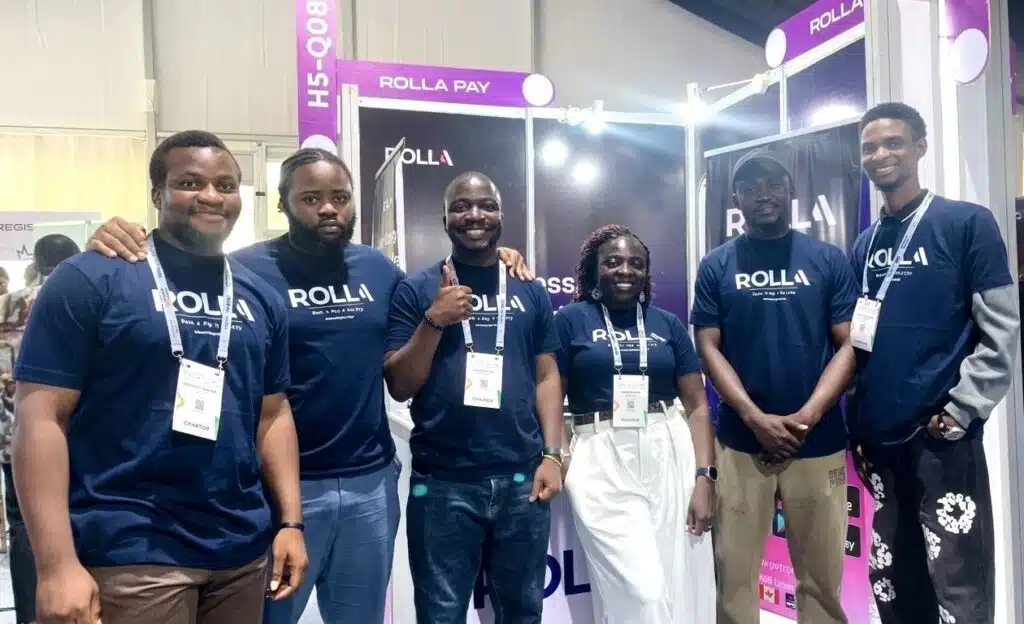
Rolla Pay operates as a money service business (MSB) and is duly registered with Canada’s financial intelligence unit, the Financial Transactions and Reports Analysis Centre (FINTRAC), and is available to startups and small businesses across 190+ countries.
The biggest achievement for me is actually seeing the product go live and customers using it, interacting with the product and transactions being processed in seconds with no issues. The other is having people give feedback, to say, I’d love to see this and that feature on Rolla Pay.
One of the issues with diaspora businesses is that they can’t do business as diaspora businesses; they still have to move it into their personal lives (personal bank accounts) before they can complete transactions, and that’s what we’re in the market to change.
The challenge is that we already have the product, we understand the market, and we know we can fully achieve our product-market fit, but we need funding. We’ve had some early conversations with a couple of investors, but we’re looking for investors to back Rolla Pay because it’s a game-changing tool.
Looking forward
I have lots of future aspirations for Rolla Pay. I want to be a unicorn; that would be a nice fix to have, but the most important thing is to onboard at least 100,000 businesses across borders.
While the big vision is to become a unicorn, most importantly, we want to be the go-to tool for a global operating system for small businesses across the African continent.