
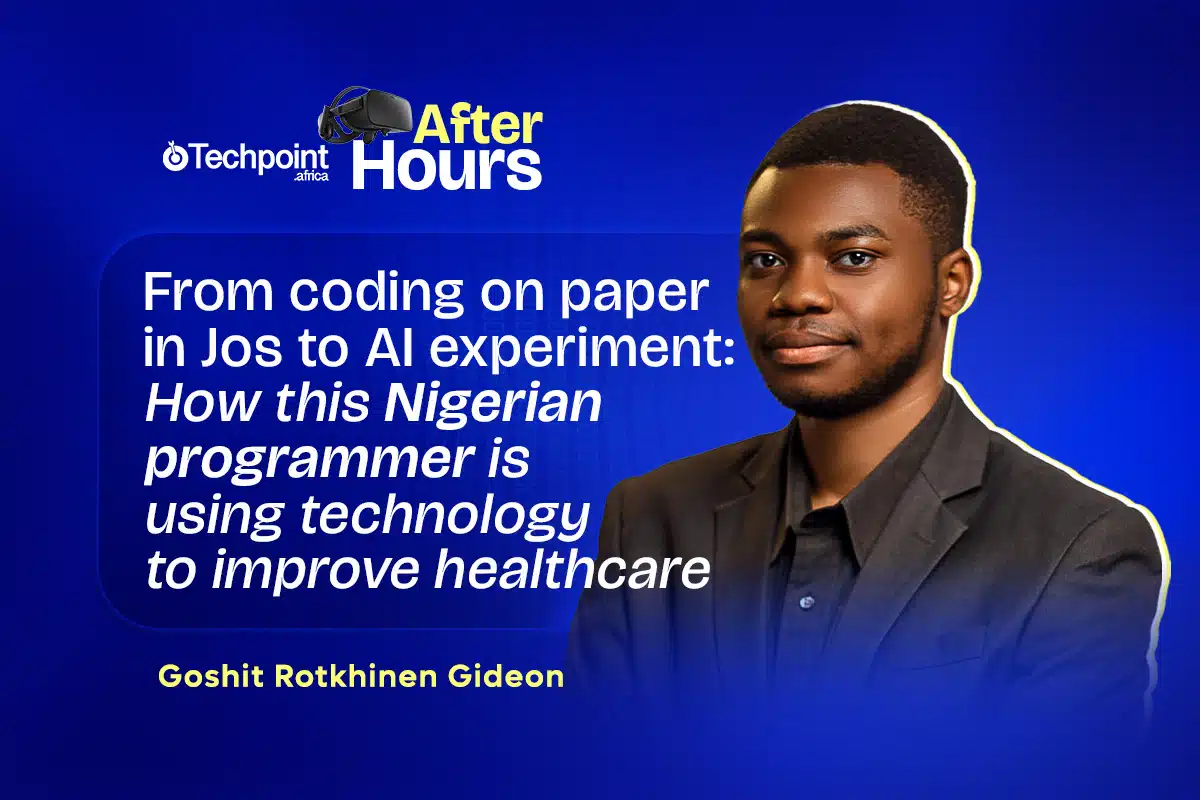


Long before he began building AI systems for healthcare, Goshit Rotkhinen Gideon was a curious child exploring his family’s desktop computer in Jos, Plateau State. What began as hours spent playing games and experimenting with Microsoft Word, Paint, and Excel soon grew into a deeper fascination with how computers work.
That curiosity led him to study computer science at the University of Jos, experiment with artificial intelligence models that generate music, and eventually work on AI tools designed to support healthcare providers and improve patient care.
In this edition of After Hours, Goshit shares his journey from writing code on paper to now working in AI and building technology solutions for the healthcare sector.
Early interactions with technology
My first interaction with technology happened when I was about five or six years old. My family got a desktop computer. At that age, I mostly used it to play games, but I was also very curious about what the computer could do.
Beyond games, I started exploring everything else on the system. I tried out Microsoft Word, Paint, Excel, and PowerPoint. I experimented with typing, creating documents, and even making small presentations. A lot of the basic computer skills I later learned in school were things I had already taught myself just by clicking around and exploring the computer. I simply wanted to know what was inside the machine and what it was capable of.
Later, in secondary school, we were introduced to programming through Visual Basic. That was my first real exposure to what programming looked like. It wasn’t deep at the time, but it opened the door to more learning.
Interestingly, the moment that really pushed me toward technology as a career came from a movie.
I had watched Iron Man before, but when I rewatched Iron Man 3 around 2014, something clicked. Tony Stark’s interaction with Jarvis fascinated me; the idea that a computer system could talk back, help manage tasks, fly a suit, play music, or control a home.
At that time, AI wasn’t mainstream, so I didn’t think in terms of artificial intelligence. What I thought about was robotics. I just knew I wanted to build systems like that; intelligent machines that could assist humans.

Victoria Fakiya – Senior Writer
Techpoint Digest
Stop struggling to find your tech career path
Discover in-demand tech skills and build a standout portfolio in this FREE 5-day email course
Around that time, I was also deciding which subjects to focus on in senior secondary school. While many of my classmates talked about becoming doctors or engineers, I had robotics in mind, so I chose the science track. When it was time to apply to university, I chose to study computer science at the University of Jos since there was no robotics engineering programme available in Nigeria.
The paper-coded path
Before my admission, my dad bought me several textbooks. He didn’t really know which book would help, but he hoped some of them would. One of those books was a programming book on Java.
I didn’t even have a computer anymore at the time, as our home desktop had stopped working. So my first serious attempt at programming involved writing code on paper. I would read a section of the book, then take a piece of paper and try to write out the code examples myself. I couldn’t run the code, but I was learning the logic and structure of programming.
When I eventually got to the university, I gravitated toward Python and eventually became a Python programmer. The path into AI that time typically involved learning Python, moving into data analysis, and then progressing into machine learning. That became the route I followed.
I took many online tutorials and courses focused on data analysis and machine learning. Most of them were free courses on platforms like Coursera or edX, because I couldn’t afford paid courses at the time. I also relied heavily on YouTube tutorials.
My undergraduate project reflected that interest. I worked on a project inspired by sequence prediction models. The idea was to build a system that could generate sheet music. The model would take a sequence of musical notes and predict the next note, gradually generating an entire piece of music in sheet notation.
After graduation, I considered building on the project. But I later discovered that similar systems already existed.
Moving from academic research to healthcare AI
After seeing my project, my supervisor invited me to assist him with several research projects. Many of those projects focused on applying artificial intelligence to medical problems.
One project tried to predict outbreaks of Lassa fever by analysing weather patterns and environmental data. Another project focused on malaria, using similar approaches. We also worked on a cancer-related project that aimed to help hospitals manage their blood supply more efficiently.
Because most of the research I was involved in revolved around medical applications of AI, healthcare gradually became a domain I was deeply familiar with.
After completing my National Youth Service, I applied for a role at an IT company. I initially applied as a data analyst, but during the interview process, they realised my background in AI and healthcare applications matched what they were trying to build. That’s how I eventually joined the team.
Today, my work focuses on building AI systems that help healthcare providers interact with and manage patient care more effectively.
For example, the systems we build can help hospitals automatically follow up with patients after clinic visits, monitor their health progress, and communicate with them outside the hospital. Instead of caregivers having to manually call patients, track data, and manage follow-ups, AI systems can assist with those tasks.
I’ve gone from experimenting with AI-generated music to building AI tools that assist healthcare systems.
Bringing AI closer to the “Jarvis” dream
The Iron Man inspiration hasn’t completely disappeared from my work. Part of what I’m currently working on involves AI agents that can actually perform computer tasks on behalf of users. That falls into what people now call agentic AI systems that can actively perform tasks rather than just respond to prompts.
Outside my job, I’m also exploring these ideas through personal projects. One area I’m particularly interested in is increasing AI adoption in local communities.
While researching AI adoption among small and medium-scale business owners, we discovered that language can be a major barrier. Many people simply cannot interact with technology comfortably because most systems are designed in English.
That inspired a hobby project I’m currently working on: building computer-use agents that can operate in Nigerian languages.
Imagine turning on your computer and speaking Hausa to it. You could say something like: “I need a business proposal to apply for a loan.” The system would prepare the document in English but explain the content back to you in Hausa. You could then ask it to modify sections of the document, all through conversation.
My long-term vision goes even further. Instead of pre-programming the system for specific languages, I want AI models that can learn new languages through interaction. To me, that’s one way technology can become truly accessible.
How technology shapes my daily life
Because I work as a programmer, technology is naturally a big part of my daily routine.
Most of my work involves writing and managing code that connects different systems: AI models, APIs, communication tools like Twilio, and databases. I also work with large language model platforms such as OpenAI to build conversational systems for healthcare interactions.
But outside work, my relationship with technology is actually quite simple.
I’m not a big social media user. In fact, I’ve deleted most of my social media accounts. I’m a fairly private person, and I prefer to keep much of my life offline.
The one platform I use a lot is YouTube. I watch videos on philosophy, history, psychology, and economics. I enjoy learning from long-form discussions and lectures.
I also play games occasionally; mostly football games like PES, and I sometimes solve Sudoku puzzles on my phone.
When it comes to work tools, the applications I rely on the most are my code editors: VS Code and PyCharm. Since most of my work revolves around writing code, those tools are essentially indispensable.
One of the biggest challenges I face with technology has more to do with my own personality.
Whenever a new technology appears, especially in the AI space, I don’t immediately jump in. Instead, I feel the need to understand how it works first. I want to read documentation, study the architecture, and understand why it’s different from previous tools.
In a fast-moving field like AI, that tendency can slow me down because by the time I finish understanding something deeply, many people have already moved ahead and started building with it. But at the same time, that deeper understanding often becomes useful later. When you understand the fundamentals behind a tool, it’s easier to adapt and build more complex systems. So it’s both a strength and a bottleneck.
Despite the many challenges people talk about, electricity issues, infrastructure gaps, and funding constraints, I’m very optimistic about the future of technology in Africa.
One reason is simple: problems create opportunities. If electricity is unreliable, it presents someone with an opportunity to build better energy solutions. If Internet access is inconsistent, that opens the door for innovations in connectivity.
Another reason is Africa’s diversity. Solutions that work in one part of the world may not work in Africa, and even solutions that work in one African region may not work in another. That means there are countless opportunities to build locally relevant technologies.
And perhaps most importantly, we have the talent. I’ve seen the ideas people around me are working on, both friends, colleagues, and developers across the continent. The creativity and ambition are already here.
Africa has problems, which means it has opportunities. It also has people capable of solving them. For me, that makes this a very exciting time to be working in technology on the continent.