



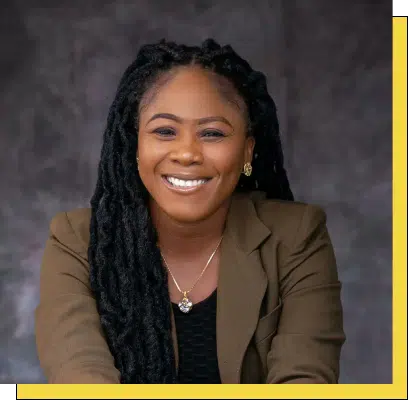
Eunice Olubayo’s interest in technology began in childhood, influenced by a STEM-oriented upbringing and early hands-on experiences with computers and design tools. Although she initially set her sights on aerospace engineering, limited local opportunities led her to study mechanical engineering, which later became a foundation for her transition into space systems.
Now, Olubayo is the National Point of Contact for the Space Generation Advisory Council (SAGC) in Nigeria, where she works with national space stakeholders and initiatives aimed at introducing young students, particularly girls, to STEM and space-related opportunities.
In this edition of After Hours, Olubayo shares the challenges and possibilities of building a career in space in Africa, and how technology continues to shape that path.
Early interactions with technology
Growing up, technology was pretty much something I was born into.
I come from a very STEM-oriented family. My dad is a software engineer, so computers were more familiar to me than any toy other children my age were playing with.
I’ve watched him program, design, edit, and build things. One of my earliest memories is sitting in his office, surrounded by computers, just playing around with them. I became comfortable with systems very early.
At seven, I had already started using CorelDRAW. One of the very first things I ever designed was a birthday card for my dad. That moment still stands out to me, not just because of the design itself, but because it showed me what technology could do.
I always knew I would end up in the sciences. Even before I understood what STEM meant, I knew my path would be somewhere in that space. It just felt natural, like a continuation of the life I had already been living.
I encountered space technology through a book, and that moment changed everything for me. I was about 10 or 11 years old, and for the first time, I had a clear vision of what I wanted to do. I didn’t just want to be part of the space industry; I wanted to build systems that could take humans to space, and at the same time, be one of the people going there. Becoming an astronaut is still very much a dream I hold onto today. But pursuing that dream in Nigeria wasn’t straightforward.

Victoria Fakiya – Senior Writer
Techpoint Digest
Stop struggling to find your tech career path
Discover in-demand tech skills and build a standout portfolio in this FREE 5-day email course
When the time came to choose a university, the options for aerospace or space systems were almost nonexistent, and even when I applied to study aeronautics, my name somehow disappeared from the admission list. I had to pivot. That was how I ended up studying mechanical engineering at the Federal University of Technology, Minna. It wasn’t the original plan, but it became the foundation I needed.
Mechanical engineering gave me a baseline for understanding aerospace systems, and in hindsight, it positioned me exactly where I needed to be.
Navigating a space dream from Africa
Chasing a career in aerospace from this part of the world comes with its realities.
There were moments of frustration, especially knowing that opportunities and infrastructure weren’t as developed here as they are in the West. But things are changing. There is now more investment, more awareness, and more intentional effort to grow the space sector in Nigeria and across Africa.
One of the biggest misconceptions about space is that people think it’s just about sending humans to the moon. But space is much more than that. Many of the technologies we use daily today came from discoveries made through space exploration.
There’s a quote I love: discovery is never just for the sake of discovery, but for the advancement of the human race. That idea has shaped how I see the industry, not as something distant or abstract, but as something deeply connected to everyday life.
Since graduating in 2025, things have moved at light speed. I realised that Africa doesn’t just need astronauts; it needs technical manpower. I’ve spent the last year balancing technical roles with policy and outreach, eventually becoming the National Point of Contact for the Space Generation Advisory Council (SGAC) in Nigeria and working with the National Space Research and Development Agency (NASRDA) on the African Space Economy and Innovation conference.
Because of my background in mechanical engineering, I had to deliberately transition into space systems. That meant taking advanced courses in satellite technology and space systems, and investing heavily in personal development.
It wasn’t easy, but I enjoyed it. I’m naturally drawn to solving difficult problems; in fact, the harder something is, the more interested I become.
Beyond the technical side, I also started thinking about impact. I started working on STEM and space-focused initiatives for secondary school students, especially girls. Seeing young students realise that space isn’t science fiction, but something they can actually be part of, has been one of the most fulfilling parts of my journey.
My work now sits at the intersection of technical, policy, and education. It’s demanding, but it’s also incredibly rewarding.
Tech as the foundation for everything I do
My relationship with technology goes beyond my career; it’s the foundation of it.
While I was in university, I co-founded the Digital Career Skills Initiative for Africa (DCSI Africa). It started as a small effort to bring tech training and opportunities to students in our immediate environment, but it quickly grew. We organised workshops, brought in professionals, and built a community around digital skills.
Over five years, that experience shaped me not just technically but also in leadership, management, and problem-solving. That foundation is what made my transition into space systems smoother.
At this point, technology is fully integrated into my life. Tech isn’t just an industry; it cuts across everything. Whether it’s engineering, healthcare, or policy, technology is at the core.
From engineering software like ANSYS and MATLAB, to communication tools like Zoom, everything I do is powered by tech. Even in space engineering, simulations and system modelling rely heavily on software built by tech professionals.
On a personal level, platforms like LinkedIn have been especially impactful for me. I’ve built relationships, found opportunities, and connected with people I would never have met otherwise.
Interestingly, I’ve also found creative ways to use technology. Recently, I started using Google Gemini to design outfits. I describe what I want, like colours, style, details, and it generates designs that I take to my fashion designer. It’s not something I ever imagined doing, but it shows how flexible technology has become.
One of the biggest challenges with technology today isn’t the usage; it’s keeping up with it. There are so many new tools, apps, and platforms emerging constantly. Sometimes it feels like everyone is building the same thing, but with a slightly different interface. That pace can be overwhelming.
Because of that, I take breaks. I sometimes disconnect completely from social media, from messaging apps, from everything. I’m naturally introverted, so stepping away helps me reset and think clearly.
Africa’s space industry and the future of tech
The space industry in Africa is growing, and that’s exciting. There’s more investment, more awareness, and more young people getting involved. Compared to 10 years ago, the difference is significant.
But we don’t have enough trained local professionals to support the industry we’re building. If that doesn’t change, we risk relying on imported talent, something that has already happened in other sectors. We need to invest not just in infrastructure, but in people. Because at the end of the day, it’s people who will power the industry.
Looking ahead, my goals are both personal and collective. I still want to become an astronaut. That dream hasn’t changed. But beyond that, I want to build platforms that connect Africans to opportunities in the global space industry, scholarships, jobs, collaborations, everything in one place.
I also want to be an example, not just known as an expert in my field, but as a woman who proved that you don’t have to compromise your personal life for your career. I want to flourish as a professional, a mother, and a wife simultaneously. I don’t believe in sacrificing one for the other.
In the next 10 years, I want to be someone young girls can look at and say, “This is possible,” because it is.