

A profound technological shift is taking place across the African continent, one that positions Africa not as a follower, but as a global frontrunner in the age of AI agents. While Western enterprises grapple with decades of technical debt, fragmented data estates and costly modernisation programmes, African businesses have a rare opportunity to build modern, agent‑ready data foundations from the ground up.

“It is not often that entire markets get the chance to start afresh. Across Nigeria, Kenya, South Africa and beyond, organisations can bypass legacy mistakes and move straight to unified, cloud‑native data architectures designed for AI agents from day one,” says Niral Patel, CEO of Accelera Digital Group (ADG).
This leapfrog moment is not theoretical; it is already reshaping how African enterprises think about scale, automation, and cross‑border growth.
From tools to autonomous workflows
The recent Google Cloud AI Agent Trends 2026 report describes a decisive shift where AI is moving from answering questions to taking actions across applications, guided by human oversight. Agents can now understand goals, plan multi‑step workflows and execute tasks across systems, in what Google Cloud calls a “digital assembly line”.
However, this shift is only possible when data is unified, governed and accessible.
“AI agents do not thrive in fragmented environments. They need clean, connected, secure data that is grounded in enterprise truth to reason, act and improve. Africa has the advantage of building this foundation correctly from the start,” says Patel.
The report reinforces the point that grounding AI in enterprise data is critical for accuracy, trust and safe automation.
Unified data as a Pan‑African advantage
Pan-African enterprises face challenges due to varying regulations, data sovereignty rules, and digital maturity across markets. Traditionally, this required duplicating systems by country, but unified data foundations are transforming the approach.
“When your data practice is standardised and cloud‑native, deploying AI agents across borders becomes a matter of configuration, not reconstruction. You can adapt to local compliance requirements while maintaining a single intelligence layer across the continent,” Patel says.
Agentic AI will hit a “Data Governance Wall” in organisations with messy, siloed data, he continues. African enterprises can avoid this wall entirely by building modern data hubs from the outset.
Driving financial inclusion through autonomous agents Financial services stand to gain the most, as millions across Africa remain underserved due to high operational costs and limited data for risk assessment. AI agents can change this dynamic.
“With unified data, autonomous agents can perform KYC, credit scoring, fraud detection and customer support at a fraction of the traditional cost. This is how you unlock financial inclusion; not by adding more branches, but by deploying intelligent, scalable digital infrastructure,” Patel notes.
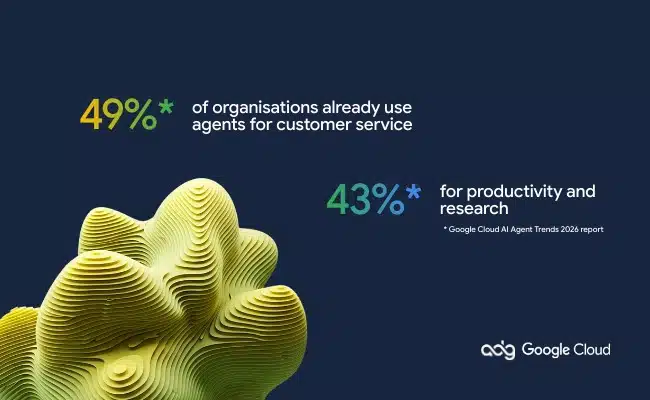
The AI Agent Trends 2026 report shows that 49% of organisations already use agents for customer service, and 43% for productivity and research, which is a clear signal that agentic systems are becoming mainstream.
For African banks and fintechs, the opportunity is even greater as they can leapfrog legacy processes and build AI‑first financial ecosystems.
AI agents are transforming supply chains, logistics, agriculture, and manufacturing by integrating siloed functions into seamless, automated workflows.
“Supply chains become smarter when data becomes connected, and when agents can act on that data autonomously, you unlock efficiencies that were previously impossible,” says Patel.
Building trust in an agent‑driven future
As AI agents scale, security becomes critical. The Cybersecurity Forecast 2026 warns that adversaries are already embracing AI, including agentic systems, to automate attacks and exploit vulnerabilities. This makes secure, governed data foundations non‑negotiable.
“Security cannot be an afterthought. African enterprises must adopt secure‑by‑design data architectures that support agentic identity, governance and oversight from day one,” Patel states. The report predicts the rise of agentic identity management, where AI agents are treated as distinct digital actors with their own permissions and audit trails.
The cost advantage of building the future without baggage
Africa’s key advantage may be cost efficiency. While Western firms pour billions into outdated systems, African businesses can invest directly in modern, scalable data solutions. “Starting fresh is a competitive advantage, because you are not paying to undo decades of technical debt. You are investing directly in the future,” Patel says. He adds that modernising the core is now a board‑level priority globally, and companies that fail to replace legacy systems face greater risk than those that embrace change. Africa can skip this painful phase entirely.
The next decade will be defined by autonomous systems, with agents that learn, reason and act on behalf of businesses and customers, and Africa is uniquely positioned to lead this transformation.
“Unified data foundations are the bedrock of the agent economy. African enterprises that invest now won’t just catch up; they’ll set the global benchmark. Africa’s leapfrog moment has arrived,” Patel concludes.