
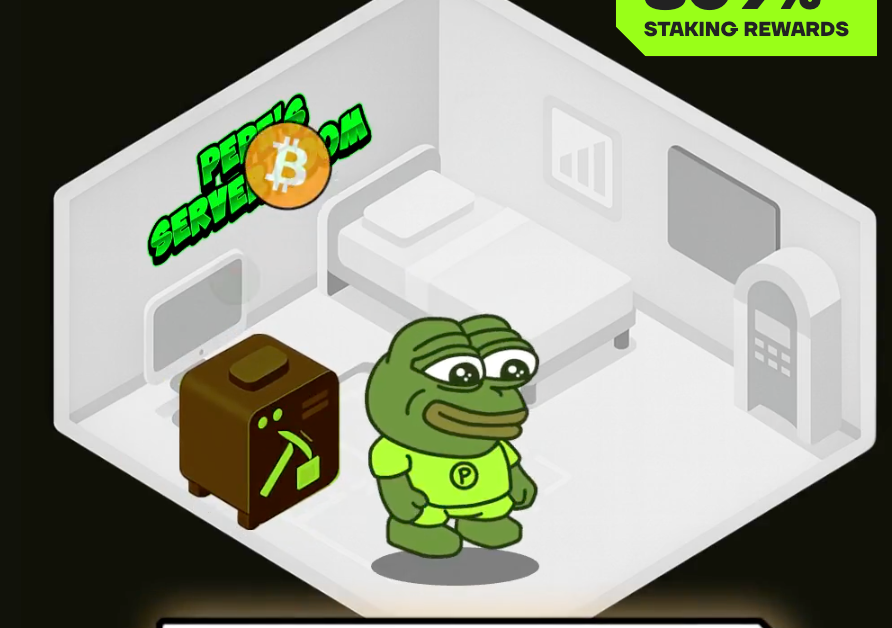

Tom Lee’s bold Ethereum price prediction is breathing new life into a recovering crypto market, but while analysts debate where ETH will go next, GameFi newcomer Pepenode is quietly turning heads with its mine-to-earn ecosystem – a model that could define the next phase of user-driven blockchain growth.
The cryptocurrency market has had its share of shocks in recent months, but Fundstrat’s Tom Lee remains as bullish as ever. Speaking to CNBC on Monday, Lee reaffirmed his outlook that Bitcoin could climb to between $150,000 and $200,000, while Ethereum (ETH) could reach around $7,000 in the same cycle.
His latest Ethereum price prediction stands in stark contrast to the subdued performance investors saw through October – a month once dubbed “Uptober” for its historically strong returns. Instead, Bitcoin ended the month 4% lower, marking its first negative October since 2018.
Much of that weakness stemmed from macroeconomic uncertainty. On October 10, President Donald Trump’s new 100% tariff on Chinese goods sparked widespread sell-offs, wiping out roughly $19 billion in crypto market value in a single day.
Even so, Lee insists the market’s correction is temporary.
“We’re only a couple weeks from that, so I think the market is consolidating,” he said. “If I look at fundamentals, Ethereum stablecoin volumes have been exploding, application revenues at all-time highs. So right now, fundamentals are leading price in crypto.”
In other words, the building blocks of recovery are already visible beneath the volatility. Lee expects this consolidation to set the stage for a year-end rally, driven by strong blockchain activity and improving macroeconomic conditions.
He’s not alone in that outlook. Standard Chartered’s Geoffrey Kendrick and MicroStrategy’s Michael Saylor have echoed similarly optimistic forecasts, suggesting Bitcoin could still hit six-figure territory this year and if Lee’s Ethereum target holds, it could signal the most aggressive cycle for altcoins since 2021.
But as markets reset and investors look beyond blue-chip tokens, attention is shifting toward new projects that embody the same fundamentals-first philosophy – building value through engagement, usability and innovation. One such contender is Pepenode ($PEPENODE).
Pepenode: When Mining Meets Gameplay
While Ethereum’s on-chain metrics may justify Tom Lee’s optimism, Pepenode is showing how similar fundamentals can drive growth in the GameFi space.
At a time when traditional mining has become increasingly inaccessible, Pepenode has introduced a mine-to-earn model that allows anyone to “mine” cryptocurrency virtually – with no hardware, no energy bills, and no barriers to entry.
The project has already raised $2.1 million in early funding and is being hailed as one of the most innovative attempts to revive the utility narrative of blockchain gaming. Players earn PEPENODE tokens through in-game mining, but they can also generate rewards in trending meme coins such as Pepe ($PEPE) and Fartcoin ($FARTCOIN).
It’s a model that merges entertainment with economics. As the crypto industry pivots toward user-centric engagement, Pepenode’s design – emphasising strategy over spending – feels particularly aligned with the trends Lee pointed to: real activity, real value creation and a shift away from pure speculation.
Mining, But Make It Playable
The brilliance of Pepenode lies in how it reimagines an old concept for a new era.
In traditional mining, success depends on access to cheap energy and expensive equipment – an environment now dominated by industrial players like CleanSpark and Marathon Digital.
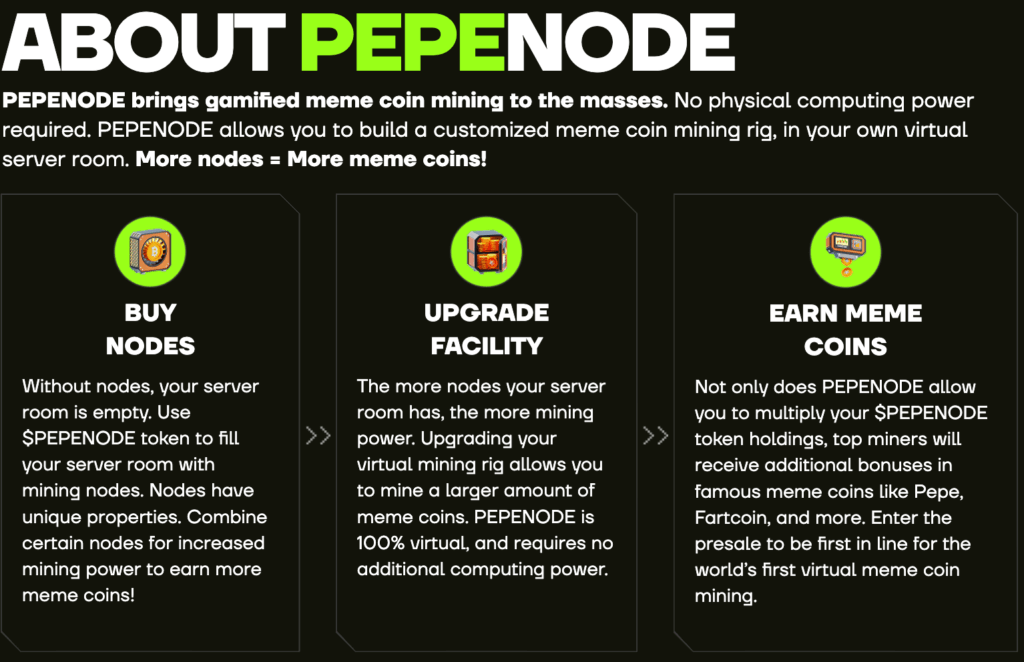
Pepenode flips that model. Players begin with a virtual server room, purchase nodes using PEPENODE tokens and combine them strategically to increase their hashrate. The more efficient the virtual rig, the higher the token rewards.
Unlike real mining, every upgrade and purchase happens within the game’s ecosystem, which burns 70% of all tokens spent, creating a deflationary tokenomics structure. This scarcity mechanism mirrors Ethereum’s post-Merge model, where reduced supply dynamics underpin long-term value.
As Lee noted, “fundamentals are leading price”, and in Pepenode’s case, its fundamentals come from engagement loops and token mechanics that directly tie user activity to ecosystem value.
The Economic Context
The timing couldn’t be better. Across the global mining industry, margins are tightening as BTC hovers over $106,000 and energy costs rise. Companies like CoreWeave have already pivoted from Ethereum mining to AI computing, while other miners are repurposing infrastructure for high-performance data workloads.
For retail users, that shift has made traditional mining nearly impossible. Pepenode’s virtualised system restores the original ethos of crypto–inclusivity and decentralisation – by giving players ownership over their productivity. Anyone with an internet connection can compete, strategise and earn.
The project’s deflationary tokenomics amplify that appeal. As more players enter and spend tokens on nodes or upgrades, supply shrinks and demand rises – a feedback loop that strengthens token value without needing external hype.
This framework aligns with Lee’s assessment of Ethereum’s current momentum: sustainable activity, rising application revenue and clear proof that blockchain utility is maturing.
Timing the Next Rally: Fundamentals Over FOMO
Both Ethereum and Pepenode illustrate the same broader principle shaping crypto’s next phase – utility first, speculation second.
For Ethereum, that means expanding dominance in decentralised finance and stablecoin settlement. For Pepenode, it’s about turning passive speculation into interactive participation through gaming mechanics that keep users engaged and economies self-sustaining.
Market watchers have already noticed. Influencers like Crypto Tech Gaming have labelled Pepenode a potential breakout, citing its 70% burn rate and strong community traction ahead of the next presale phase. With only hours remaining before token prices rise, early participants are rushing to secure entry.
Just as Lee’s Ethereum call rests on strong fundamentals, Pepenode’s trajectory may depend on how successfully it converts hype into lasting engagement. If adoption continues at its current pace, the game could play a crucial role in revitalising the GameFi sector, which has struggled since the 2022 downturn.
Ethereum’s Fundamentals and Pepenode’s Vision
The overlap between Tom Lee’s macro-level optimism and Pepenode’s micro-level innovation is hard to ignore. Both signal a market leaning toward real engagement and functional ecosystems rather than short-term speculation.
Ethereum remains the benchmark for blockchain utility – its soaring stablecoin volumes and record application revenues underscore that shift. Pepenode, meanwhile, captures the same ethos at the grassroots level, proving that users don’t need million-dollar rigs to participate in crypto’s value creation.
This alignment reflects the broader evolution of the industry: from mining blocks to building experiences, from speculative holding to active participation.
From $7K Ethereum to the Next Frontier of GameFi
Tom Lee’s Ethereum price prediction may appear bold, but it’s rooted in clear fundamentals – expanding on-chain activity, developer momentum and growing real-world integration.
As investors anticipate the next major rally, Pepenode embodies the same spirit of progress, utilising gameplay to make mining inclusive, engaging, and deflationary by design. It may not move markets like Ethereum, but it highlights where crypto is headed: toward utility that’s accessible, entertaining and economically sound.
JOIN THE PEPENODE PRESALE NOW – EXPERIENCE THE NEXT EVOLUTION OF MINE-TO-EARN GAMING
If Lee’s prediction holds true – that fundamentals eventually lead price – Pepenode could be one of the early projects to ride that wave. Whether through virtual mining or smart gameplay, it represents the next generation of blockchain engagement in an ecosystem ready for its next breakout.
Disclaimer: This article is for informational purposes only and does not constitute financial advice. Cryptocurrency and GameFi investments are volatile and may result in capital loss. Always conduct independent research or consult a licensed advisor before investing.